

 English
  русский
  Español
  عربى
عربى 
V Shape Wide Edge Gap Cleaning Floor Brush: Efficient Edge Cleaning for Residential and Commercial Spaces
Date:Sep 03, 2026

Cleaning floors thoroughly requires more than removing visible dirt from the center of a room. Dust, hair, crumbs, and fine debris often collect along wall edges, floor gaps, corners, and narrow transition areas where ordinary brooms and flat brushes may not make consistent contact. The V Shape Wide Edge Gap Cleaning Floor Brush is designed to address this specific challenge with an extended V-shaped head that reaches broader edge zones and supports more efficient routine cleaning.
With its practical structure, three-section handle, PP and TPR construction, and grayish-white and blue color combination, this floor brush is suitable for kitchens, hallways, utility rooms, storage areas, workshops, and other residential or light commercial environments. Its purpose is straightforward: to help users clean difficult floor edges with less repeated movement and better surface contact.
The product is manufactured by Jinhua Jieqing Plastic Co., Ltd., an industry and trade enterprise specializing in cleaning supplies, household brushes, industrial brushes, brooms, and supporting plastic products. Since its establishment in 2008, the company has developed production, supply-chain, quality-control, export, and customization capabilities intended to serve supermarkets, cross-border e-commerce businesses, industrial buyers, and other bulk procurement customers.
This article examines the design, practical advantages, material characteristics, manufacturing strengths, application possibilities, purchasing considerations, and maintenance recommendations associated with the V Shape Wide Edge Gap Cleaning Floor Brush.
1. The Cleaning Problem Addressed by the V-Shaped Design
Floor cleaning is often treated as a simple open-surface task. A standard broom or floor brush can move across the middle of a room relatively quickly, but the cleaning result may be less consistent near fixed boundaries. Wall edges, floor joints, corners, cabinet bases, and narrow gaps can interrupt the movement of a conventional cleaning head. As a result, debris may remain in locations that are visible only after the main cleaning task has been completed.
These edge zones are common collection points for dust and loose particles. Air movement can carry debris toward walls, while foot traffic may push crumbs and dirt into gaps. In kitchens, small food particles can accumulate beside cabinets or appliances. In hallways, sand and dust may collect along skirting boards. In utility rooms, workshop areas, and storage spaces, fine particles can settle in corners that are difficult to reach with a wide but inflexible cleaning tool.
The V Shape Wide Edge Gap Cleaning Floor Brush responds to this problem through an extended V-shaped head. Instead of relying only on a straight, narrow contact line, the V-shaped structure is intended to provide broader contact around edge areas and guide the brush into corner-related cleaning zones. The geometry supports a more targeted cleaning motion while still allowing the product to function as a general floor brush for routine maintenance.
The key benefit is not that the brush eliminates every cleaning step. Rather, it is designed to make a frequently overlooked task more practical. Users can direct the head along wider gaps, wall edges, and corner areas to help loosen and collect dust buildup more efficiently. This makes the product especially relevant for spaces where edge cleaning is required regularly rather than occasionally.
2. Product Overview
The product category is Floor Brush, and the item number is 910. It is made from PP+TPR, has a grayish-white and blue color combination, and uses a three-section structure measuring approximately 28 by 130 centimeters. The listed packing quantity is 60 pieces per carton, with a carton size of 91 by 28 by 40 centimeters.
| Product Attribute | Specification |
|---|---|
| Product name | V Shape Wide Edge Gap Cleaning Floor Brush |
| Category | Floor Brush |
| Item number | 910 |
| Main material | PP+TPR |
| Color | Grayish-white and blue |
| Structure | Three-section handle and extended V-shaped head |
| Product size | Approximately 28*130 cm |
| Packing quantity | 60 pieces |
| Carton size | Approximately 91*28*40 cm |
| Recommended environments | Homes, kitchens, hallways, utility areas, storage areas, workshops, and light commercial facilities |
The 28-centimeter head width gives the product a useful balance between edge coverage and maneuverability. A brush that is too narrow may require numerous passes across a larger area, while a very wide brush can be inconvenient around furniture, appliances, and narrow corridors. The listed dimensions indicate a format intended for practical household and facility use rather than specialized heavy machinery.
The approximately 130-centimeter total length is also important for everyday comfort. A longer handle allows the user to work while standing, reducing the need to bend repeatedly when cleaning floors. The three-section construction supports packaging and transportation efficiency while providing a practical assembled length for routine use.
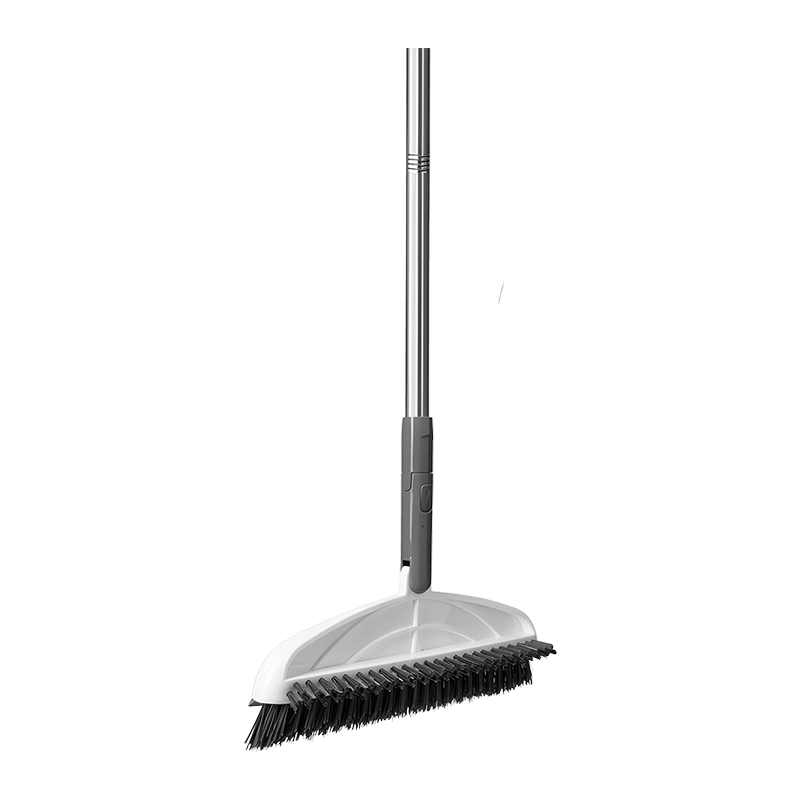
V Shape Wide Edge Gap Cleaning Floor Brush
3. Extended V-Shaped Head and Edge Contact
3.1 Broader contact along floor boundaries
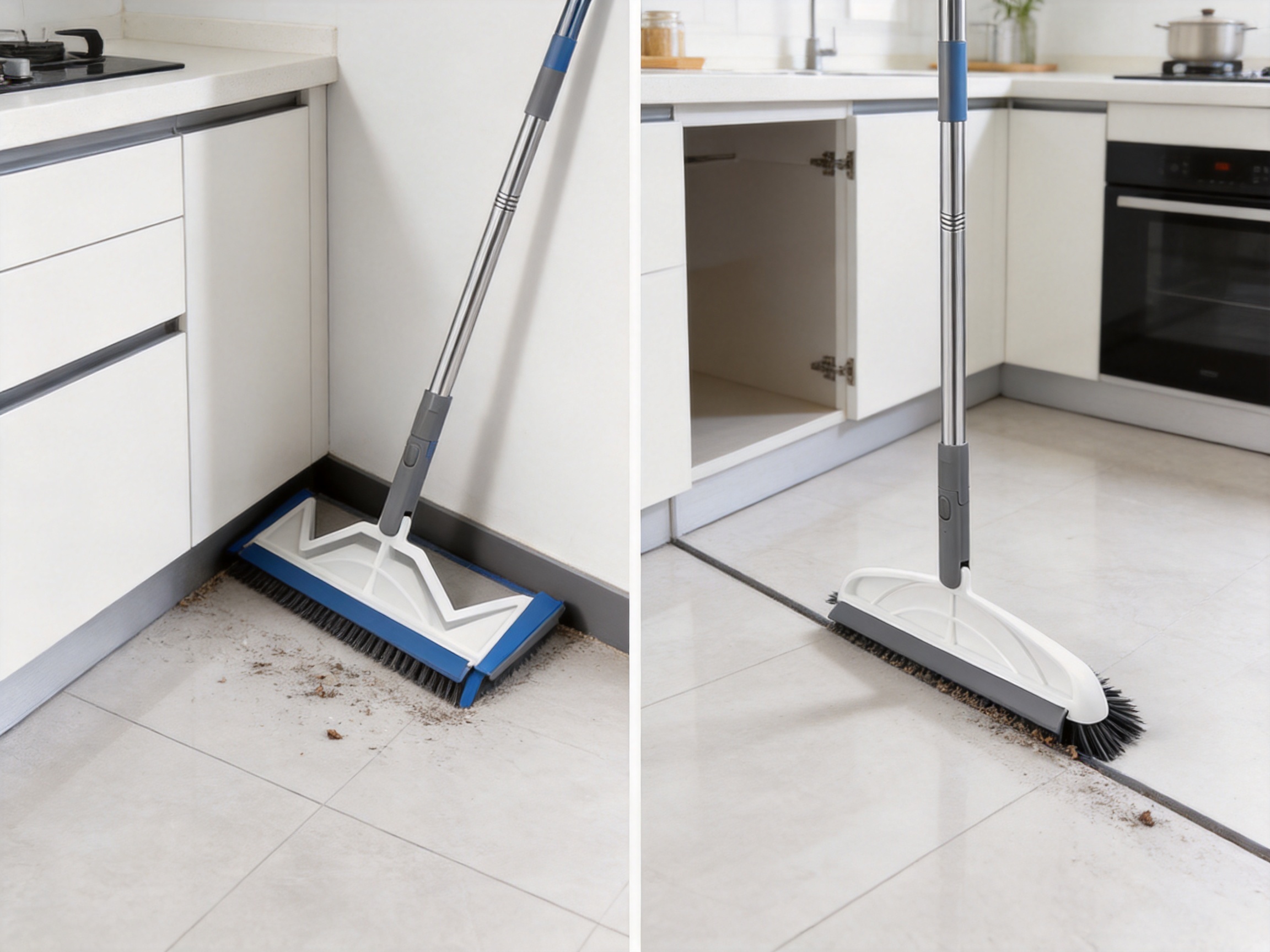
The defining feature of this model is its extended V-shaped head. The shape is intended to improve contact with wider floor gaps, wall edges, and corners. When the brush is pushed or pulled along a boundary, the angled portions of the head can help direct cleaning action toward areas that a straight brush may approach only from one direction.
Edge cleaning often involves a combination of forward movement and slight directional adjustment. The V-shaped profile supports this movement by creating two angled contact zones rather than a single uniform front edge. Depending on the surface and the user’s angle, one side of the head can work closer to a wall or corner while the rest of the brush continues moving across the floor.
This design can be especially useful where dust has formed a visible line beside a wall or cabinet. Instead of repeatedly trying to position a flat brush at an exact angle, the operator can guide the V-shaped head along the boundary. The shape helps make the cleaning motion more deliberate and may reduce the number of passes required for routine dust removal.
3.2 Access to corner-related areas
Corners present a different challenge from straight wall edges. Debris can become concentrated where two surfaces meet, and a broad rectangular cleaning head may not enter that area evenly. The V-shaped profile is intended to support corner-area cleaning by narrowing toward the relevant contact region while retaining a broader surrounding structure.
In practical use, the brush can be guided into corners in a controlled motion. Users should avoid forcing the head into spaces that are too narrow or obstructed. Instead, the product is best suited to open floor corners, wider joints, cabinet-side edges, and other areas where the head can move without excessive pressure.
3.3 Support for routine maintenance
A cleaning tool becomes more valuable when it is easy to include in regular maintenance. Because the product is designed for ordinary sweeping and edge cleaning, it can be incorporated into daily or weekly cleaning schedules. Users may first clean the main floor area and then make a second pass along walls, gaps, and corners. Alternatively, the brush can be used directly on areas where dust buildup is already visible.
The product is not presented as a replacement for every specialized cleaning tool. It is better understood as a focused floor brush that combines general sweeping capability with a structure intended to improve edge access. This combination can help simplify purchasing decisions for users who want one practical tool for both open-floor and boundary cleaning tasks.
4. Advantages Compared with Conventional Floor Brushes
4.1 More targeted edge cleaning
A conventional straight-head broom is often effective across open floor areas but may leave a narrow strip of material beside a wall or inside a gap. The V Shape Wide Edge Gap Cleaning Floor Brush is designed around this limitation. Its head profile makes edge contact a central function rather than an afterthought.
For homes and facilities where dust frequently gathers near boundaries, targeted contact can provide a practical advantage. The user does not need to rely entirely on a separate hand brush or repeatedly reposition a standard broom. The long handle also means the cleaning action can generally be performed while standing.
4.2 Coverage suitable for regular floor work
The extended head is intended to cover a broader edge area than a narrow detail brush. This is useful in hallways, kitchens, utility rooms, and other spaces with long wall lines or repeated floor joints. A small hand tool may reach a corner, but it is inefficient when many meters of edge must be cleaned. The 28-centimeter product width provides a more suitable format for repeated floor maintenance.
The product therefore occupies a useful position between a compact detail brush and a large commercial sweeping device. It offers enough coverage for household and light commercial work while remaining relatively manageable in confined areas.
4.3 Standing-operation format
Repeated bending can make ordinary edge cleaning uncomfortable, especially when the task must be performed frequently. The three-section handle reaches approximately 130 centimeters when assembled, giving users a long-handled format for standing operation. This feature is valuable in kitchens, corridors, storerooms, and facility environments where cleaning staff need to cover floor areas efficiently.
The extended handle also helps users maintain a comfortable distance from dust and debris. While ergonomic needs differ among individuals, a long-handled floor tool is generally more convenient than a short hand brush for larger areas.
4.4 Practical material combination
PP and TPR are widely used in household cleaning products because they provide different functional characteristics. Polypropylene can be used for structural components that need to be lightweight and practical. TPR, or thermoplastic rubber, can provide a more flexible or tactile element where a softer interface is beneficial. The combined material specification reflects an effort to balance product weight, usability, molded-part production, and everyday handling.
The exact distribution of PP and TPR may vary according to the component design. Buyers requiring detailed material allocation, testing documentation, or customized construction should confirm specifications with the supplier before placing a production order.
4.5 Easier logistics for wholesale buyers
The product is packed at 60 pieces per carton, with a carton size of approximately 91*28*40 centimeters. A defined carton configuration helps distributors, wholesalers, supermarkets, and e-commerce suppliers plan storage and shipment. The three-section handle also supports more compact packaging than a single-piece handle of the same assembled length might allow.
For wholesale purchasing, logistics efficiency affects the total cost of ownership. Carton quantity, carton dimensions, product assembly, warehouse stacking, and container planning all influence procurement decisions. A standardized packing format gives buyers a practical basis for estimating inventory requirements, although final shipping calculations should be confirmed according to the actual order and packaging method.
5. Material and Construction Considerations
5.1 PP components
Polypropylene is a common thermoplastic material used in consumer goods and household products. It is valued for its relatively low weight, moldability, and suitability for producing repeatable plastic parts. In a floor brush, PP may be used for handle sections, connectors, support structures, or other molded components.
For a product intended for frequent household handling, a lightweight plastic structure can make sweeping less tiring. It also allows manufacturers to produce consistent shapes at scale. Consistency is important because handle sections and head components must fit together correctly during assembly.
5.2 TPR components
Thermoplastic rubber can add flexibility and a softer touch to selected areas. Depending on the design, it may support grip comfort, impact moderation, or contact performance. The use of TPR alongside PP suggests a multi-material approach rather than relying on one rigid plastic for every part.
Material selection alone does not determine final performance. Product durability also depends on wall thickness, connection design, molding quality, assembly accuracy, storage conditions, and how the brush is used. Buyers should evaluate the complete product and request samples when assessing suitability for a demanding application.
5.3 Three-section handle
The three-section handle is a practical feature for both use and distribution. It allows the product to be separated into manageable sections during packing and transportation. Once assembled, it provides an extended reach suitable for floor cleaning without requiring the product to be shipped as one long rigid piece.
Users should assemble each section carefully and ensure that connections are secure before applying force. A properly fitted handle can support controlled movement, while an incompletely connected handle may feel unstable or place unnecessary stress on the joints. For institutional buyers, simple assembly instructions can be included in packaging or product documentation.
6. Recommended Application Environments
6.1 Kitchens
Kitchens require frequent cleaning because food particles, packaging debris, dust, and moisture can accumulate quickly. Floor edges near cabinets, refrigerators, counters, and walls are especially likely to collect material. The V-shaped brush can be used after sweeping the central floor area to address these boundary zones.
When used in kitchens, the floor should be cleared of objects that could obstruct the head. Users should also follow appropriate hygiene procedures, particularly when cleaning around food preparation areas. The brush should be kept clean and dry after use, and it should not be used interchangeably between food-contact surfaces and dirty utility areas without proper cleaning.
6.2 Hallways and entrances
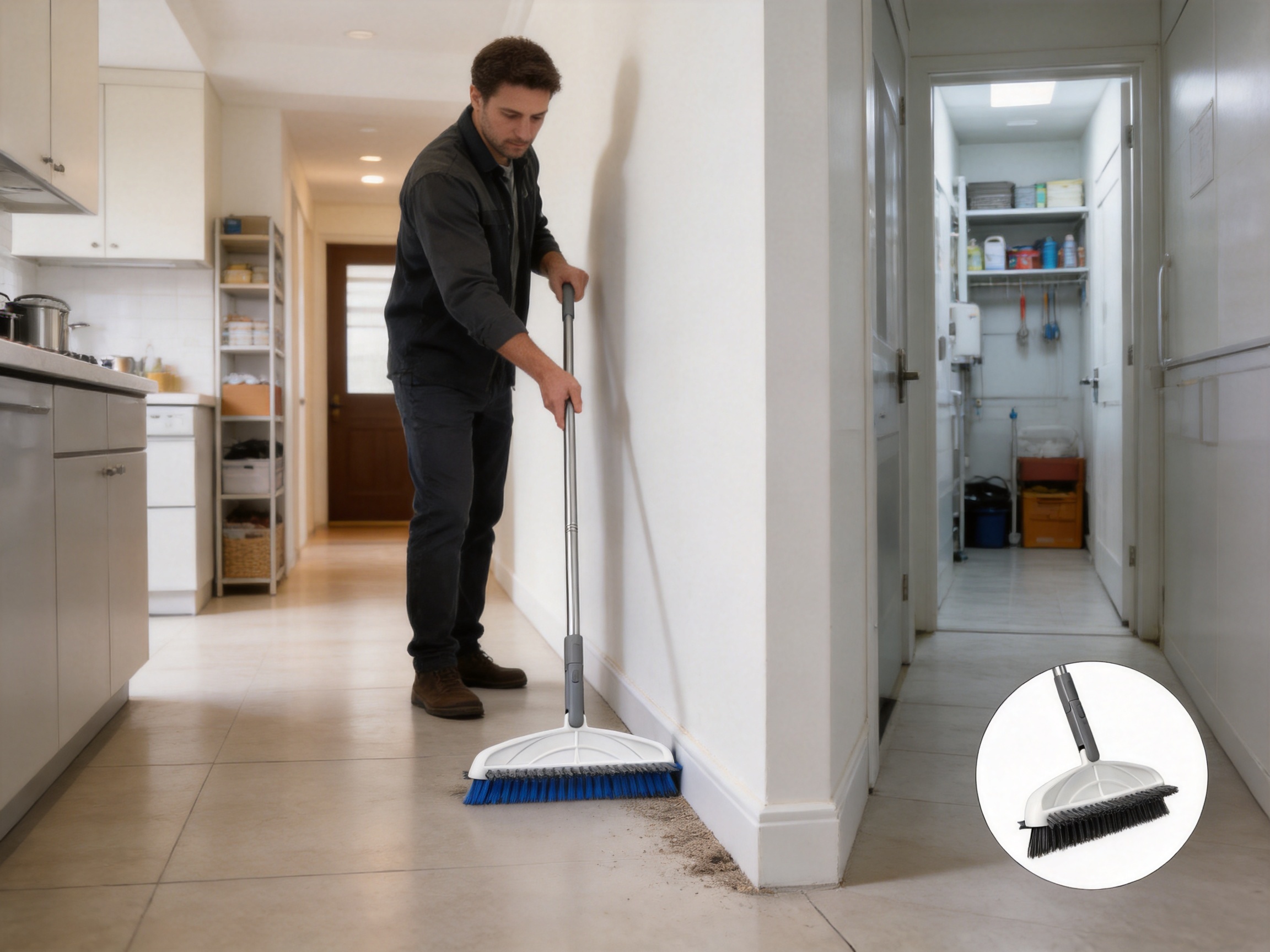
Hallways and entrances often receive dust and grit carried in from outside. Particles can accumulate beside skirting boards and along the edges of flooring. Because these areas may be long and narrow, a standing floor brush with a 28-centimeter head can offer a practical balance between coverage and movement.
Routine edge cleaning in hallways can also improve the visible appearance of floors. Removing loose debris before it is pressed into joints or spread through foot traffic may support easier ongoing maintenance.
6.3 Utility rooms and storage spaces
Utility rooms, laundry areas, storage rooms, and similar spaces may not be cleaned as frequently as living areas. As a result, dust can collect in corners and around fixed equipment. The product’s extended V-shaped head is suitable for directing cleaning action toward these often-overlooked zones.
In storage environments, users should check for sharp objects, chemical residues, or heavy debris before sweeping. The floor brush is designed for ordinary dust and loose dirt removal. Hazardous materials, wet spills, corrosive substances, and sharp waste require procedures and equipment appropriate to those specific risks.
6.4 Light commercial environments
Small offices, retail back rooms, apartment common areas, service rooms, and similar facilities may benefit from a floor brush that is simple to store and easy to deploy. The product can support routine cleaning in areas where a full industrial sweeping machine would be unnecessary or impractical.
Facility managers can assign the brush to particular zones, such as entrance edges, corridor lines, or maintenance rooms. Multiple units may be purchased for different departments or floors, reducing the need to move one tool throughout an entire building.
6.5 Workshops and work areas
The company describes its product range as serving both household and industrial brush markets. In light-duty workshops, the floor brush may be used for loose dust, packaging fragments, and ordinary dry debris. It should not be assumed that the brush is intended for heavy metal chips, hot materials, aggressive chemicals, or industrial waste unless the supplier confirms such suitability.
For workshop procurement, buyers should communicate the expected debris type, floor material, frequency of use, and cleaning method. These details help determine whether the standard model is appropriate or whether a customized brush structure would be more suitable.
7. Manufacturing Strengths of the Supplier
7.1 Industry and trade integration
Jinhua Jieqing Plastic Co., Ltd. operates as an industry and trade enterprise specializing in the research, development, production, and sales of cleaning supplies. This structure can provide advantages for buyers who want to communicate with a supplier that understands both manufacturing requirements and market distribution needs.
An integrated approach can simplify discussions about product design, packaging, order quantities, documentation, and export arrangements. Instead of treating product development and sales support as completely separate activities, the company can coordinate these functions around the requirements of supermarkets, cross-border e-commerce sellers, industrial procurement teams, and other customers.
7.2 Experience since 2008
Founded in 2008, the company has accumulated experience in the cleaning-supplies sector across product development, manufacturing, sales, and export. Long-term participation in a specialized product category can help a manufacturer understand recurring buyer requirements, common packaging issues, product presentation needs, and the importance of stable supply.
Experience does not remove the need for product inspection or clear specifications. However, it can contribute to more efficient communication when buyers are comparing materials, dimensions, colors, packaging methods, customization options, and target-market requirements.
7.3 Own production base
The company has its own production base, which supports direct involvement in manufacturing operations. A production base can provide greater visibility into molding, assembly, inspection, packing, and production scheduling than a purely trading-based sourcing model.
For buyers, direct production capability may be especially valuable when an order involves repeated replenishment, customized parts, private-label packaging, or modifications based on drawings and samples. It can also support more consistent communication between the customer’s technical requirements and the factory’s production team.
7.4 Complete supply-chain coordination
Cleaning products frequently involve multiple components, including molded plastic parts, flexible materials, handles, connectors, packaging materials, labels, and cartons. The company emphasizes a complete supply chain and a comprehensive product range. This can help buyers coordinate several related items or manage a broader cleaning-supply program through one supplier.
Supply-chain coordination is important for maintaining delivery schedules and reducing unnecessary fragmentation. When a buyer needs several types of brooms, brushes, storage-related plastic products, or household cleaning tools, a supplier with a broad product portfolio may make quotation, sampling, and shipment planning more efficient.
7.5 Standardized production processes
The company identifies standardized production processes as one of its strengths. Standardization can cover material preparation, molding procedures, part inspection, assembly, packing, and order handling. For a product such as the V Shape Wide Edge Gap Cleaning Floor Brush, standardized procedures are relevant to the consistency of head shape, handle dimensions, component fit, color, and carton packing.
Consistent production is particularly important in wholesale markets. Retailers and distributors expect units within the same order to have a uniform appearance and functional structure. Standardized methods can help reduce variation, although buyers should still establish agreed inspection criteria and tolerances for commercial orders.
7.6 Quality-control capability
Stable quality control is another stated company strength. Quality control for a floor brush may include checks on molded surfaces, head dimensions, handle connections, color matching, material appearance, assembly security, and packaging condition. The exact inspection plan should be confirmed according to the order and customer requirements.
For importers and institutional purchasers, quality control is most effective when requirements are written clearly. A purchase specification can define acceptable color variation, product dimensions, packaging quantity, labeling, assembly condition, and inspection sampling. The supplier can then align production and inspection activities with those expectations.
8. Research, Development, and Customization
The company offers customization based on customer drawings and samples. This capability is relevant because cleaning-tool buyers often have different requirements depending on sales channel, target user, region, packaging format, and intended application. A supermarket may prioritize shelf appearance and retail packaging, while an industrial buyer may prioritize bulk packing, durability, and standardized replenishment.
8.1 Customization from drawings
Customer drawings can communicate dimensions, shape changes, handle length, head width, connection details, color requirements, logo placement, and packaging arrangements. Technical drawings are most effective when they include tolerances and material information rather than only general visual dimensions.
For a V-shaped floor brush, a drawing may specify the angle and extent of the head, the relationship between the head and handle, the position of flexible components, and the dimensions of the assembled product. Buyers should also identify the floor types and cleaning conditions for which the modified model is intended.
8.2 Development from samples
Samples allow the customer and manufacturer to evaluate physical handling, surface contact, assembly, storage, and visual presentation. A sample can reveal practical issues that are difficult to identify in a drawing, such as whether the handle feels comfortable, whether the head reaches a desired gap, or whether the product fits a planned retail package.
When approving a sample, buyers should document the final version carefully. Photographs, signed specifications, color references, packaging layouts, and sample codes can help reduce confusion during mass production.
8.3 Private-label and market adaptation
Retailers and e-commerce sellers may require different colors, labels, instruction sheets, barcode areas, or carton markings. A manufacturer with production and trade experience can help coordinate these requirements. Any private-label arrangement should be discussed in advance, including minimum order quantities, artwork approval, packaging costs, lead times, and intellectual-property responsibilities.
Customization should be evaluated not only by appearance but also by production feasibility. Changes to materials, head geometry, handle connections, or packaging may affect tooling, unit cost, carton quantity, and shipping dimensions. Early technical communication helps buyers select modifications that provide meaningful market value.
9. Procurement Benefits for Different Buyer Groups
9.1 Supermarkets and home-goods retailers
Supermarkets and home-goods retailers need products that are easy for shoppers to understand. The V-shaped head offers a clear functional selling point: it is intended to help clean wider floor gaps, wall edges, and corners. This benefit can be communicated through packaging, shelf signage, or product demonstrations.
The grayish-white and blue color combination presents a clean household appearance, while the long-handled format fits the expectations of a conventional floor-cleaning tool. Retailers can position the product as an edge-focused floor brush or as a multi-purpose household cleaning item with an emphasis on difficult boundary areas.
9.2 Cross-border e-commerce sellers
Cross-border e-commerce sellers generally need accurate product dimensions, clear photography, reliable packaging, and repeatable supply. The listed product size and carton details provide a starting point for preparing product pages and logistics estimates.
Because shipping costs can be influenced strongly by dimensional volume, sellers should confirm the final packed size, whether the handle is shipped assembled or separated, and the protective packaging used for each order. Product descriptions should state the intended applications accurately and avoid claims about chemical resistance, outdoor durability, or heavy industrial use unless those characteristics have been verified.
9.3 Industrial procurement teams
Industrial buyers may require multiple cleaning tools for workshops, facilities, warehouses, service areas, or commercial buildings. The product can be considered for light-duty dry floor maintenance where edge cleaning is a recurring requirement.
Procurement teams should provide details about floor surfaces, debris types, cleaning frequency, storage conditions, and expected service life. They may also request pre-shipment inspections, documentation, sample approval, carton marking, or a specific replenishment schedule.
9.4 Distributors and wholesalers
Distributors often need products that can serve several customer segments. The floor brush is suitable for household channels, cleaning-supply stores, facility-maintenance suppliers, and selected light commercial markets. Its broad application range can make it easier to include in a larger cleaning-product portfolio.
The supplier’s broader range of brooms, brushes, household and industrial cleaning products, and supporting plastic items may also allow distributors to build mixed orders. Such arrangements can simplify sourcing, although buyers should confirm order minimums, production schedules, and carton requirements for each item.
10. Using the Brush Effectively
10.1 Initial assembly
Before use, assemble the three handle sections according to the supplier’s instructions. Check that each connection is fully engaged and that the handle does not rotate excessively. If a section is difficult to connect, inspect the joint for packaging material or misalignment rather than forcing it.
After assembly, examine the V-shaped head and confirm that it is securely attached to the handle. A short inspection before the first use can help prevent instability and identify any transport-related damage.
10.2 Recommended sweeping motion
For open floor areas, use controlled forward and backward strokes that allow the brush head to maintain contact with the surface. For wall edges, position the angled side of the V-shaped head toward the boundary and move steadily along the edge. In corners, use shorter strokes and avoid excessive pressure.
The brush is intended to support efficient contact, not to function as a scraping tool. If debris is stuck firmly to the floor, use a suitable scraper or cleaning method rather than applying extreme force to the brush head.
10.3 Cleaning sequence
A practical sequence is to remove larger objects first, sweep the central floor area, and then address edges and corners. This prevents loose debris from being pushed back into already-cleaned areas. In a kitchen or utility room, users may also separate dry sweeping from wet mopping so that the brush is used for loose material before moisture is introduced.
For facility cleaning, staff can develop a route that starts at the farthest area and moves toward the exit. Edge zones can be included as part of the same route rather than left until they become heavily contaminated.
10.4 Surface awareness
The product may be used on common hard floor surfaces, but users should consider the condition and sensitivity of the floor. On delicate finishes, begin with light pressure in a small test area. Avoid dragging abrasive particles aggressively across surfaces that may scratch easily.
Outdoor use should also be considered carefully. The supplied information emphasizes residential and light commercial environments and does not specify exposure ratings or performance under prolonged weather conditions. If the brush will be stored or used outdoors, the buyer should confirm suitability with the supplier.
11. Cleaning, Storage, and Maintenance
Proper maintenance can help preserve the function and appearance of a floor brush. After use, remove hair, threads, paper, and other material caught in the head. If the product becomes wet or dirty, clean it according to the material and application requirements, then allow it to dry before storage.
Do not store the assembled brush where the handle is likely to be bent, crushed, or used as a support. Excessive side loading can place stress on the connections. If storage space is limited, the three-section handle may be separated when appropriate, provided that repeated assembly and disassembly does not damage the joints.
Keep the brush away from open flames, extreme heat, and incompatible chemicals. The PP+TPR material specification does not by itself establish resistance to every cleaning agent. Users should avoid exposing the product to solvents, corrosive substances, or concentrated chemicals unless compatibility has been confirmed.
Inspect the brush periodically for cracks, loose connections, deformation, or damaged contact components. A brush that has become unstable should be removed from service until it has been assessed. Commercial cleaning teams may include these checks in routine equipment inspections.
12. Quality and Order Confirmation Points
Before placing a bulk order, buyers should confirm the product description, dimensions, material composition, color, head structure, handle assembly, unit packing, carton quantity, and carton size. The item number 910 should be included in purchase documents to reduce the possibility of confusion among related products.
Sample approval is recommended when the product is intended for retail sale, private-label packaging, or a demanding cleaning program. The approved sample should represent the final material, color, construction, and packaging condition. If any part of the product changes after approval, the supplier and buyer should document the change before production.
Buyers may also want to establish an inspection checklist covering:
1. Correct product model and quantity.
2. Accurate grayish-white and blue color presentation.
3. Secure connection among the three handle sections.
4. Correct approximate assembled dimensions.
5. Proper formation of the extended V-shaped head.
6. No visible cracks, sharp molding defects, or serious surface damage.
7. Correct carton quantity and external carton markings.
8. Packaging that protects the product during transport.
These checkpoints can be adjusted according to the buyer’s market and quality requirements. Clear criteria support better communication and make it easier to manage repeat orders.
13. Packaging and Distribution Considerations
The stated packing quantity is 60 pieces per carton, and the listed carton size is approximately 91*28*40 centimeters. These details are useful for warehouse planning, freight quotations, and inventory calculations. However, actual shipping dimensions may vary depending on inner packaging, labels, protective materials, and whether the handle sections are packed in a specific arrangement.
For retail distribution, each unit may require an individual label, hanging feature, instruction card, or barcode. For wholesale and industrial shipment, bulk packing may be preferred to reduce packaging costs. Buyers should identify the intended sales channel before finalizing the packing method.
Carton markings can include item number, product name, quantity, color, destination information, handling instructions, and customer purchase-order details. Export buyers should confirm any destination-market labeling requirements before production begins.
Because the brush has an extended assembled length, packaging design should prevent unnecessary bending or pressure on the handle and head. A properly planned carton arrangement can help maintain product presentation and reduce the risk of deformation during handling.
14. Sustainability and Practical Resource Use
Long-lasting cleaning tools can contribute to practical resource efficiency by reducing the frequency of replacement. A product that is easy to use and suitable for regular maintenance may also help users clean earlier, before debris becomes difficult to remove or requires more intensive methods.
The PP+TPR construction should be considered from the perspective of material use, service life, packaging, and disposal. Buyers interested in sustainability may ask the supplier about material details, packaging reduction, recycled-content options, production waste management, and end-of-life handling. These topics should be verified for the specific order rather than assumed from the general material description.
Retailers can also support responsible use by providing clear care instructions. Customers who understand how to clean, dry, store, and handle the brush may be more likely to keep it in service for an appropriate period.
15. Why the Product Is Suitable for a Broad Cleaning Portfolio
The V Shape Wide Edge Gap Cleaning Floor Brush has a focused design, but its use cases are broad. It can be included in kitchen cleaning supplies, household cleaning supplies, indoor and outdoor cleaning supplies where suitable, and light facility-maintenance programs. Its primary value comes from combining ordinary floor sweeping with additional attention to edges and gaps.
For a cleaning-supply distributor, this positioning creates several possible sales approaches. The brush can be sold as a stand-alone household tool, paired with a dustpan or mop, included in a move-in cleaning kit, or offered as part of a facility-maintenance assortment. It can also complement other brushes designed for walls, tiles, bathrooms, workshops, or industrial surfaces.
The company’s wider product capability in brooms, cleaning brushes, household and industrial brushes, and supporting plastic products strengthens the possibility of coordinated sourcing. Customers can discuss related products with one manufacturer while maintaining a consistent approach to quality, packing, customization, and export documentation.
16. Frequently Asked Questions
Q1: What is the main purpose of the V Shape Wide Edge Gap Cleaning Floor Brush?
The main purpose is to help clean wider floor gaps, wall edges, and corner areas where dust and debris often accumulate. Its extended V-shaped head is designed to provide broader contact in these zones while remaining suitable for routine floor sweeping.
Q2: Can it be used as a regular floor brush?
Yes. Although the product emphasizes edge and gap cleaning, it can also support general floor-cleaning tasks in kitchens, hallways, utility rooms, storage areas, and light commercial spaces.
Q3: What materials are used?
The listed material is PP+TPR. Polypropylene is commonly used for lightweight molded structural components, while thermoplastic rubber can provide flexibility or a softer contact and handling feature depending on the part design.
Q4: What are the product dimensions?
The listed product size is approximately 28*130 centimeters, with a three-section structure. Buyers should confirm dimensional tolerances and the final assembled or packed measurements with the supplier for a specific order.
Q5: What colors are available for the standard model?
The listed color is grayish-white and blue. Custom colors may be discussed with the supplier, subject to production feasibility, minimum order quantities, and color approval.
Q6: How is the handle packaged?
The product uses a three-section handle, which can support more compact packing and transportation than a single long handle. The exact packing arrangement should be confirmed for the intended order.
Q7: How many pieces are packed in one carton?
The listed carton quantity is 60 pieces. The listed carton size is approximately 91*28*40 centimeters. Buyers should confirm the final packing specification before shipment.
Q8: Is the brush suitable for heavy industrial debris?
The supplied information describes the product for residential and light commercial environments. It may be suitable for light-duty workshop or facility cleaning, but heavy metal chips, hot debris, corrosive chemicals, and other hazardous materials require specific confirmation and appropriate equipment.
Q9: Can the product be customized?
Yes. The supplier offers customization based on customer drawings and samples. Possible discussions may include dimensions, colors, product structure, packaging, labeling, and other requirements, subject to technical and commercial evaluation.
Q10: What should buyers confirm before placing a bulk order?
Buyers should confirm the item number, materials, color, dimensions, head design, handle connections, carton quantity, carton size, packaging, inspection requirements, lead time, and any customization details. Sample approval is recommended for private-label or large-volume orders.
Q11: How should the brush be maintained?
Remove collected debris after use, clean the product when necessary, allow it to dry, and store it away from extreme heat and incompatible chemicals. Periodically check the head and handle connections for cracks, looseness, or deformation.
Q12: Where is the supplier located?
Jinhua Jieqing Plastic Co., Ltd. is located at No. 1388 Cuntong Road, Jinhua City. Buyers can contact the company to discuss product specifications, samples, customization, and wholesale requirements.
17. Conclusion
The V Shape Wide Edge Gap Cleaning Floor Brush is designed for a specific and common weakness in routine floor cleaning: the difficulty of reaching dust and debris along wider gaps, wall edges, and corners. Its extended V-shaped head is intended to improve edge contact, while the 28-centimeter width provides practical coverage for household and light commercial work.
The approximately 130-centimeter three-section handle supports standing operation and more convenient storage and transportation. The PP+TPR material combination offers a practical balance of lightweight molded construction and selected flexible or tactile features. The grayish-white and blue color scheme gives the standard model a clean household appearance, and the 60-piece carton configuration provides a clear basis for wholesale planning.
Beyond the product itself, the supplier offers manufacturing and trade strengths developed through experience since 2008. Its own production base, standardized processes, quality-control focus, complete supply-chain coordination, export experience, and customization capability can support buyers seeking reliable cleaning-supply sourcing. Customers can use drawings and samples to discuss product changes, packaging requirements, and market-specific solutions.
For homes, supermarkets, distributors, cross-border e-commerce sellers, facility managers, and light industrial procurement teams, this floor brush represents a practical edge-cleaning option. Its strongest advantage is the combination of a targeted V-shaped head and a familiar long-handled floor-brush format. When used with suitable cleaning procedures and supported by clear purchase specifications, it can become a useful part of a broader household, commercial, or industrial cleaning-supply program.
References
1. Product specification information for Item No. 910, including material, color, dimensions, packing quantity, and carton size.
2. Product application information describing use in halls, kitchens, utility areas, wall edges, floor gaps, and corner zones.
3. Manufacturer company information concerning cleaning-supply research, development, production, sales, customization, and export experience.
4. General technical reference information regarding polypropylene and thermoplastic rubber in molded consumer products.
5. General purchasing and quality-control practices for household and light commercial cleaning tools.
Product: V Shape Wide Edge Gap Cleaning Floor Brush

 CONTACT US
- CONTACT DETAILS
- Address : No. 1388 Cuntong Road, Jinhua City
- Tel: +86-0579-81534043
- Email:wangjinhua1@zjjqsj.com
- PRODUCTS
- Kitchen Cleaning Supplies
- Household Cleaning Supplies
- Indoor & Outdoor Cleaning Supplies
- Baby Products & Cleaning Supplies
- Home Storage Containers
- QUICK LINK
- Company Profile
- Plant equipment
- Certifications
- FAQ
- NEWS CENTER
- Company News
- Industry News
- MOBILE TERMINAL

