

 English
  русский
  Español
  عربى
عربى 
Reusable Colored Nylon Pipe Cleaning Brush for Household, Baby, and Industrial Applications
Date:Aug 22, 2026
Keeping narrow tubes, drains, pipes, and channels clean can be surprisingly difficult. Conventional cloths and general-purpose scrubbers often cannot reach deep interiors, while disposable cleaning tools create unnecessary waste and may fail after only a few uses. The reusable colored nylon pipe cleaning brush is designed to solve these challenges with a long handle, a dedicated brush section, two-tone nylon bristles, and a durable construction suitable for repeated cleaning.
This practical cleaning tool is suitable for kitchens, bathrooms, workshops, food-service areas, baby-care applications, and light industrial maintenance. Its narrow brush profile allows users to clean spaces that ordinary household brushes cannot reach. It can be used for sink drains, shower pipes, reusable drinking straws, coffee machine tubes, bottles, narrow containers, and other tubular passages where residue, grease, dust, and organic buildup may collect.
Manufactured by Jinhua Jieqing Plastic Co., Ltd., the brush reflects the company’s broader experience in cleaning supplies, household brushes, industrial brushes, and supporting plastic products. The company combines product development, manufacturing, quality control, customization, and export supply capabilities to serve supermarkets, distributors, cross-border e-commerce businesses, industrial purchasers, and other bulk-buying customers.
The brush is not simply a narrow handle with attached fibers. Its design brings together flexible outer bristles, firmer internal scrubbing fibers, a strong handle-to-bristle connection, visual two-tone styling, mold-resistant material selection, and a reusable structure. These details make it a more practical alternative to disposable pipe cleaners and basic low-durability brushes.
Why Narrow-Tube Cleaning Requires a Specialized Brush
Many household and commercial cleaning problems occur inside spaces that are too narrow for a sponge or cloth. Sink overflows, drain openings, shower tubes, reusable straws, coffee machine lines, bottle necks, and small hoses may all accumulate material below the visible surface. When this buildup is not removed, it can contribute to unpleasant odors, slow drainage, poor hygiene, and reduced equipment performance.
A standard flat brush may clean the outer surface of a pipe but cannot reach its interior. A sponge may absorb liquid but usually lacks the stiffness needed to dislodge compact residue. Disposable wire or plastic cleaners may enter the tube, yet they can bend, shed material, or become unusable after one cleaning cycle. A purpose-built pipe cleaning brush provides a more controlled solution because its bristles are arranged around a narrow cleaning section and connected to a handle long enough to reach recessed areas.
The reusable colored nylon pipe cleaning brush is designed around this specific need. Its approximately 14-centimeter brush section provides a useful cleaning area, while the 42-centimeter handle gives the user additional reach. The listed product configuration is recorded as 42+3+14, representing the handle and brush-related dimensions supplied for the item. This format helps purchasers evaluate storage requirements, packaging, and intended reach during procurement.
The brush can be pushed into a tube, rotated manually, moved back and forth, and rinsed after use. This combination of insertion and scrubbing motion enables the bristles to contact the inner walls of a pipe or channel. Because the brush section is narrow and flexible, it can follow the internal path of many tubular products without requiring disassembly in every situation.
Product Design Overview
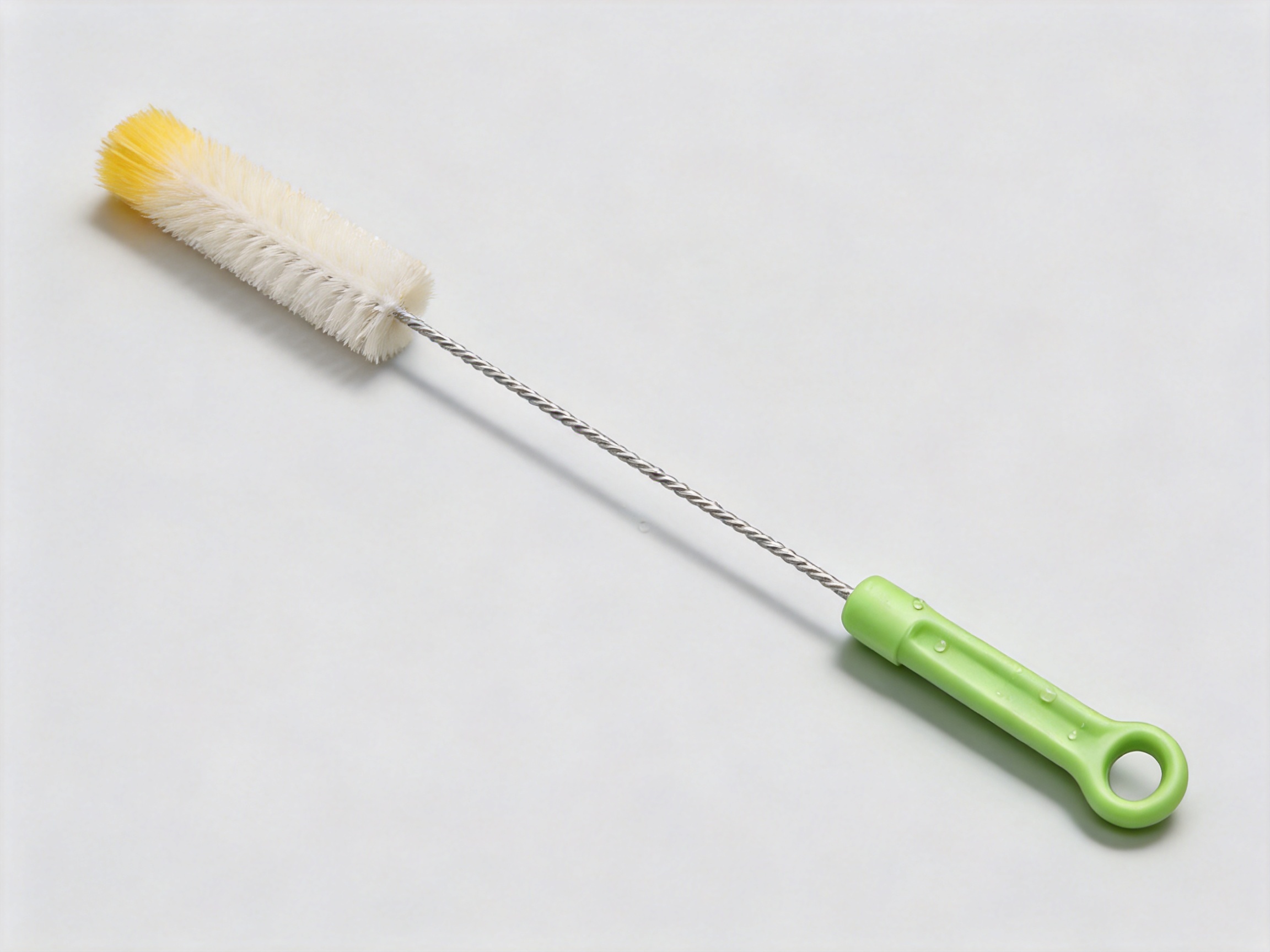
The product uses a colored handle combined with two-tone nylon bristles. The handle provides reach and control, while the bristles perform the cleaning action. The two-tone arrangement is both visually distinctive and functionally useful. It makes the brush easier to identify in a cleaning cabinet and provides a visual reference as the bristles become loaded with residue during use.
The bristle system combines softer outer fibers with stiffer internal cores. This arrangement is intended to balance surface protection and scrubbing strength. The outer fibers can help reduce the risk of aggressive contact against delicate tubing or container interiors, while the firmer core fibers contribute to the removal of stubborn residue. Compared with a brush made entirely from very soft fibers, the two-level structure offers more effective mechanical action. Compared with a brush made entirely from hard fibers, it offers a more balanced approach for everyday household use.
The 42-centimeter handle helps users reach into deep or recessed areas while keeping their hands away from dirty water and residue. The handle also improves leverage during repeated push-and-pull motions. A longer handle is especially useful when cleaning sink drains, shower channels, tall bottles, and tubing connected to equipment.
The 14-centimeter brush section provides a meaningful contact area without making the tool excessively difficult to control. A longer cleaning section could be harder to insert into short tubes or narrow openings, while a shorter section might require more repeated strokes. The selected dimensions offer a practical compromise for multiple cleaning scenarios.
A strong handle-bristle bond is another important feature. Bristle shedding is a common concern with low-quality cleaning tools, especially when the brush is twisted, pulled through a tight opening, or washed repeatedly. By reinforcing the connection between the cleaning head and the handle, the product is designed to maintain its structure during regular use and reduce the chance of loose fibers remaining inside a cleaned tube.
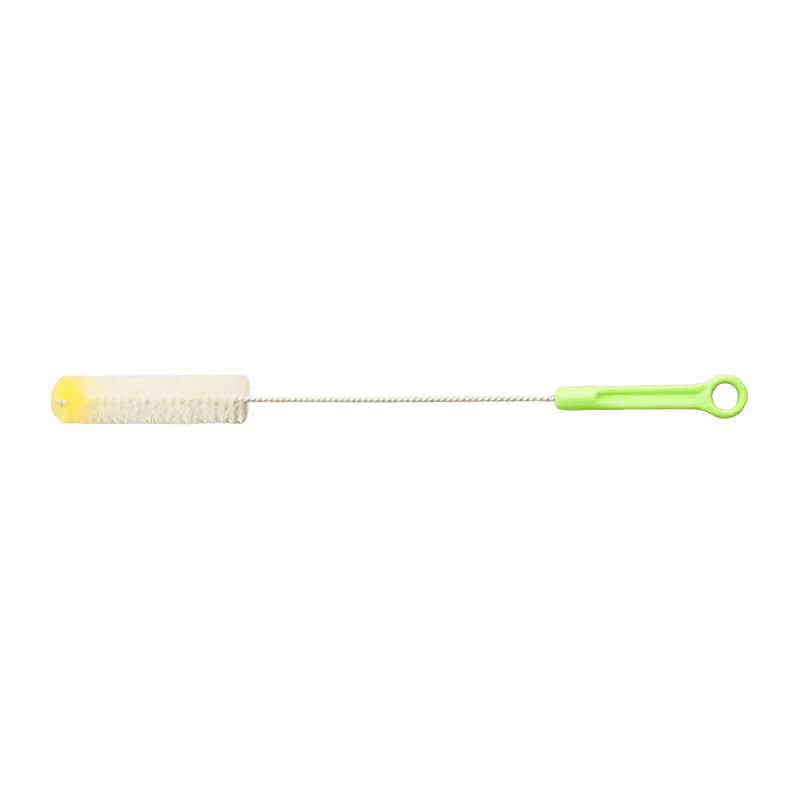
Reusable Colored Nylon Pipe Cleaning Brush
Two-Tone Nylon Bristles for Balanced Cleaning Performance
The central performance feature of this brush is its two-tone nylon bristle construction. Nylon is widely used in cleaning brushes because it can provide a useful combination of flexibility, resilience, wear resistance, and water compatibility. When appropriately designed, nylon fibers can bend during insertion, return toward their original position after use, and continue to provide contact against the inner surface of a tube.
The outer bristles are described as soft fibers. Their role is to provide gentler contact and help protect surfaces during cleaning. This is valuable for reusable straws, baby bottles, coffee machine tubes, and other products where excessive abrasion may be undesirable. Soft fibers can also reach into fine gaps and irregularities that rigid bristles may not contact effectively.
The inner bristles are stiffer and provide additional scrubbing force. Residue inside a pipe is not always loose. Grease, beverage deposits, milk residue, mineral films, and general dirt may adhere to the internal wall. A brush with only soft fibers may move across this residue without sufficiently disturbing it. The firmer core helps create the mechanical action required for more demanding cleaning tasks.
The combination of fiber types is a meaningful advantage over single-grade brushes. A very soft brush may be gentle but ineffective against stubborn buildup. A very hard brush may remove residue quickly but may be too aggressive for delicate surfaces. The two-tone structure helps create a more versatile product for users who want one brush to serve different cleaning purposes.
The contrasting colors also provide a practical visual benefit. Users can quickly distinguish the brush from other tools and can observe visible residue collected by the fibers. In environments where cleaning tools are assigned to different tasks, color differentiation may support better organization. For example, separate colors or brush sets can be allocated to kitchen, bathroom, baby-care, or equipment-cleaning activities.
Color can also contribute to product presentation. Retail customers often prefer cleaning tools that are easy to recognize and visually appealing. For distributors and supermarkets, a colored design may make the item more noticeable on a shelf or in an online product listing. At the same time, the color does not replace the functional qualities of the brush; it supports identification while the nylon structure performs the cleaning work.
Reach and Access in Difficult Cleaning Areas
One of the main advantages of a long-handled pipe brush is access. Narrow tubes frequently extend deeper than a user can reach with their fingers. The 42-centimeter handle allows the user to insert the brush while maintaining a comfortable distance from the opening. This can be helpful when dealing with dirty drains, wet channels, or containers that are difficult to empty and clean by hand.
In a kitchen, the brush may be used to clean sink drain passages, narrow discharge tubes, bottle components, reusable straws, and coffee machine tubing. Food and beverage residues can remain in these areas even after ordinary rinsing. A suitable brush gives the user a way to apply direct mechanical pressure rather than depending entirely on hot water, detergent, or chemical cleaners.
In a bathroom, the brush can be used for shower pipes, narrow drain channels, and small openings where hair, soap residue, and mineral deposits may collect. The long handle helps reduce the need to place hands near unpleasant material. Users should still follow appropriate hygiene procedures, including wearing gloves when necessary and rinsing the tool thoroughly after use.
In baby-care applications, the brush may help clean reusable straws, bottle accessories, narrow feeding components, and other tubular items, provided that the item being cleaned is compatible with brush use. The softer outer fibers are particularly relevant in these applications because they are intended to reduce harsh contact. After cleaning baby-related products, the brush itself should be rinsed carefully, dried completely, and stored in a clean location.
In workshops and light industrial environments, narrow tubes may contain dust, lubricant, process residue, or other deposits. The brush provides a manual cleaning option for maintenance teams that need a compact, reusable tool. It can complement broader cleaning systems and may be useful when a component is too small for a standard bottle brush or too delicate for a rigid metal tool.
Reusable Construction and Lower Disposable Consumption
Disposable cleaning tools are convenient, but frequent replacement increases purchasing costs and generates additional waste. A reusable pipe cleaning brush is intended to remain in service through multiple cleaning cycles. Its nylon bristles can be rinsed after use, and the brush can be dried for the next application.
Reusability offers benefits for households, commercial kitchens, maintenance departments, and cleaning contractors. Instead of purchasing a new narrow cleaner after every task, users can maintain a small inventory of durable brushes and replace them according to actual wear. This may simplify inventory management and reduce the number of individual tools consumed over time.
The environmental benefit depends on correct use and maintenance. A reusable tool has the greatest value when it is cleaned properly, used for an appropriate application, and kept in service for as long as its bristles and handle remain effective. Users should avoid forcing the brush into openings that are too small, because excessive bending can shorten its service life. The brush should also be stored dry and should not be exposed unnecessarily to aggressive chemicals that may damage the fibers or handle.
Compared with disposable cleaners, the product offers a more durable approach to regular tube maintenance. The strong bond between the handle and the bristle section supports repeated use, while the mold-resistant design helps the brush remain more suitable for damp cleaning environments. No cleaning tool is maintenance-free, but a rinse-and-dry routine can help preserve performance.
Fast Rinsing and Drying Characteristics
Cleaning tools used around water can become unpleasant if they retain moisture for long periods. A brush that dries slowly may develop odors or become harder to store hygienically. The reusable colored nylon pipe cleaning brush is designed to rinse quickly and dry fast, which supports repeated use in kitchens, bathrooms, and other damp environments.
Nylon bristles allow water to pass through the brush structure more readily than a dense sponge-like material. After cleaning, the user can rinse the bristles under running water to remove loosened residue. Shaking off excess water and placing the brush in a ventilated area can further support drying.
The mold-resistant characteristic is especially relevant to products that may be used for bottles, straws, drains, and other wet applications. It does not eliminate the need for cleaning and drying, but it helps make the brush more suitable for repeated exposure to moisture. Users should avoid storing the brush in a sealed, wet container immediately after use.
Fast rinsing also improves workflow efficiency. In a commercial setting, staff may need to clean several tubes or components in succession. A brush that can be washed quickly between tasks may be more convenient than a tool that holds residue and requires lengthy preparation. For households, quick cleaning makes it easier to incorporate the brush into normal maintenance routines rather than treating it as a specialized item that is rarely used.
Applications Across Household and Commercial Settings
Kitchen Cleaning
Kitchen environments contain many narrow and difficult-to-reach parts. Reusable straws, bottle caps, coffee machine tubes, sink drains, appliance channels, and small hoses can all collect residue. The brush’s long handle and narrow cleaning section provide a direct way to reach these areas.
For reusable straws, the brush should be inserted gently and moved through the full length of the straw. Rotating the handle while moving it back and forth can improve contact with the inner wall. The straw and brush should then be rinsed thoroughly. If the straw manufacturer provides specific cleaning instructions, those instructions should take priority.
For coffee machine tubes, the brush can assist with removing loose deposits and beverage residue. Equipment should be turned off, cooled, and disconnected as appropriate before cleaning. The brush is a manual cleaning accessory and should be used as part of the equipment manufacturer’s recommended maintenance procedure.
Bathroom and Drain Maintenance
Bathroom drains and shower channels may collect hair, soap residue, and other material. The brush can help loosen deposits near the opening and inside accessible sections. Its length allows users to maintain distance from the drain while applying controlled strokes.
The brush should not be forced against a blockage that cannot be moved safely. For severe blockages, users may need a dedicated drain tool or professional service. Chemical drain products should not be used with the brush unless the materials are confirmed compatible and all safety instructions are followed.
Baby Products and Bottle Components
Baby bottles, narrow feeding accessories, and reusable drinking components require careful cleaning. The softer outer fibers may provide a more suitable contact surface than a harsh abrasive tool. The brush can help reach internal areas where milk or formula residue may remain after ordinary rinsing.
After cleaning baby products, all components should be rinsed and sanitized according to the product manufacturer’s guidance. The brush should also be cleaned separately and allowed to dry fully. A brush used for baby-care items should preferably be assigned exclusively to that purpose to reduce cross-use between different cleaning areas.
Household Storage Containers
Small storage containers and narrow-necked bottles can be difficult to clean with a standard sponge. The pipe cleaning brush can reach into the neck and interior, helping remove food, drink, dust, or household residue. The two-tone bristles make the tool easy to locate in a storage area, and the long handle reduces the need to insert fingers into small openings.
Industrial and Workshop Cleaning
Industrial users often require simple tools for routine maintenance. Small channels, tubes, conduits, and equipment openings may need cleaning during inspections or between production tasks. The brush is suitable for light-duty manual cleaning where a flexible nylon tool is preferred over a metal implement.
Its value in industrial purchasing comes from versatility. A single brush design can support multiple maintenance tasks, reducing the need to stock many specialized shapes. For larger operations, different colors may be assigned to specific production zones or applications. This can support tool segregation and help reduce the risk of using a brush from one work area in another.
Comparison with Common Alternative Cleaning Tools
| Cleaning Tool Type | Typical Strength | Common Limitation | Advantage of the Reusable Colored Nylon Pipe Cleaning Brush |
|---|---|---|---|
| Disposable pipe cleaner | Low initial cost and quick availability | Often intended for limited use and may generate more waste | Designed for repeated rinsing, drying, and reuse |
| Short bottle brush | Useful for containers with wide openings | May not reach deep tubes or recessed drains | 42-centimeter handle provides extended reach |
| Single-grade soft brush | Gentle contact with surfaces | May provide limited scrubbing strength | Soft outer fibers are combined with stiffer core fibers |
| Very stiff brush | Strong mechanical scrubbing | May be too aggressive for delicate tubing or baby products | Two-tone nylon construction balances contact and firmness |
| Metal wire brush | High rigidity for heavy-duty abrasion | Can scratch surfaces and may be unsuitable for food-related applications | Nylon fibers offer a more flexible, non-metal cleaning option |
| Cleaning cloth or sponge | Effective on broad external surfaces | Cannot easily clean narrow internal passages | Dedicated narrow brush section reaches tubular interiors |
The comparison shows why a specialized pipe brush can occupy an important position between gentle household cleaning tools and aggressive industrial implements. It is not intended to replace every brush or drain tool. Instead, it addresses the specific need for a long, reusable, flexible cleaner that can work inside narrow passages while offering more scrubbing strength than a soft disposable cleaner.
Advantages for Retailers, Distributors, and Bulk Buyers
For retailers, the product has a clear and easy-to-understand function. Consumers frequently search for solutions to clogged straws, difficult bottle interiors, sink drains, and coffee machine tubes. A product that directly communicates its intended use can be suitable for supermarket cleaning aisles, household goods departments, online stores, and home-organization catalogs.
The colorful design may improve shelf recognition. In online listings, the two-tone bristle arrangement and long handle can be presented as visual signals of the product’s purpose. The product also fits several related categories, including kitchen cleaning supplies, household cleaning supplies, indoor and outdoor cleaning supplies, baby products and cleaning supplies, and home storage-related accessories.
Distributors may appreciate the product’s broad application range. Instead of offering a tool limited to one type of pipe, they can position it for several use cases. This can support sales to households, cafés, restaurants, cleaning contractors, property managers, workshops, and maintenance departments.
The listed carton quantity is 800 pieces. This packaging information is important for procurement planning, warehouse allocation, shipping calculations, and wholesale quotation preparation. Buyers should confirm carton dimensions, gross weight, packaging method, color assortment, and final order quantities during commercial discussions.
Customization is another potential advantage for bulk purchasers. Depending on project requirements, customers may discuss color options, packaging formats, private labeling, product drawings, samples, and other specifications with the manufacturer. The company’s stated ability to customize according to customer drawings and samples can support buyers seeking a product adapted to a particular market or sales channel.
Manufacturing Strengths and Production Capabilities
Jinhua Jieqing Plastic Co., Ltd. was founded in 2008 and operates as an industry and trade enterprise specializing in the research, development, production, and sales of cleaning supplies. This combination of manufacturing and trading functions allows the company to connect product development with market requirements, customer communication, order coordination, and export supply.
The company offers brooms, cleaning brushes, household brushes, industrial brushes, and supporting plastic products. This product range provides experience across different brush shapes, handles, materials, applications, and customer requirements. Such experience can be valuable when developing a narrow pipe brush because the product depends on coordinated decisions involving bristle selection, handle dimensions, assembly strength, usability, and packaging.
The company reports that it has its own production base, a complete supply chain, standardized production processes, and stable quality control. These capabilities are important for buyers who need consistent repeat orders. A cleaning brush may appear simple, but production consistency can affect handle straightness, bristle density, bond strength, color uniformity, dimensions, and final appearance.
A standardized process helps reduce variation between production batches. For a product such as the reusable colored nylon pipe cleaning brush, process control may include material preparation, handle forming or processing, bristle arrangement, assembly, bonding, trimming, appearance inspection, functional checks, and packaging. The exact production parameters depend on the approved sample and customer specification, but a controlled workflow supports repeatability.
Material management is also significant. The brush combines a colored handle with two-tone nylon bristles, so the supplier must coordinate multiple material characteristics. Bristle flexibility, color consistency, bonding compatibility, and resistance to moisture all influence the final product. A complete supply chain can make it easier to coordinate these components and maintain production continuity.
Quality control is not limited to checking the finished appearance. A reliable brush supplier should also pay attention to dimensions, fiber attachment, handle integrity, bristle distribution, surface cleanliness, color accuracy, packaging protection, and carton quantity. Strong inspection practices help reduce the risk of receiving products with loose bristles, damaged handles, incorrect quantities, or inconsistent specifications.
The company’s export experience is another strength for international buyers. Export orders often require careful coordination of product documentation, packaging, labeling, carton planning, shipping schedules, and communication across different time zones. Experience in these areas can make procurement more efficient and reduce avoidable problems during order execution.
Flexible customization services are useful for customers with different retail or institutional requirements. One buyer may need bright colors for consumer sales, while another may need specific colors for workplace tool segregation. Some customers may require individual packaging, multipack presentation, bulk packing, or custom labels. The ability to evaluate drawings and samples gives the manufacturer a basis for discussing these needs more accurately.

How Standardized Production Supports Product Reliability
Product reliability begins with a stable design. The brush’s defined handle length, brush-section length, material description, and bristle structure provide a reference for production. When these elements are documented and linked to an approved sample, manufacturing teams can work toward consistent results across different batches.
Assembly quality is especially important for a pipe brush. The user applies force through the handle, and that force transfers to the bristle section. If the connection is weak, the head may loosen or fibers may shed during insertion and withdrawal. A strong handle-bristle bond helps the tool withstand ordinary twisting, pulling, rinsing, and repeated use.
Dimensional control affects usability. If the brush section is too thick, it may not fit through the intended opening. If it is too thin, it may not contact the internal wall effectively. If the handle is shorter than expected, access becomes more difficult. Maintaining the specified dimensions helps preserve the balance between reach, flexibility, and cleaning contact.
Color control supports product identification and retail consistency. Two-tone bristles should present a clear visual contrast, while the handle should retain a consistent appearance according to the approved specification. A stable color system can also help bulk buyers organize product variations or create a recognizable product range.
Packaging control protects the brush during transport. Long handles can be vulnerable to bending or deformation if packed carelessly. Proper carton arrangement helps prevent excessive pressure, surface damage, and quantity discrepancies. With a stated carton quantity of 800 pieces, accurate counting and orderly packing are important for warehouse receiving and inventory management.
Recommended Cleaning and Maintenance Procedure
Before using the brush, inspect the handle and bristles. Confirm that the brush is suitable for the tube, bottle, drain, or component being cleaned. Do not force the brush into an opening that is visibly smaller than the brush section. Excessive pressure may damage the item being cleaned or shorten the life of the brush.
Insert the brush gradually. Use a gentle back-and-forth movement, adding controlled rotation when appropriate. The stiffer core fibers can help dislodge residue, while the softer outer fibers provide additional surface contact. For stubborn buildup, repeat the cleaning motion rather than applying excessive force.
After use, rinse the brush thoroughly with clean water. Make sure that food particles, hair, detergent residue, and other loosened material are removed from the bristles. If a cleaning solution has been used, follow the solution manufacturer’s instructions for rinsing and handling.
Shake off excess water and place the brush in a clean, ventilated location. Allow it to dry before storing. Do not leave it submerged for long periods or place it in a closed container while wet. These steps help maintain a more hygienic tool and support the product’s quick-drying characteristics.
For professional environments, establish separate brushes for different zones or applications. A kitchen brush should not automatically be used for industrial lubricant residue, bathroom drains, or workshop cleaning. Color coding, labels, and assigned storage locations can help prevent cross-use.
Replace the brush when the bristles become heavily deformed, the handle is cracked, the bond shows damage, or the tool no longer cleans effectively. Reusability does not mean indefinite service. Timely replacement is part of responsible hygiene and maintenance management.
Important Application Considerations
The brush is suitable for many routine cleaning tasks, but users should consider the material of the item being cleaned. Flexible nylon is generally more suitable than metal for many household and tubing applications, yet any brush can cause wear if used with excessive pressure or on a delicate surface. Testing on an inconspicuous area may be appropriate when the surface finish is unknown.
The brush should not be treated as a medical device, sterilization instrument, or guarantee of complete sanitation. In baby-care, food-contact, and beverage equipment applications, cleaning should be followed by the appropriate rinsing, sanitizing, or sterilization procedure specified for the item.
Users should also consider chemical compatibility. Strong solvents, highly concentrated acids, oxidizers, or high-temperature processes may affect nylon fibers, colored components, or bonding materials. Before using the brush with a chemical solution, consult the chemical safety information and confirm compatibility with the brush materials.
For industrial use, the product is best positioned as a manual cleaning brush for suitable light-duty or routine maintenance applications. Heavy blockage removal, high-temperature cleaning, pressurized systems, and hazardous-material environments may require specialized equipment and procedures.
Why the Product Offers a Practical Competitive Position
The competitive value of this brush comes from the combination of features rather than from one isolated specification. Its long handle addresses reach. Its narrow brush section addresses access. Its two-tone nylon construction balances softness and stiffness. Its reinforced bond supports repeated use. Its mold-resistant and quick-rinsing characteristics suit damp environments. Its reusable design offers an alternative to disposable cleaners.
Many competing products may provide one or two of these advantages but not the full combination. A basic narrow brush may reach a tube but have a short handle. A disposable cleaner may be inexpensive but lack long-term durability. A stiff wire brush may scrub aggressively but be unsuitable for delicate surfaces. A soft bottle brush may protect surfaces but fail to remove stubborn residue. This product is designed to occupy the versatile middle ground.
The broad application range also improves its commercial appeal. Household consumers can use it for straws, bottles, drains, and coffee machine tubes. Retailers can place it within several cleaning categories. Industrial buyers can use it for routine maintenance. Distributors can offer it to multiple customer segments without changing the basic product design.
The manufacturer’s production base, supply chain, quality-control approach, export experience, and customization capability further strengthen the product’s position. Buyers are not only purchasing an individual brush; they are selecting a supplier capable of supporting product communication, bulk order coordination, repeat production, and market-specific requirements.
Specification Summary
| Specification Item | Product Information |
|---|---|
| Product name | Reusable Colored Nylon Pipe Cleaning Brush |
| Product category | Pipe Brush |
| Primary material | Colored handle with two-tone nylon bristles |
| Handle length | Approximately 42 centimeters |
| Brush section | Approximately 14 centimeters |
| Recorded length format | 42+3+14 |
| Bristle structure | Soft outer fibers with stiffer core fibers |
| Design characteristics | Two-tone appearance, strong handle-bristle bond, mold-resistant construction |
| Recommended applications | Sink drains, shower pipes, reusable straws, coffee machine tubes, bottles, household and industrial cleaning |
| Item number | CC-3252 |
| Carton quantity | 800 pieces |
The specification table provides a concise reference for purchasing teams and product managers. Final commercial specifications should be confirmed with the supplier, especially when the customer requests customized materials, colors, packaging, labels, dimensions, or carton configurations.
Supplier Support for Customized Orders
Different markets may require different presentation and packaging solutions. A supermarket may prefer an individual retail package with clear usage information. An online seller may require compact packaging and barcode coordination. An industrial buyer may prefer bulk packing to reduce handling and packaging costs. The same basic brush can be adapted to these channels through appropriate project discussions.
Customization based on drawings and samples can also help buyers refine the product. A purchaser may wish to compare a specific handle color, bristle arrangement, brush-section length, or packaging format. By reviewing physical samples and documented requirements, the manufacturer can better understand the intended application and identify practical production considerations.
For large orders, buyers should provide information about target markets, expected annual volume, packaging preferences, color requirements, inspection standards, labeling, delivery schedules, and any relevant regulatory or retailer requirements. Clear specifications reduce uncertainty and help both sides establish a more reliable production plan.
The company’s one-stop supply approach may be useful for customers sourcing multiple cleaning products. In addition to pipe brushes, the company offers brooms, household cleaning brushes, industrial brushes, and supporting plastic products. A broader product range can simplify supplier management and support coordinated purchasing for cleaning-supply programs.
Quality and Procurement Checklist
When evaluating the reusable colored nylon pipe cleaning brush for a wholesale or industrial order, buyers should review the approved sample carefully. Check the overall handle length, brush-section length, fiber distribution, color contrast, handle finish, and connection between the handle and brush head.
Pull testing or repeated manual use can help evaluate whether the bristles remain securely attached. Buyers should also examine whether the brush can be rinsed easily and whether the fibers return to a usable shape after normal bending. For applications involving bottles, straws, or food equipment, confirm the intended cleaning and material requirements before placing the order.
Packaging should be reviewed in relation to the sales channel. Individual retail packaging may need product instructions and identification, while bulk industrial packaging may prioritize protection, counting accuracy, and efficient warehouse handling. Since the standard carton quantity is listed as 800 pieces, buyers should confirm whether this quantity applies to the requested packaging configuration.
Inspection criteria should be written clearly. Useful criteria may include allowable dimensional variation, acceptable color variation, maximum loose-fiber tolerance, handle surface requirements, carton quantity, packaging condition, and labeling accuracy. A written quality standard helps create a consistent basis for production inspection and shipment approval.
Frequently Asked Questions
What is the main purpose of this pipe cleaning brush?
The brush is designed to clean narrow internal passages such as sink drains, shower pipes, reusable straws, coffee machine tubes, bottles, and similar tubular components. Its long handle and narrow brush section help users reach areas that are difficult to clean with cloths, sponges, or short brushes.
How long is the brush?
The handle is approximately 42 centimeters long, and the brush section is approximately 14 centimeters long. The product information records the length as 42+3+14. Buyers should confirm the final dimensional interpretation and tolerance with the supplier when preparing a purchase order or customized project.
What are the bristles made from?
The bristles are made from two-tone nylon. The design combines softer outer fibers with stiffer core fibers to balance surface protection and scrubbing performance.
Can the brush be used for reusable straws?
Yes. Reusable straws are one of the intended applications. The brush should be inserted gently and moved through the straw without forcing it. After cleaning, the straw and brush should be rinsed thoroughly. Users should also follow the straw manufacturer’s care instructions.
Is it suitable for baby bottles?
The brush is designed for baby bottle and baby-care cleaning applications, particularly for narrow components. The softer outer fibers are intended to provide gentler contact. However, the bottle and accessories should still be rinsed and sanitized according to their care instructions, and the brush should be cleaned and dried separately.
Can it clean coffee machine tubes?
Yes. The brush can help remove residue from suitable coffee machine tubes and narrow passages. The machine should be switched off, cooled, and prepared according to the equipment manufacturer’s maintenance procedure before cleaning.
What makes the two-tone design useful?
The two-tone design improves visual identification and makes the brush easier to distinguish from other tools. It can also provide visual feedback when residue collects on the fibers. In workplaces, colors may be used to organize brushes by cleaning area or application.
Does the brush shed bristles easily?
The product is designed with a strong handle-bristle bond to reduce shedding during normal use. As with any brush, users should inspect it periodically and replace it if the bond becomes damaged or the bristles are excessively worn.
Can the brush be reused?
Yes. It is intended as a reusable alternative to disposable narrow-tube cleaners. Rinse the brush after use, remove visible residue, and allow it to dry completely before storage.
Is the brush mold-proof?
The brush is described as mold-resistant and suitable for damp cleaning environments. This characteristic does not remove the need for proper rinsing, drying, ventilation, and hygienic storage.
Can it be used with strong chemicals?
Users should verify chemical compatibility before applying strong solvents, acids, oxidizers, or other aggressive substances. Nylon and bonding materials may be affected by certain chemicals or high temperatures. The safest approach is to use the brush with compatible cleaning solutions and follow relevant safety instructions.
Is it suitable for heavy industrial cleaning?
The brush is suitable for routine manual cleaning and light industrial maintenance where flexible nylon bristles are appropriate. It is not a substitute for specialized tools used in severe blockages, hazardous environments, high-temperature processes, or high-pressure systems.
What is the item number?
The item number is CC-3252. Buyers should include this reference in inquiries and order documents while also confirming the required color, packaging, quantity, and specifications.
How many pieces are packed in one carton?
The listed carton quantity is 800 pieces. Carton dimensions, weight, packaging configuration, and final quantity should be confirmed for each order, particularly when customization is requested.
Can the product be customized?
The manufacturer provides customization services based on customer drawings and samples. Buyers may discuss colors, packaging, labels, product details, and other requirements during the development and quotation process.
What types of buyers can use this product?
The product can serve households, supermarkets, cleaning-supply distributors, cross-border e-commerce sellers, restaurants, cafés, property-maintenance teams, workshops, facility managers, and industrial procurement departments.
Conclusion
The reusable colored nylon pipe cleaning brush is a practical solution for narrow-tube cleaning across household, baby-care, commercial, and light industrial environments. Its 42-centimeter handle improves reach, while the approximately 14-centimeter brush section provides direct access to internal passages. The two-tone nylon bristle system combines soft outer fibers with stiffer core fibers, creating a balanced approach to surface protection and residue removal.
Its strong handle-bristle bond supports repeated use, and its mold-resistant, quick-rinsing design is suited to damp cleaning tasks. The reusable structure provides a more durable alternative to disposable cleaners, while the colored appearance improves identification, organization, and product visibility.
Behind the product is a manufacturer with experience in cleaning-supply research, development, production, sales, customization, and export service. Its own production base, standardized processes, supply-chain capabilities, quality-control systems, broad product range, and flexible customer support provide a solid foundation for wholesale and customized orders.
For buyers seeking a versatile pipe brush, the product offers a useful combination of access, durability, cleaning performance, and application flexibility. It can support everyday household maintenance while also fitting broader procurement programs for retailers, distributors, facilities, and industrial users.
References
1. Product specification information for Reusable Colored Nylon Pipe Cleaning Brush, Item No. CC-3252.
2. Manufacturer-provided information concerning materials, dimensions, carton quantity, applications, and product characteristics.
3. Manufacturer company profile concerning cleaning-supply research, development, production, sales, customization, quality control, and export experience.
4. General principles of brush maintenance, cleaning-tool hygiene, rinsing, drying, and storage.
5. General procurement practices for household cleaning tools, industrial maintenance accessories, packaging review, and incoming quality inspection.
Product: Reusable Colored Nylon Pipe Cleaning Brush

 CONTACT US
- CONTACT DETAILS
- Address : No. 1388 Cuntong Road, Jinhua City
- Tel: +86-0579-81534043
- Email:wangjinhua1@zjjqsj.com
- PRODUCTS
- Kitchen Cleaning Supplies
- Household Cleaning Supplies
- Indoor & Outdoor Cleaning Supplies
- Baby Products & Cleaning Supplies
- Home Storage Containers
- QUICK LINK
- Company Profile
- Plant equipment
- Certifications
- FAQ
- NEWS CENTER
- Company News
- Industry News
- MOBILE TERMINAL

