

 English
  русский
  Español
  عربى
عربى 
White Nylon Pipe Cleaning Brush for Precise Household, Baby, and Industrial Cleaning
Date:Aug 24, 2026
Maintaining clean, narrow passages is one of the more difficult tasks in household, commercial, laboratory, and industrial environments. Ordinary cloths cannot reach inside slim tubes, while large brushes may be too rigid or too wide for delicate openings. The White Nylon Pipe Cleaning Brush with Blue Plastic Handle is designed to solve this specific problem with a long, narrow cleaning format, flexible white nylon bristles, a reinforced stainless steel ferrule, and a practical plastic handle.
Approximately 41 centimeters long, this small-size pipe brush is suitable for faucets, spray nozzles, narrow pipes, baby bottle nipples, hydration pack tubes, laboratory instruments, and other confined areas. Its design combines accessibility, cleaning visibility, surface protection, and repeated-use durability. The brush is also suitable for users who need a simple tool that can be rinsed, sanitized, dried, and returned to service without complicated maintenance.
Behind this product is a professional cleaning-supplies manufacturer with experience in research and development, production, sales, export, and customized manufacturing. Its own production base, established supply chain, standardized processes, quality-control procedures, and ability to work from customer drawings or samples provide a reliable foundation for bulk purchasing and private-label or project-based supply.
This article examines the brush’s construction, applications, practical advantages, cleaning performance, production strengths, customization potential, and purchasing considerations. It also explains why a focused pipe-cleaning tool can provide better results than general-purpose brushes when hygiene, access, and repeatability are important.
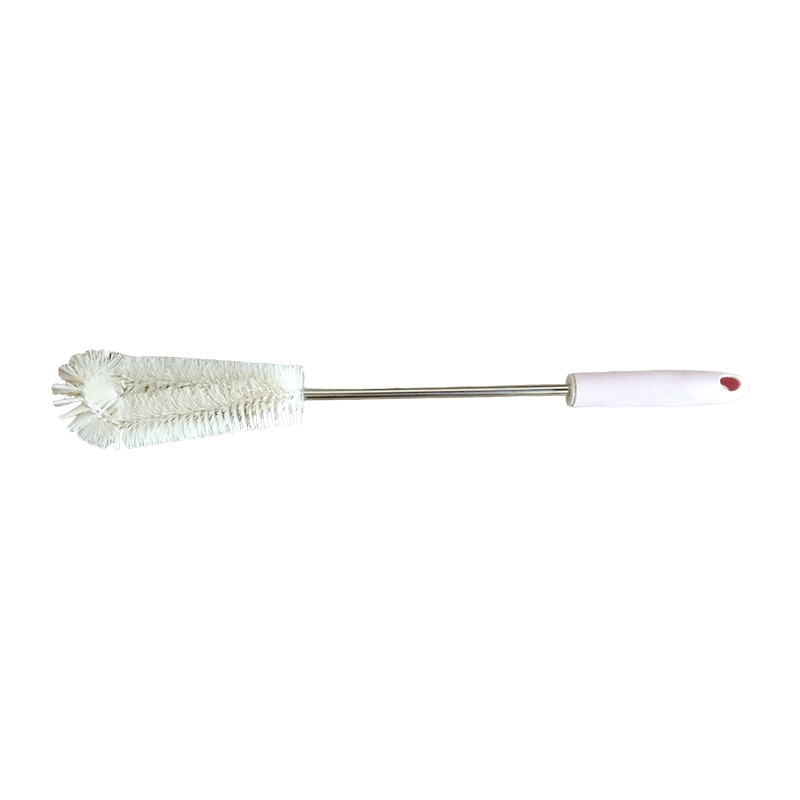
White Nylon Pipe Cleaning Brush with Blue Plastic Handle
1. Why Narrow-Passage Cleaning Requires a Specialized Brush
Many products used in kitchens, bathrooms, laboratories, workshops, healthcare-support areas, and outdoor activities contain channels that are difficult to clean. Faucets have internal openings, spray nozzles collect deposits around their outlets, drinking systems contain flexible tubes, and laboratory instruments may include slender passages that must be kept free from residue. Baby-feeding accessories also require careful cleaning because remaining milk or formula can create unpleasant odors and hygiene concerns.
A conventional sponge is effective on broad, flat surfaces but usually cannot enter these spaces. A standard dish brush may have a suitable handle but a head that is too large. A rigid wire tool can reach deeply but may scratch plastic, silicone, polished metal, or coated surfaces. A short brush may clean the entrance of a pipe without reaching its full interior. These limitations can leave contamination behind even when the outside of the item appears clean.
A purpose-designed pipe brush addresses the problem by using a slender bristle section that can move through a narrow passage. The bristles contact the inside wall and loosen residue through controlled brushing action. Because the brush is approximately 41 centimeters long, the user can access recessed or extended passages while keeping the hand outside the wet or contaminated area.
The White Nylon Pipe Cleaning Brush is especially useful where users need a balance between reach and control. Its small-size construction helps it enter openings that are not suitable for broad cleaning brushes. At the same time, the blue plastic handle provides a visible gripping area and makes the tool easy to identify among other cleaning equipment.
1.1 Cleaning Access and Reach
Reach is one of the most important features of a pipe brush. A tool that is too short may fail to clean the full length of a tube. A tool that is too long or too flexible may be difficult to guide. At approximately 41 centimeters, this model provides useful working length for many household and light industrial applications while remaining manageable during routine cleaning.
The elongated form allows the operator to guide the brush into a passage gradually rather than forcing a bulky head through the opening. This reduces the likelihood of sudden pressure against the end of the tube or accidental contact with nearby surfaces. It also supports a push-and-pull cleaning motion that can be repeated several times until the passage is visibly clear.
1.2 Bristle Contact in Confined Spaces
The white nylon bristles are arranged to provide contact around the interior of a narrow passage. As the brush moves, the bristles reach areas that water alone may not remove effectively. They can loosen light residue, particles, and accumulated contamination from the inner wall of a pipe or nozzle.
Nylon is widely used in cleaning brushes because it offers flexibility, resilience, and compatibility with repeated washing. The bristles can bend as they enter a confined opening and recover their working shape after use. This makes the brush more adaptable than a rigid cleaning probe and more durable than a soft disposable swab for repeated applications.
1.3 Visibility During Cleaning
White bristles provide a practical visual advantage. Contamination collected during use is easier to see against a light-colored brush head than against dark bristles. This helps the operator judge whether the brush needs rinsing, whether additional passes are required, and whether the cleaning process has removed visible residue.
Visual inspection is particularly helpful in environments where cleaning consistency matters. A user can rinse the brush when buildup becomes apparent and continue working with a cleaner bristle surface. After the task, the white material also makes it easier to inspect the brush before storage.
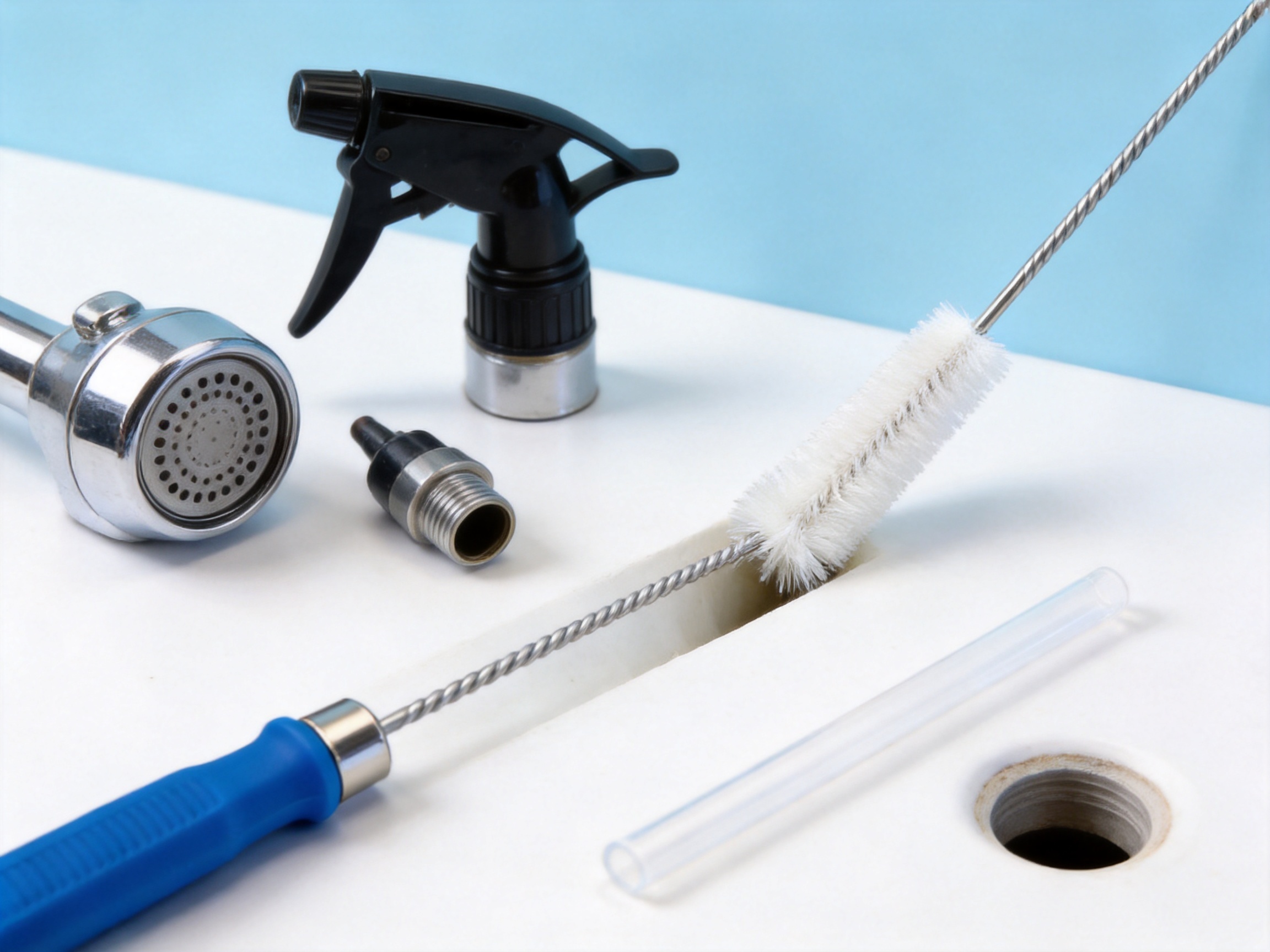
2. Product Construction and Functional Design
The brush consists of three principal material elements: a plastic handle, white nylon bristles, and a stainless steel ferrule. Each component has a defined purpose. The handle provides control, the bristles perform the cleaning work, and the ferrule reinforces the connection between the working head and the handle.
| Product Element | Material | Primary Function | Practical Benefit |
|---|---|---|---|
| Handle | Blue plastic | Provides a gripping and guiding point | Lightweight, visible, and easy to handle |
| Bristles | White nylon | Contact and agitation inside narrow passages | Flexible, visible during inspection, and suitable for repeated cleaning |
| Ferrule | Stainless steel | Reinforces the brush-to-handle connection | Helps reduce detachment during regular use |
| Overall length | Approximately 41 centimeters | Provides access to recessed and slim passages | Useful reach without requiring a bulky tool |
| Product category | Pipe brush | Specialized cleaning of tubes, nozzles, and openings | More targeted than a general surface brush |
2.1 Blue Plastic Handle
The plastic handle is designed to make the tool easier to hold and direct. A handle is essential for pipe cleaning because the user must apply controlled forward and backward movement. The blue color also provides visual separation from the white bristle head and helps distinguish the brush from other tools in a cleaning kit.
Plastic is a practical handle material for wet environments. It does not absorb water in the same way as untreated wood, and it can be rinsed after use. Its lightweight character helps reduce fatigue when several tubes or fittings must be cleaned in succession. For commercial buyers, the plastic handle also offers a suitable base for potential color coordination, packaging differentiation, or product-range organization, subject to customization discussion.
2.2 White Nylon Bristles
The nylon bristles are the main working component. Their flexibility allows them to adapt to the internal shape of a narrow tube without behaving like a rigid scraper. This is important for items made from plastic, silicone, coated metal, or other materials that may be marked by excessively hard tools.
The bristles are suitable for cleaning applications where the user wants effective contact without aggressive abrasion. They can enter small openings, sweep along interior walls, and loosen common residues through repeated movement. The white color supports visual monitoring, while the nylon material is appropriate for a product intended to withstand repeated sanitization and regular drying.
2.3 Stainless Steel Ferrule
The stainless steel ferrule reinforces the connection between the bristles and the handle. In a pipe brush, this connection is exposed to repeated pushing, pulling, bending, rinsing, and drying. A weak connection may allow the head to loosen or detach, creating inconvenience and potentially leaving part of the tool inside a tube.
The ferrule provides structural support at this critical junction. It helps maintain the integrity of the brush during normal use and contributes to a more dependable service life. The use of stainless steel is also appropriate for wet cleaning environments because the material is commonly selected for its resistance to corrosion and its ability to support hygienic maintenance.
3. Key Advantages Compared with General-Purpose and Competing Brushes
Every cleaning brush should be evaluated according to the task it performs. A broad scrub brush may be excellent for floors or countertops, but it is not necessarily suitable for a narrow tube. The advantages of this pipe brush become most apparent when compared with tools that lack the same combination of reach, slimness, bristle visibility, material balance, and connection reinforcement.
3.1 More Targeted Than a General Household Brush
General-purpose brushes are usually designed to cover larger surfaces. Their heads may be wide, their bristles may be arranged for open areas, and their handles may not provide the precision required for narrow channels. Using such a brush inside a slim pipe can be inefficient or impossible.
The small-size pipe brush is designed around the geometry of confined areas. Its working end can be guided through faucets, spray nozzles, hydration tubes, and similar passages. This specialized design means that users do not need to improvise with unsuitable tools or rely solely on soaking and rinsing.
3.2 Better Reach Than Short Cleaning Tools
Short brushes can be convenient for accessible openings, but they may not reach the entire interior of a long tube. With an approximate length of 41 centimeters, this model supports deeper access and gives the user more control from outside the cleaning area.
Longer reach also helps reduce the need to dismantle some items before cleaning, although users should always follow the care instructions of the item being cleaned. Fewer disassembly steps can save time in routine maintenance and reduce the chance of losing small components.
3.3 Gentler Than Rigid Wire Tools
Rigid metal tools can remove hard deposits, but they may scratch delicate surfaces or damage soft tubing. The nylon bristles provide a gentler alternative for applications where surface protection matters. They can flex around the interior without creating the same concentrated scraping action as a sharp or rigid wire.
This advantage is relevant for baby bottle nipples, hydration pack tubes, laboratory instruments, and plastic spray components. In these applications, cleaning effectiveness must be balanced with the need to preserve the shape and finish of the item.
3.4 Easier Contamination Monitoring Than Dark Bristles
Dark bristles can conceal collected residue, especially when the brush is used with colored liquids or in low-light areas. White nylon makes contamination more visible. Users can quickly determine when the brush needs rinsing and can inspect it after cleaning.
This feature may appear simple, but it supports better work habits. A visibly dirty brush is less likely to be returned to storage without rinsing. In environments with multiple cleaning steps, visual identification can also help workers confirm which tools have already been used.
3.5 More Secure Construction Than Weakly Joined Brushes
Brush-head detachment is a common concern in long, narrow cleaning tools because the head may experience repeated resistance inside a passage. The stainless steel ferrule reinforces the connection and helps reduce the risk of separation during ordinary use.
A secure connection improves user confidence and reduces interruptions. It can also lower replacement frequency when the brush is used according to its intended purpose. Buyers seeking dependable tools for repeated cleaning can therefore consider the ferrule an important functional feature rather than a decorative detail.
3.6 Suitable for Repeated Sanitization
The product is designed to withstand repeated sanitization and to dry quickly. This is important for cleaning tools used in hygiene-sensitive applications. A brush that remains damp for long periods may develop unpleasant odors or become difficult to store responsibly.
Fast drying depends on proper rinsing, drainage, ventilation, and storage conditions, but the product’s materials and open brush structure support a practical maintenance routine. After use, the brush can be rinsed, shaken or drained, and placed in a clean, ventilated area.
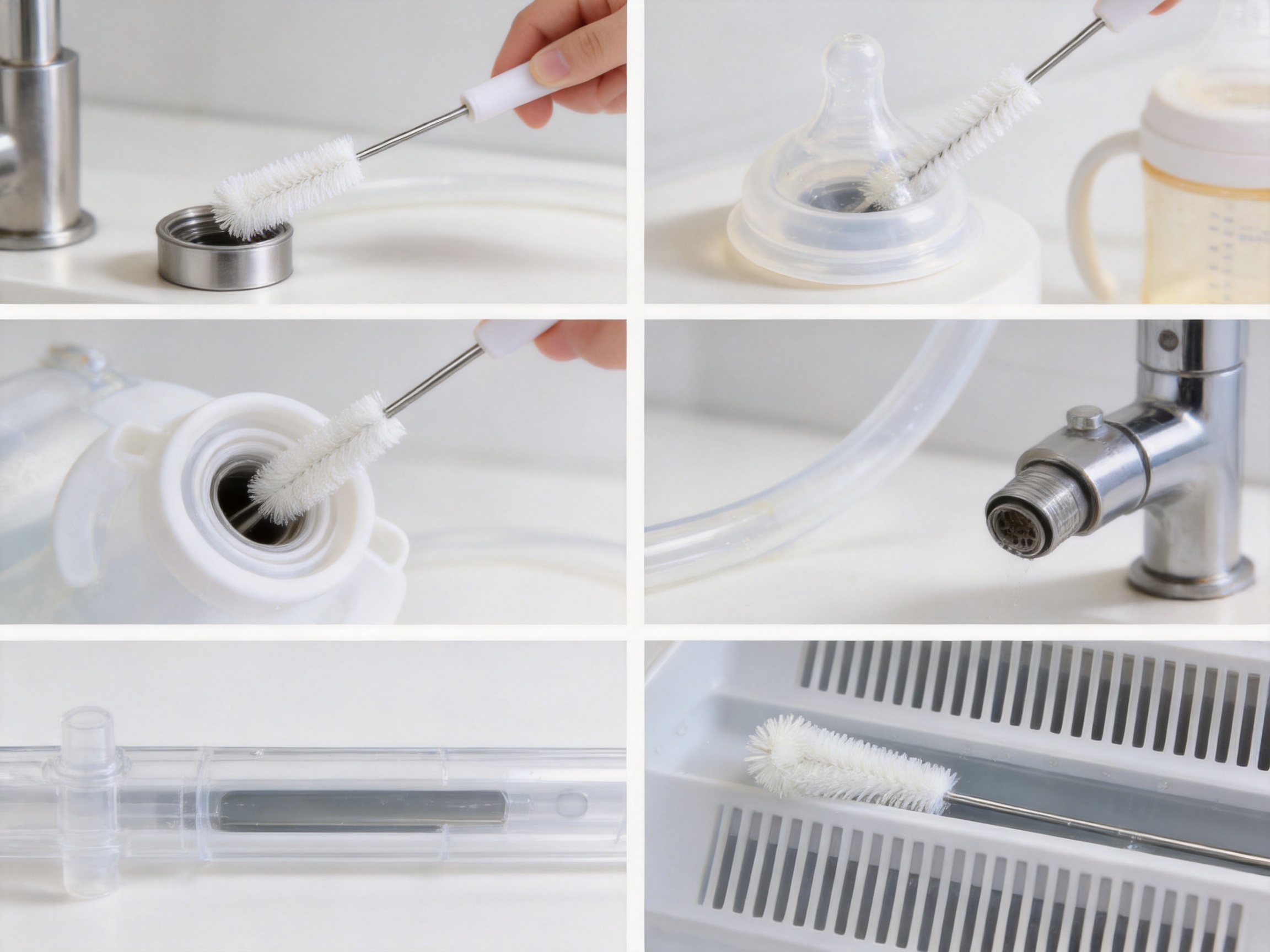
4. Main Applications
The brush is suitable for a broad range of cleaning tasks. Its applications are connected by one common requirement: a narrow, recessed, or elongated passage needs direct brushing rather than surface wiping alone.
4.1 Faucets and Spray Nozzles
Faucet openings and spray nozzles can collect mineral deposits, particles, soap residue, and other buildup. The small brush head can be guided into these openings to help remove material that a cloth cannot reach.
For routine maintenance, users can first flush the fitting with water, insert the brush gently, move it back and forth, and rinse again. The white bristles make it easier to see whether visible residue has been removed. The brush should not be forced into an opening that is smaller than the working head, and the fitting should be handled according to its own maintenance instructions.
4.2 Baby Bottle Nipples and Feeding Accessories
Baby bottle nipples and related accessories often contain narrow openings and curved areas where milk residue may remain. The brush’s flexible nylon bristles can help clean these difficult sections while being gentler than rigid tools.
Because these items are used for infants, users should follow the cleaning and sanitization guidance supplied by the accessory manufacturer. The brush should be thoroughly washed before and after use, and it should be kept separate from tools used for harsher chemicals or heavily soiled industrial components.
4.3 Hydration Pack Tubes and Drinking Systems
Hydration packs, reusable drinking systems, and similar outdoor equipment often contain long tubes that are difficult to clean with a sponge. The approximately 41-centimeter length can provide useful access to many tube sections, depending on the specific design.
Regular brushing helps remove drink residue and supports better odor control. After cleaning, the tube should be rinsed thoroughly and allowed to dry completely. Hanging or positioning the tube so that air can circulate through it may improve drying performance.
4.4 Laboratory Instruments
Laboratory instruments may include narrow channels, sample tubes, fittings, or glass and plastic components that require careful cleaning. The nylon bristles are appropriate for situations where the user wants controlled contact without relying on a harsh abrasive tool.
Suitability depends on the laboratory’s material-compatibility, sanitation, and validation requirements. In regulated environments, the cleaning brush should be selected as part of an established procedure. The product’s visible white bristles can assist with routine inspection, while the stainless steel ferrule supports structural reliability during repeated handling.
4.5 Household Tubes and Small Components
Additional household uses may include cleaning narrow parts of water dispensers, coffee equipment, humidifiers, small drainage channels, reusable straws, and selected kitchen accessories. Users should confirm that the brush diameter and material are appropriate for each item.
4.6 Workshop and Light Industrial Maintenance
Workshops and facilities often need simple tools for cleaning narrow fittings, hoses, channels, and equipment components. This pipe brush can support routine maintenance where contamination is light to moderate and the surface requires a flexible cleaning tool.
For heavy industrial deposits, users should evaluate the required bristle stiffness, chemical compatibility, temperature range, and cleaning validation criteria. The manufacturer can discuss customized brush specifications when the standard model does not meet a particular industrial requirement.
5. Hygiene, Sanitization, and Maintenance Practices
A cleaning brush can only perform well when it is itself maintained properly. The White Nylon Pipe Cleaning Brush is designed for repeated sanitization, but proper operating habits remain important. Users should match their cleaning and sanitization method to the materials of the brush and to the requirements of the items being cleaned.
5.1 Recommended Basic Cleaning Sequence
Begin by removing loose residue from the item and rinsing the brush with suitable water. Apply an appropriate cleaning solution when required by the item’s care instructions. Insert the brush gently into the narrow passage and use repeated forward-and-backward strokes. Avoid twisting with excessive force, especially when the passage is curved or the opening is very small.
After brushing, rinse the item and the brush thoroughly. Inspect the white bristles for remaining contamination. If residue is still visible, repeat the process rather than increasing force sharply. This approach helps protect both the brush and the component being cleaned.
5.2 Sanitization Considerations
The brush can withstand repeated sanitization as part of normal hygiene maintenance. However, the precise method should be selected according to the intended application. Household users should follow product-care instructions. Commercial and laboratory users should follow their internal sanitation procedures and confirm material compatibility before adopting a new method.
Sanitization should not be confused with simply rinsing. Rinsing removes loose material, while sanitization is a controlled step intended to reduce microorganisms to an acceptable level. The brush should be cleaned before sanitization so that organic residue does not interfere with the process.
5.3 Drying and Storage
After rinsing or sanitization, place the brush where air can reach the bristles and handle. The brush’s structure supports quick drying, but storage in a sealed, damp container should be avoided. A dry, clean storage location can help preserve the bristles and reduce odor.
For professional users, dedicated storage racks or labeled containers can help prevent cross-use between different cleaning zones. The blue handle and white bristle head make the brush easy to identify, which can support simple color or tool-management systems.
5.4 Inspection and Replacement
Users should inspect the bristles, ferrule, and handle regularly. Replace the brush if the bristles become excessively worn, the ferrule loosens, the handle cracks, or the brush no longer fits securely into the intended passage. A brush should also be replaced if it has been used with incompatible chemicals or in an environment that may have compromised its material integrity.
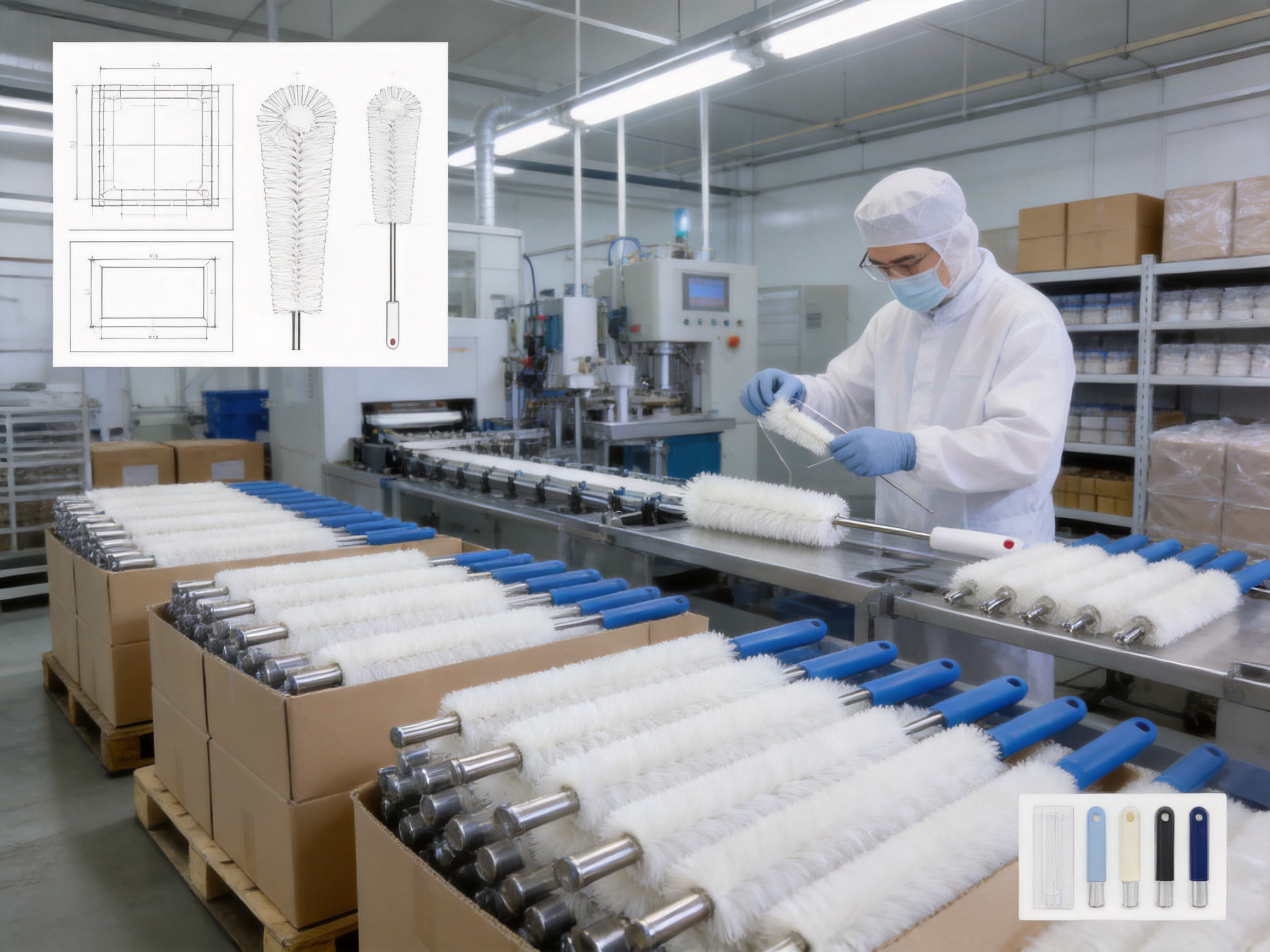
6. Manufacturing Strengths Behind the Product
Product performance depends not only on the visible design but also on the consistency of manufacturing. A pipe brush must maintain reliable bristle attachment, stable dimensions, clean assembly, and repeatable material quality across production batches. The manufacturer’s production structure is intended to support these requirements.
6.1 Industry and Trade Integration
Jinhua Jieqing Plastic Co., Ltd. is an industry and trade enterprise specializing in the research, development, production, and sales of cleaning supplies. This integrated structure allows product development and market service to operate within a connected business system.
For buyers, an industry-and-trade model can simplify communication. Product requirements, packaging questions, production schedules, export coordination, and after-sales discussions can be managed through a more unified supply channel. This can be useful for distributors, supermarket suppliers, cross-border e-commerce businesses, and industrial procurement teams.
6.2 Own Production Base
The company operates its own production base, providing a foundation for direct control over manufacturing activities. Direct production capability can support more consistent coordination of materials, assembly, inspection, packaging, and order planning.
For a brush with multiple connected components, production oversight is especially important. The handle, nylon bristles, and stainless steel ferrule must work together as a functional unit. Stable production management helps reduce variation in appearance, dimensions, attachment quality, and overall usability.
6.3 Standardized Production Processes
Standardized processes are essential when a product must be supplied repeatedly to different customers or markets. A consistent process may include material preparation, component forming, bristle arrangement, ferrule assembly, inspection, cleaning, packing, and shipment preparation.
Although exact factory procedures may vary according to order requirements, the company’s emphasis on standardized production supports repeatability. Customers can provide specifications and discuss required tolerances, packaging formats, color selections, or other conditions before production begins.
6.4 Quality Control and Supply-Chain Coordination
The company highlights stable quality control and a complete supply chain as important operating strengths. Coordinated sourcing helps support the availability of plastic, nylon, stainless steel, packaging materials, and related production inputs.
Supply-chain stability matters for distributors who need regular replenishment. It can help reduce uncertainty when an order requires a fixed product configuration or when a customer is building a long-term cleaning-tool assortment. Quality control is equally important because the brush must retain its functional characteristics from one shipment to the next.
6.5 Research and Development Capability
Research and development support allows the manufacturer to improve existing products and develop new brush formats. Different cleaning tasks may require changes in length, diameter, bristle stiffness, handle shape, color, ferrule material, or packaging. A manufacturer with product-development experience can evaluate these requirements more effectively than a supplier that only resells standard items.
For customers with a specific application, the development process may begin with a drawing, sample, photograph, or written specification. The manufacturer can then discuss feasibility, materials, construction, and production arrangements. Final results should be confirmed through samples and technical approval before mass production.
6.6 Export Experience
Extensive export experience is valuable for buyers operating across different markets. Export orders often involve product documentation, carton planning, labeling, packaging protection, shipment coordination, and communication across time zones and languages.
A supplier familiar with international business can help customers organize these details more efficiently. The product’s carton quantity is listed as 230 pieces for the specified small-size model, giving buyers an initial reference for bulk-order planning. Actual packing configuration, carton dimensions, and shipping terms should be confirmed for each order.
7. Customization and Bulk Procurement Potential
The standard white-and-blue pipe brush provides a practical starting point, but some buyers require product adaptations. Retailers may want packaging designed for a particular shelf format. Industrial users may need a different length or bristle diameter. Cleaning-equipment distributors may request coordinated colors across a complete brush range.
The manufacturer provides customization based on customer drawings and samples. This creates opportunities to develop product variations while retaining the basic purpose of the pipe brush.
7.1 Possible Specification Discussions
Customization may involve overall length, brush-head dimensions, bristle material, bristle stiffness, handle color, handle design, ferrule selection, labeling, packaging, and carton arrangement. Not every change is suitable for every application, and technical feasibility should be reviewed before confirmation.
For example, a laboratory customer may prioritize a specific material combination and cleaning compatibility. A household retailer may focus on visual presentation, packaging, and consumer-friendly instructions. An industrial buyer may prioritize long reach, reinforced construction, and consistent bulk supply.
7.2 Drawings and Samples
Drawings provide dimensions and construction details, while physical samples help clarify texture, flexibility, appearance, and handling. Providing both can improve communication between the buyer and manufacturer. A clear sample-approval process can reduce the risk of misunderstanding before large-scale production.
When submitting a sample, buyers should identify the intended cleaning environment, the target passage size, the preferred cleaning force, sanitation conditions, and expected order volume. These details help the manufacturer recommend a suitable construction rather than treating the request as a simple appearance change.
7.3 Bulk Order Advantages
Bulk procurement can provide a more stable supply for supermarkets, online sellers, facility-management companies, hospitality groups, laboratories, and industrial maintenance programs. A standard product configuration can simplify inventory management, while customized packaging can support market differentiation.
Before placing a bulk order, buyers should confirm the product specification, sample approval, carton quantity, packing method, labeling, production lead time, inspection requirements, and shipping arrangements. Clear confirmation at the beginning helps both parties manage expectations throughout the order cycle.
8. Product Information and Order Reference
The following information summarizes the specified model and provides a practical reference for distributors and procurement teams.
| Item | Specification |
|---|---|
| Product name | White Nylon Pipe Cleaning Brush with Blue Plastic Handle |
| Category | Pipe Brush |
| Item number | 21-67 Small Size |
| Handle | Plastic, blue |
| Bristles | White nylon |
| Ferrule | Stainless steel |
| Approximate length | 41 centimeters |
| Suggested uses | Faucets, spray nozzles, slim pipes, baby bottle nipples, hydration pack tubes, and laboratory instruments |
| Carton quantity | 230 pieces |
| Customization | Available for discussion based on customer drawings and samples |
Measurements described as approximate should be confirmed against the final production specification. Buyers should also request current packaging and shipping details when preparing a purchase order, because carton arrangements may vary according to market, labeling, or packaging requirements.
9. Selecting the Right Pipe Brush for Different Users
Not every buyer approaches a pipe brush with the same priorities. Household consumers may want easy handling and simple cleaning. Commercial users may need repeatability and sanitation. Distributors may require stable supply and attractive packaging. Industrial customers may need a modified design.
9.1 Household Buyers
Household buyers should consider the size of the openings they intend to clean, the length of the tubes, and the material of the items. The brush is particularly useful when ordinary sponges and cloths cannot reach the interior. Its white bristles also make routine inspection straightforward.
9.2 Baby-Product and Family-Care Suppliers
Suppliers serving baby-product markets should pay close attention to material suitability, cleaning instructions, packaging, and consumer communication. The gentle nylon construction can be attractive for bottle nipples and related accessories, but the final use should always follow the care recommendations of the item being cleaned.
9.3 Outdoor and Hydration-Equipment Retailers
Outdoor retailers can position the brush as an accessory for hydration systems and reusable drinking equipment. Its extended format and narrow brush head address a common maintenance challenge for tubes. Packaging may explain proper rinsing and drying practices to help users obtain better results.
9.4 Laboratory and Facility Procurement Teams
Laboratories and facilities should evaluate the brush within their standard operating procedures. They may need to confirm chemical compatibility, sanitation methods, bristle dimensions, and traceability requirements. The manufacturer’s ability to discuss customized specifications can be useful when a standard brush requires modification.
9.5 Importers and Distributors
Importers and distributors should review carton quantity, product presentation, order consistency, export documentation, and replenishment capability. A manufacturer with a broad product range can also help them combine pipe brushes with brooms, household brushes, industrial brushes, and supporting plastic products in a more complete cleaning-supplies portfolio.
10. Practical Use Procedure
A simple, consistent procedure can help users obtain better cleaning results and extend brush life.
Step 1: Check the Passage
Confirm that the brush head can enter the opening without excessive force. Inspect the passage for sharp edges, broken parts, or obstructions that could damage the bristles or ferrule.
Step 2: Pre-Rinse
Rinse the item and the brush to remove loose particles. Pre-rinsing can reduce the amount of material that must be dislodged by brushing and may help prevent unnecessary wear.
Step 3: Brush Gently
Insert the brush in a controlled manner. Move it forward and backward through the passage using moderate pressure. For curved tubes, guide the brush gradually rather than bending it sharply.
Step 4: Inspect and Rinse
Withdraw the brush and check the white bristles. Rinse away collected residue. If contamination remains visible inside the item, repeat the brushing motion.
Step 5: Sanitize as Required
Apply the appropriate sanitization method for the item and the operating environment. Do not use a chemical or temperature condition unless it is compatible with the brush and the surface being cleaned.
Step 6: Dry and Store
Allow the brush and the cleaned item to dry fully. Store the brush in a clean, ventilated location away from incompatible chemicals, excessive heat, and cross-contamination sources.
11. Sustainability and Service-Life Considerations
A reusable cleaning tool can reduce the need for frequent disposable swabs or improvised single-use materials. The White Nylon Pipe Cleaning Brush is intended for repeated use, repeated rinsing, and repeated sanitization. Its reinforced connection is designed to support continued service when the brush is used appropriately.
Longer service life depends on selecting the right brush for the task. Using a small nylon brush to remove extremely hard scale, forcing it into an undersized opening, or exposing it to incompatible chemicals can shorten its useful life. Proper selection and maintenance are therefore important parts of responsible product use.
For commercial buyers, a durable reusable brush can also support standardized cleaning routines. Instead of assigning a different improvised tool to each task, a facility can maintain a defined brush program with inspection, cleaning, storage, and replacement procedures.
12. Why Manufacturing Reliability Matters to Buyers
A cleaning brush is a relatively compact product, but its reliability is influenced by multiple manufacturing details. Bristle material must be consistent. The handle must be properly formed. The ferrule must be securely installed. The final assembly must be clean and visually acceptable. Packaging must protect the product during transportation.
Inconsistent quality can create operational problems. A brush head that is too large may not enter the intended passage. Bristles that are too soft may provide insufficient contact. Bristles that are too stiff may damage delicate components. A weak ferrule may reduce service life. A poorly organized shipment can create inventory and retail difficulties.
The manufacturer’s combination of production capability, quality control, supply-chain coordination, export experience, and customization service is intended to address these concerns. Buyers can work with the supplier to define the required standard, review samples, approve the specification, and organize repeat orders.
13. Frequently Asked Questions
Q1: What is the main purpose of this brush?
The main purpose is to clean narrow, recessed, or elongated passages that ordinary cloths and general-purpose brushes cannot reach. Typical applications include faucets, spray nozzles, slim pipes, baby bottle nipples, hydration pack tubes, and laboratory instruments.
Q2: How long is the brush?
The specified model is approximately 41 centimeters long. Because the measurement is described as approximate, buyers should confirm the final production dimensions before placing a large order.
Q3: What materials are used?
The brush has a blue plastic handle, white nylon bristles, and a stainless steel ferrule. The nylon provides flexible cleaning contact, the plastic handle supports handling, and the ferrule reinforces the connection.
Q4: Why are the bristles white?
White bristles make collected contamination easier to see. This helps users decide when to rinse the brush, assess visible cleaning residue, and inspect the tool before storage.
Q5: Is the brush suitable for delicate surfaces?
The flexible nylon bristles are designed to be gentler than rigid wire tools and are suitable for many delicate applications. However, users should test compatibility on the specific material and follow the care instructions of the item being cleaned.
Q6: Can it be used for baby bottle nipples?
Yes, baby bottle nipples are listed as one of the intended applications. The brush should be washed and sanitized appropriately, kept separate from unsuitable cleaning tools, and used according to the bottle or nipple manufacturer’s care instructions.
Q7: Can it clean hydration pack tubes?
Yes. Its narrow format and approximately 41-centimeter length can help clean many hydration pack tubes and similar drinking-system passages. Thorough rinsing and complete drying are recommended after use.
Q8: Can it be used in laboratories?
It may be suitable for laboratory instruments and narrow components where nylon bristles are compatible with the material and cleaning process. Laboratory users should evaluate chemical compatibility, sanitation requirements, and internal validation procedures before use.
Q9: Does the ferrule prevent the brush head from detaching?
The stainless steel ferrule reinforces the connection and helps reduce the risk of detachment during normal use. No brush should be forced beyond its intended application, and users should inspect the ferrule periodically.
Q10: Can the brush withstand repeated sanitization?
The product is designed to withstand repeated sanitization and to dry quickly. The exact sanitization method must be compatible with the brush materials and the item being cleaned. Users should follow applicable household, commercial, or laboratory procedures.
Q11: Is the product available for customization?
Customization is available for discussion based on customer drawings and samples. Possible topics may include dimensions, bristle characteristics, handle color, packaging, labeling, and other order requirements, subject to technical feasibility.
Q12: What is the carton quantity?
The listed carton quantity for item 21-67 Small Size is 230 pieces. Buyers should confirm the final carton configuration, dimensions, and packing details for each order.
Q13: Who can purchase this product in bulk?
Potential bulk buyers include supermarkets, cleaning-supplies distributors, cross-border e-commerce sellers, facility-management companies, laboratories, outdoor-equipment suppliers, baby-product retailers, and industrial procurement departments.
Q14: What information should be provided when requesting a quotation?
Buyers should provide the intended application, required quantity, target market, preferred packaging, delivery destination, required dimensions, customization needs, labeling requirements, and any inspection or sanitation specifications. Drawings and samples are helpful when a modified design is required.
14. Conclusion
The White Nylon Pipe Cleaning Brush with Blue Plastic Handle is a focused solution for narrow-passage cleaning. Its approximately 41-centimeter length provides practical reach, while the small-size brush head is suited to faucets, spray nozzles, slim pipes, baby bottle nipples, hydration pack tubes, and laboratory instruments. White nylon bristles offer flexible contact and make contamination easier to see. The blue plastic handle supports control and identification, while the stainless steel ferrule reinforces the connection for more dependable repeated use.
Compared with general-purpose brushes, the product offers more precise access. Compared with rigid wire tools, it provides a gentler cleaning option for many delicate surfaces. Compared with weakly joined brush designs, its reinforced ferrule supports improved structural confidence. Its suitability for repeated sanitization and quick drying also makes it practical for hygiene-focused routines.
The manufacturer adds value through an own production base, standardized manufacturing processes, quality-control systems, supply-chain coordination, export experience, broad product coverage, and customization based on drawings and samples. These capabilities make the brush suitable not only for individual users but also for distributors, retailers, laboratories, facility operators, and industrial procurement teams.
For buyers seeking a reliable cleaning-supplies partner, the product can serve as a useful component in a wider range of household, baby-care, indoor, outdoor, and industrial cleaning solutions. A careful review of dimensions, application conditions, packaging, and order requirements will help ensure that the standard model or a customized version delivers the expected performance.
References
1. Product specification for White Nylon Pipe Cleaning Brush with Blue Plastic Handle, item 21-67 Small Size.
2. Manufacturer-provided material information: plastic handle, nylon bristles, and stainless steel ferrule.
3. Manufacturer-provided application information for faucets, spray nozzles, slim pipes, baby bottle nipples, hydration pack tubes, and laboratory instruments.
4. Manufacturer-provided company profile concerning research and development, production, sales, quality control, export experience, and customized manufacturing.
5. General principles of brush selection, narrow-passage cleaning, sanitation, drying, and tool maintenance.
Product: White Nylon Pipe Cleaning Brush with Blue Plastic Handle

 CONTACT US
- CONTACT DETAILS
- Address : No. 1388 Cuntong Road, Jinhua City
- Tel: +86-0579-81534043
- Email:wangjinhua1@zjjqsj.com
- PRODUCTS
- Kitchen Cleaning Supplies
- Household Cleaning Supplies
- Indoor & Outdoor Cleaning Supplies
- Baby Products & Cleaning Supplies
- Home Storage Containers
- QUICK LINK
- Company Profile
- Plant equipment
- Certifications
- FAQ
- NEWS CENTER
- Company News
- Industry News
- MOBILE TERMINAL

