

 English
  русский
  Español
  عربى
عربى 
Heavy-Duty 60-Jin Storage Bin for Organized Homes, Workshops, and Commercial Spaces
Date:Aug 20, 2026
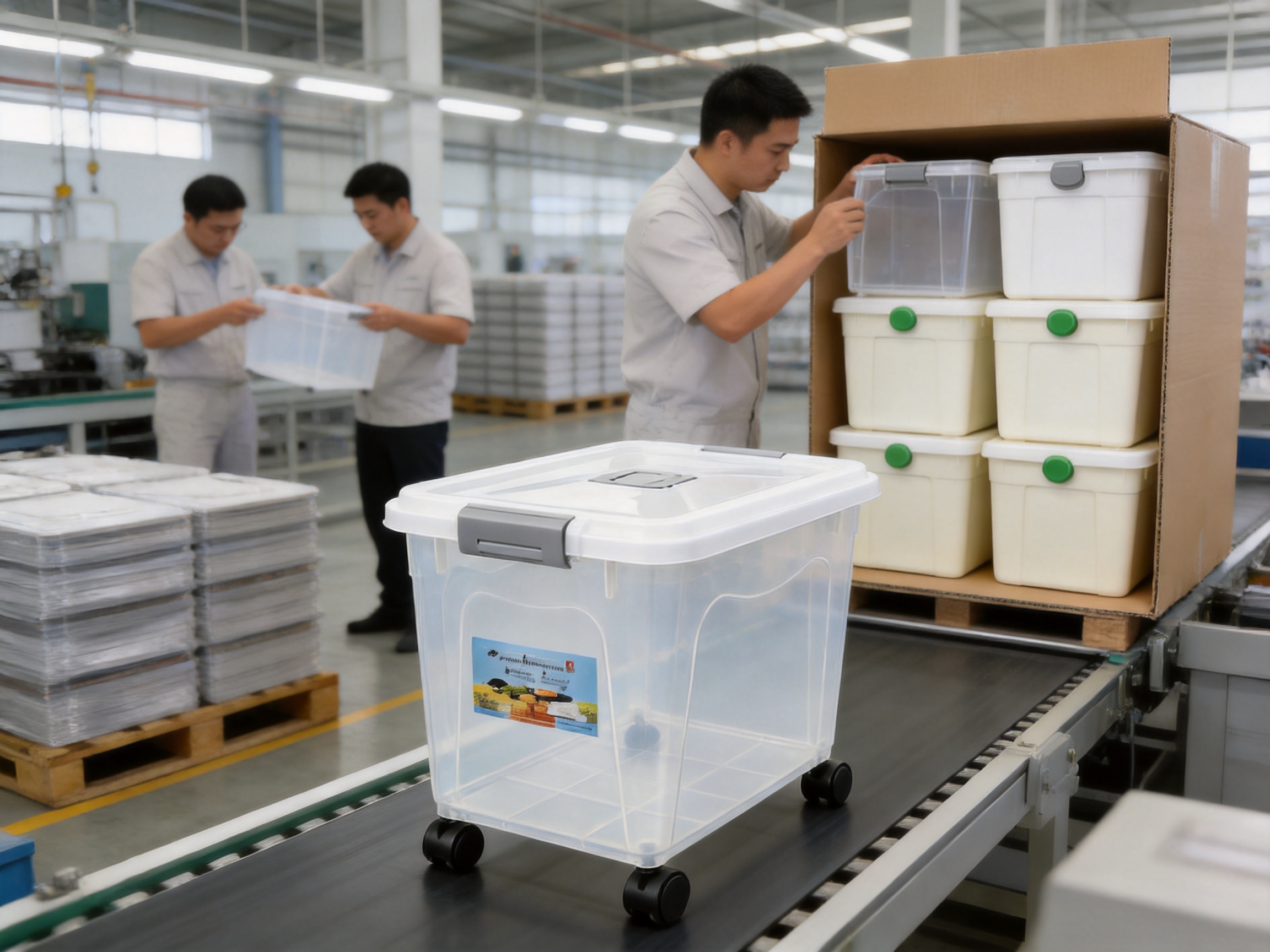
Reliable storage is not simply a matter of putting objects into a container. The right storage bin must protect its contents, use available space efficiently, remain stable under repeated handling, and continue performing when exposed to the demands of daily household, workshop, warehouse, or emergency-preparedness use. The 60-jin heavy-load daily storage item is designed around these practical requirements. With a rated capacity of up to 30 kilograms, a tall 46-centimeter profile, reinforced corners, a strengthened lid rim, and a durable polypropylene structure, it provides a dependable solution for users who need more than a lightweight organizer.
This heavy-duty storage bin is suitable for large tool cases, backpacks, emergency water containers, seasonal household goods, cleaning supplies, hardware, outdoor equipment, and many other items that are difficult to accommodate in shallow or fragile boxes. Its frosted finish gives the product a practical appearance while helping reduce the visual impact of minor scuffs associated with normal use. Mixed buckle colors add variation to the assortment, while the structural design focuses on load-bearing performance, stackability, and everyday convenience.
Produced by Jinhua Jieqing Plastic Co., Ltd., the product reflects the company’s experience in plastic household goods, cleaning supplies, supporting plastic products, and customized manufacturing. The company combines product development, production, quality control, sales, export experience, and customization services in one operating system. This integrated capability is valuable for distributors, supermarkets, cross-border e-commerce sellers, facility buyers, and industrial procurement teams that require consistent products and dependable supply.
The following article examines the bin’s design, materials, applications, manufacturing strengths, packaging information, purchasing advantages, and suitability for different markets.
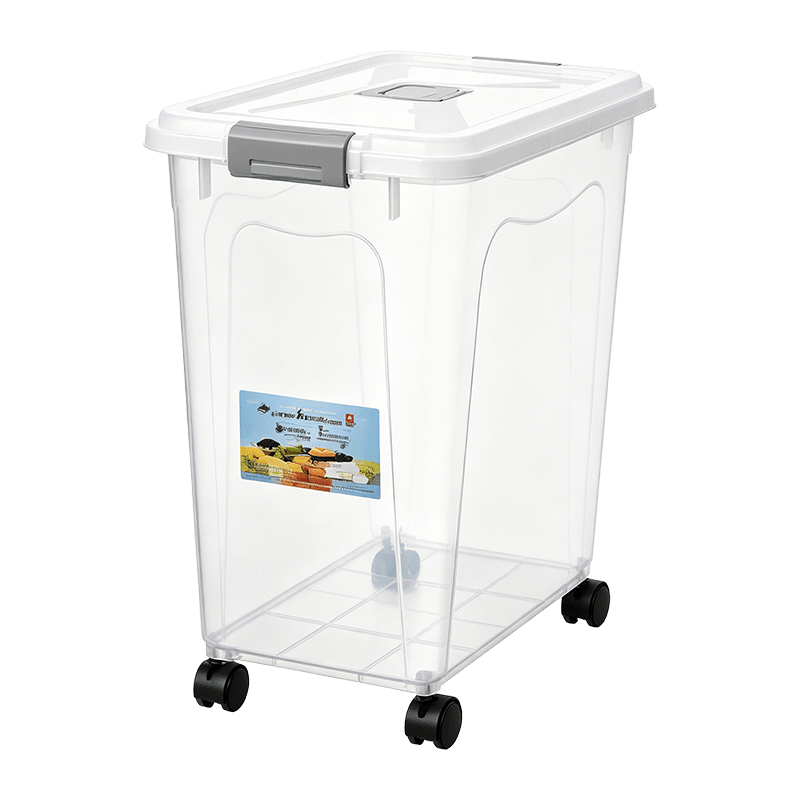
60 Jin Heavy Load Daily Storage Items
1. Product Overview
The 60-jin heavy-load daily storage item is a large-capacity plastic storage bin made from PP, or polypropylene. Its product dimensions are 44 by 29.5 by 46 centimeters, creating a tall and useful internal volume for items that need vertical clearance. The product weight is approximately 1,585 grams per unit, which is relatively light compared with its stated load-bearing capability. This balance allows users to move the bin without excessive effort while still receiving the strength expected from a heavy-duty container.
The term “60 jin” is associated with a load level of approximately 30 kilograms. In practical terms, the bin is intended for substantial household or commercial storage rather than only small accessories. It can accommodate dense or bulky items that might deform thin plastic organizers, including tools, cleaning equipment, packaged supplies, emergency goods, sports gear, and household maintenance materials.
Each carton contains six units. The carton dimensions are 46 by 30.5 by 68.5 centimeters, with a cubic measurement of 0.096 cubic meters and a gross weight of 11.8 kilograms. These specifications are important for wholesalers, importers, warehouse managers, and online sellers because they help determine shipping arrangements, pallet planning, storage requirements, and landed-cost calculations.
| Product Attribute | Specification |
|---|---|
| Product name | 60-jin heavy-load daily storage item |
| Item number | A-9159, 60 jin |
| Material | PP, polypropylene |
| Product size | 44 × 29.5 × 46 centimeters |
| Approximate unit weight | 1,585 grams |
| Approximate load capacity | Up to 30 kilograms |
| Packing quantity | 6 units per carton |
| Carton dimensions | 46 × 30.5 × 68.5 centimeters |
| Cubic measurement | 0.096 cubic meters |
| Gross carton weight | 11.8 kilograms |
| Finish | Frosted surface |
| Assortment | White cap with gray button; cream white with green button |
The design is especially useful for vertical storage. A 46-centimeter height gives the bin more capacity for tall objects than many low-profile boxes. Users can place the bin beneath workbenches, along basement walls, inside utility rooms, or in storage areas where floor space is limited but vertical capacity is available.
2. Why Heavy-Duty Storage Matters
Many ordinary household storage boxes are adequate for clothing, toys, stationery, or lightweight linens. However, they may not be suitable for dense objects. Tools, bottled water, cleaning chemicals, hardware, books, packaged food, and outdoor equipment can create significant localized pressure. When a container is not designed for such loads, its base may flex, its sidewalls may bulge, or its lid may become difficult to close.
A heavy-duty bin addresses these problems through a combination of material selection, shape, wall structure, corner reinforcement, and lid design. The 60-jin model is built for users who need a storage product that can handle more demanding contents while remaining manageable in daily use. Its structure is intended to resist common forms of deformation, especially when the bin is filled, transported, or stacked.
Load capacity also affects organization. If users can safely place heavier contents in one container, they may reduce the number of small boxes required for a storage project. This can simplify inventory management, decrease clutter, and make it easier to group related items together. For a workshop, one bin might hold hand tools and accessories. For a household, another might contain emergency supplies. For a cleaning contractor, the same style of container could organize replacement brushes, cloths, protective items, and packaged consumables.
The product’s tall profile supports efficient use of space, but users should still distribute weight evenly. A heavy object placed at the center of the base is generally preferable to concentrated weight at one corner. The bin should also be used on a stable, level surface, and the total load should remain within the stated capacity. These practices help preserve the product and improve handling safety.
3. Structural Advantages of the Product
Reinforced Corners
Corners are among the most vulnerable areas of a storage container. They receive impact during handling, bear stress when bins are stacked, and often experience pressure when the container is moved through narrow spaces. The reinforced corners of this model provide additional support in these high-stress areas.
Reinforcement helps the bin maintain its shape when it is full. It also contributes to improved resistance during transportation from the production facility to the distributor, retailer, or end user. Compared with a basic thin-wall organizer, a product with strengthened corner areas is better positioned to handle repeated movement and heavier contents.
Extra-Thick Lid Rim
The lid rim is another important structural element. A weak rim may bow when a second container is placed on top, making the stack unstable or preventing the lid from closing correctly. This model uses an extra-thick lid rim to reduce bowing and support more stable stacking.
Stable stacking is valuable in crowded homes, storage rooms, workshops, warehouses, and retail backrooms. It allows users to build organized vertical arrangements instead of spreading containers across the floor. Better stacking also supports quicker visual identification of stored goods, particularly when different categories are assigned to separate bins.
Mixed Buckle Design
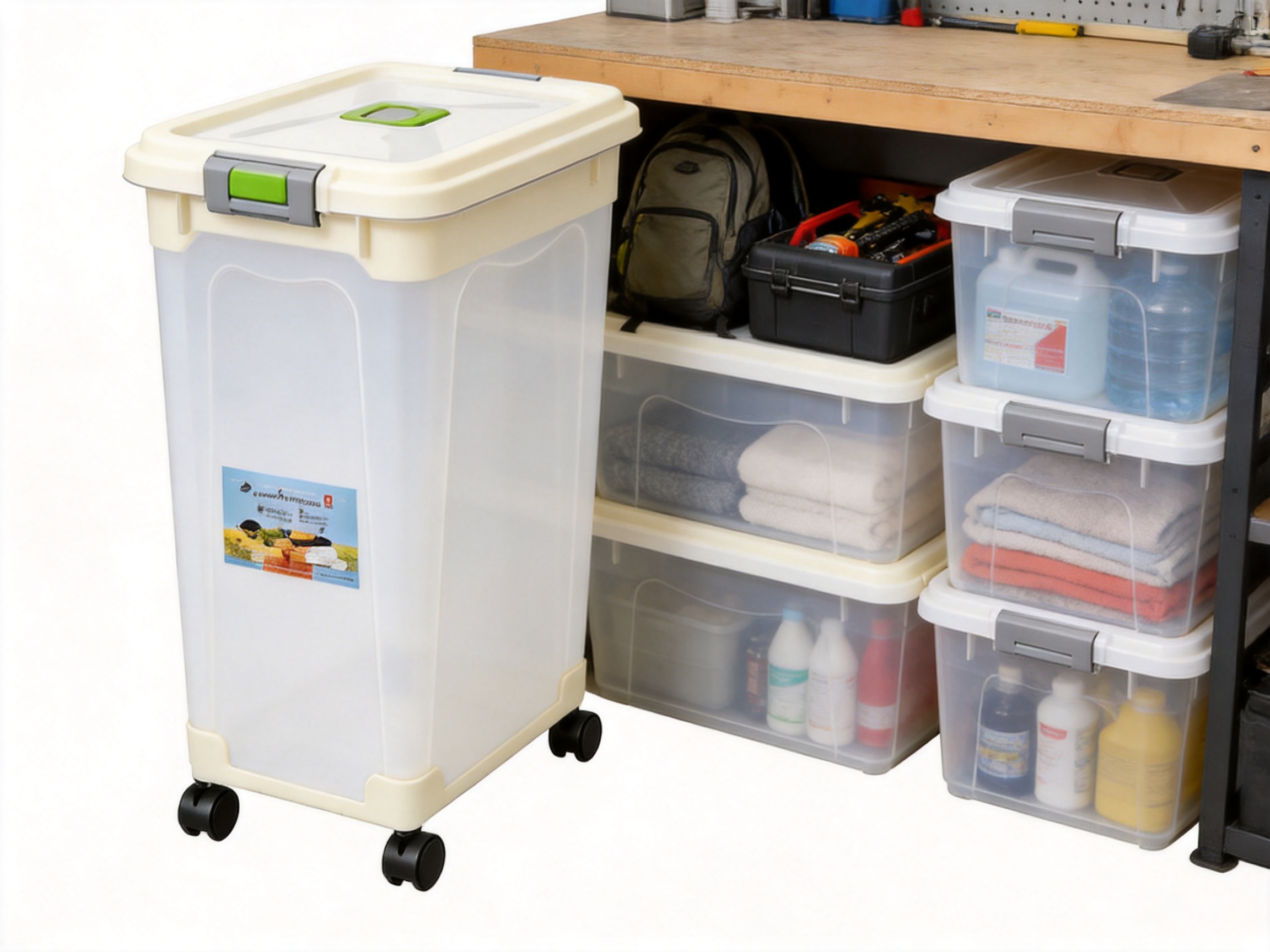
The bin is supplied with mixed buckle combinations, including a white cap with a gray button and a cream-white version with a green button. The buckle system helps keep the lid secured during normal handling and provides a visible closure point. Color variation can also help distributors create an assortment that appears more distinctive on retail shelves.
For household users, a colored button may make it easier to identify a specific box within a group. For commercial customers, different colors can potentially support internal organization, such as assigning one color to maintenance equipment and another to emergency goods, subject to the buyer’s assortment and labeling system.
Frosted Surface
The frosted finish gives the bin a subdued, practical appearance. Unlike highly glossy surfaces, a frosted texture can make ordinary handling marks less visually prominent. This is useful in workshops, garages, basements, utility rooms, and other environments where containers may be handled frequently.
The appearance is also suitable for modern household organization. The neutral white and cream-white options can blend into many interior settings, while the gray and green buckle details provide a modest visual distinction without overwhelming the surrounding space.
4. Polypropylene Material and Performance
Polypropylene is widely used in household and industrial plastic products because it offers a useful combination of low weight, toughness, chemical resistance, and processing flexibility. For storage applications, these characteristics are valuable because the container must withstand handling while remaining light enough to move.
The use of PP supports the product’s relatively low unit weight of 1,585 grams. A heavy steel or thick rigid-material container could provide strength, but it would be more difficult to carry and might increase transportation costs. The polypropylene construction offers a practical compromise between durability and portability.
Polypropylene is also suitable for molded shapes with integrated structural details. Reinforced corners, lid rims, buckle areas, and other functional features can be formed as part of the product design. This reduces the need for numerous separate components and supports a clean, easy-to-use container structure.
As with all plastic storage products, the intended use should be considered carefully. The bin is designed for storage and organization, not as a certified container for hazardous chemicals, pressurized materials, hot liquids, or food contact unless separately approved for those applications. Users should follow applicable handling requirements for the items being stored.
For ordinary household, workshop, facility, and emergency-preparedness uses, PP provides a durable and economical material platform. It is also familiar to international buyers and compatible with established plastic manufacturing processes, making it practical for volume production and repeat orders.
5. Applications in the Home
Basement and Utility Room Storage
Basements and utility rooms often contain a mixture of seasonal items, maintenance tools, cleaning products, spare parts, and emergency supplies. Without a structured system, these items can quickly become difficult to locate. The tall profile of the 60-jin bin allows users to group related products and store them in an orderly arrangement.
One bin may hold extension cords, hand tools, and repair accessories. Another may be used for spare light bulbs, batteries, tape, fasteners, and household hardware. A separate container can store seasonal decorations or protective equipment. The secure lid helps keep stored goods covered during normal storage, while the reinforced structure supports repeated access.
Emergency Preparedness
Emergency preparedness requires storage for items such as bottled water, packaged food, flashlights, blankets, first-aid materials, sanitation products, and backup batteries. These supplies can be heavy, especially when grouped together. A high-capacity bin helps keep them consolidated and protected from ordinary dust and clutter.
The product description specifically identifies emergency water jugs as one possible use. Because water is dense, the load-bearing capacity of the bin is an important consideration. Users should distribute weight responsibly and verify the weight of the contents before filling the container. The bin can then serve as part of a broader preparedness system in a basement, garage, storeroom, or shelter area.
Backpacks and Travel Equipment
Multiple backpacks can be awkward to store because their straps, frames, and pockets occupy irregular space. The 46-centimeter height provides room for several bags or travel accessories, helping users keep them together between trips. Outdoor clothing, camping accessories, and travel organizers can be placed in the same container when a dedicated storage category is desired.
Children’s and Family Storage
Family homes often need larger containers for sports equipment, building materials, seasonal toys, and school-related supplies. A heavy-duty bin can help organize these items when smaller boxes are insufficient. Because the container is designed for substantial loads, adults can use it for dense items, although children should not move heavily filled bins without supervision.
6. Workshop, Garage, and Industrial Uses
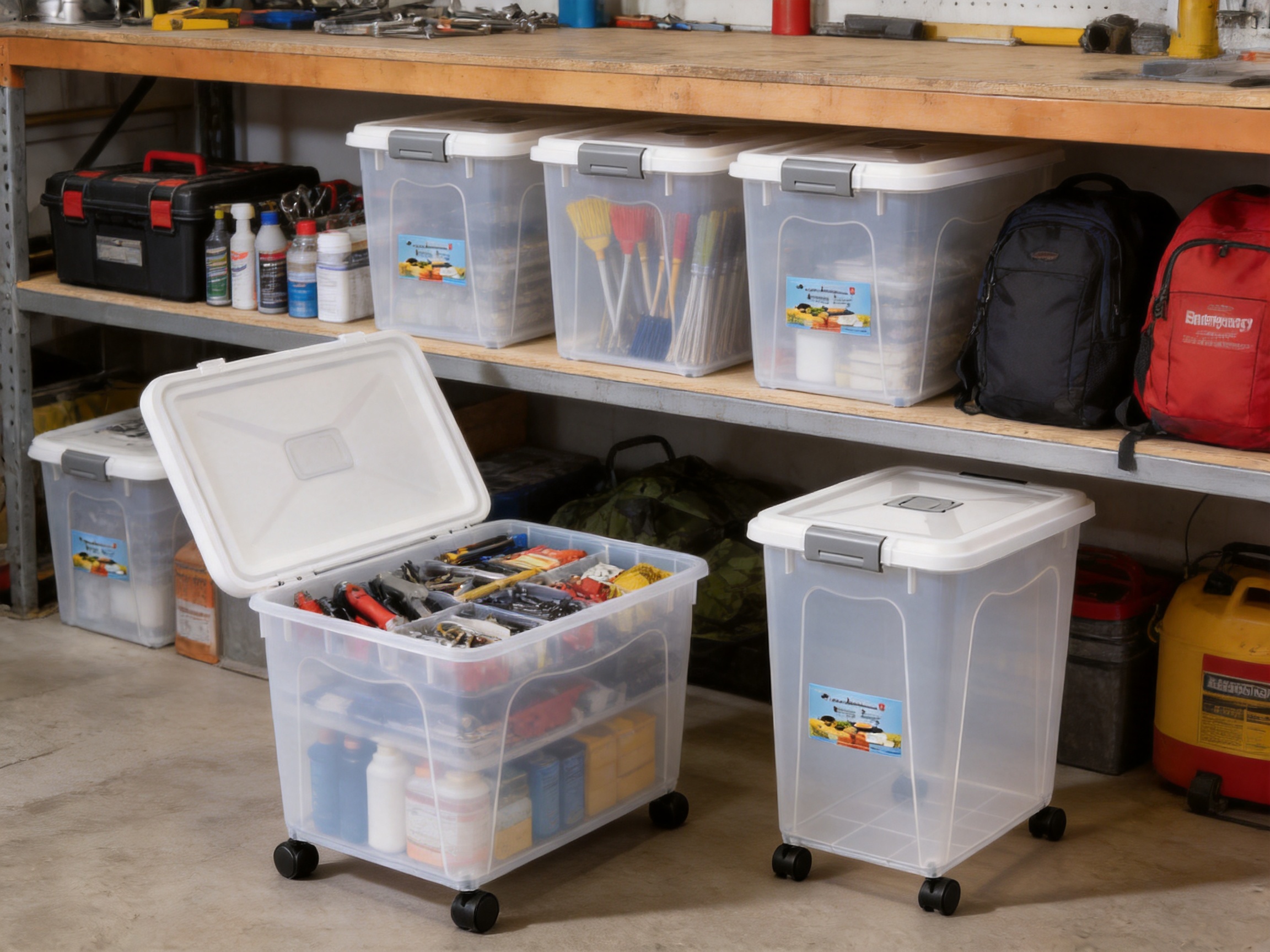
The bin is particularly suitable for workshops and garages, where storage requirements are more demanding than in many living areas. A workshop may need containers for power-tool accessories, measuring equipment, replacement components, protective gear, cleaning materials, and maintenance supplies. These items vary in shape and weight, so a sturdy, high-capacity box can simplify organization.
The reinforced corners and thick lid rim are valuable in environments where bins may be moved frequently or stacked between projects. A workshop manager can assign individual containers to different jobs, machines, or departments. The product can also support inventory rotation by allowing older supplies to be kept visibly separate from newly received stock.
For industrial facilities, the bin may be appropriate for general non-hazardous storage, maintenance organization, housekeeping supplies, and internal material handling. Its use should be matched to the operating environment. Facilities with special fire, chemical, hygiene, or safety requirements should confirm that the product satisfies their internal standards before adoption.
Cleaning contractors and facility-service teams can also use the bin to organize brushes, replacement mop heads, cloths, protective accessories, spare packaging, and other non-liquid supplies. Although the manufacturer specializes in cleaning supplies and brushes, this storage product broadens the company’s offering by providing a supporting plastic solution for organizing cleaning operations.
7. Advantages Compared with Ordinary Storage Boxes
The product’s main advantage over ordinary light-duty boxes is its focus on load-bearing performance. Many low-cost organizers are designed for small, lightweight objects and may not perform well when filled with tools, water, books, or dense hardware. The 60-jin model is positioned for heavier contents and more demanding storage conditions.
Its height is another advantage. Shallow containers may waste vertical space or require users to lay tall objects on their sides. With a 46-centimeter height, the bin can store larger tool cases, backpacks, and upright supplies more efficiently. This can reduce the need for multiple smaller boxes and make stored items easier to group.
The structural combination of reinforced corners and an extra-thick lid rim provides an advantage over containers that rely only on thin, flexible walls. These features are especially relevant when the bin is stacked or transported. A stronger rim can help maintain lid alignment, while reinforced corners can reduce the likelihood of deformation at high-stress points.
The product also balances strength with portability. At approximately 1,585 grams before contents are added, it is lighter than many rigid heavy-duty alternatives. This makes it more practical for household users, warehouse staff, maintenance teams, and retail customers who need to move containers as part of normal operations.
The six-unit carton quantity provides an advantage for commercial buyers seeking a manageable purchasing unit. Retailers can test demand without committing to an excessively large case pack, while distributors can combine multiple cartons for larger programs. The carton dimensions and gross weight are clearly defined, supporting more accurate logistics planning.
| Comparison Area | 60-Jin Heavy-Load Bin | Typical Light-Duty Organizer |
|---|---|---|
| Intended contents | Tools, equipment, emergency supplies, dense household goods | Clothing, small accessories, lightweight items |
| Load orientation | Designed for substantial loads up to approximately 30 kilograms | Usually better suited to lighter contents |
| Height | 46 centimeters for tall and bulky items | Often shallower and less suitable for upright objects |
| Structural focus | Reinforced corners and extra-thick lid rim | Basic walls and standard lid construction |
| Stacking support | Designed to reduce lid-rim bowing when stacked | Stacking ability may be limited by lid flexibility |
| Portability | Approximately 1,585 grams per empty unit | Often lighter, but may sacrifice load capacity |
| Commercial packaging | Six units per carton with defined carton specifications | Packaging varies widely by supplier |
This comparison is a positioning guide rather than a universal performance test. Actual results depend on the competing product’s material, dimensions, wall thickness, closure design, and stated load rating. Nevertheless, the 60-jin model clearly targets a more robust segment than basic household organizers.
8. Manufacturing Capability and Company Strengths
Jinhua Jieqing Plastic Co., Ltd. was founded in 2008 and operates as an industry and trade enterprise specializing in cleaning supplies and related plastic products. Its product range includes brooms, cleaning brushes, household brushes, industrial brushes, and supporting plastic items. This combination of manufacturing and commercial capability allows the company to understand both product performance and market requirements.
The company’s own production base is an important strength. Direct control over production can support better coordination among product development, molding, assembly, packaging, and quality inspection. It also gives the company a stronger foundation for managing repeat orders, adjusting production schedules, and maintaining consistency across different batches.
The company describes its manufacturing system as including standardized production processes and stable quality control. For a plastic storage item, standardized production is important because dimensions, closure alignment, surface finish, buckle installation, and structural details must remain consistent. Buyers who sell through retail or online channels need predictable product quality to reduce customer complaints and simplify replenishment.
Product research and development is another stated capability. The company can develop products according to market needs and offers customization based on customer drawings and samples. For commercial buyers, this may support adjustments to color combinations, packaging presentation, labeling, dimensions, or related product features, subject to technical review and order requirements.
Customization is particularly valuable for supermarkets, private-label programs, cross-border e-commerce sellers, industrial procurement teams, and distributors serving specific regional markets. A buyer may require a particular assortment, carton marking, product insert, or retail presentation. Working with a supplier that has both product development and production resources can reduce communication gaps between design and manufacturing.
The company also reports a complete supply chain and extensive export experience. These strengths are relevant to overseas buyers because international supply requires more than manufacturing alone. It involves packaging coordination, documentation, production scheduling, communication, quality follow-up, and shipment preparation. An integrated supplier can provide a more efficient one-stop purchasing process.
9. Production Process Considerations
Material Preparation
The production process begins with polypropylene material preparation. Material selection and preparation influence the final product’s appearance, weight, toughness, and molding performance. Consistent material handling supports more uniform results from one production run to the next.
Molded Forming
The bin’s body, lid, reinforced corners, and structural edges are formed through plastic molding processes. A well-designed mold helps define the product’s dimensions and functional details. It also supports repeatability, which is essential when a product is supplied to commercial customers in multiple batches.
During molding, appropriate process control helps limit common problems such as uneven walls, incomplete forming, excessive flash, surface defects, or dimensional variation. The exact machinery and parameters may vary according to the production arrangement, but the goal remains consistent: produce a stable bin that meets the intended design specification.
Surface and Component Treatment
After molding, the product may undergo finishing and component handling steps associated with its frosted appearance, lid assembly, and buckle configuration. The white cap with gray button and cream-white body with green button combinations require orderly component matching so that the finished assortment is consistent with the intended packing arrangement.
Inspection and Quality Control
Quality control for a heavy-duty storage bin can include visual inspection, dimensional checks, weight verification, closure checks, surface evaluation, and functional handling tests. Particular attention should be given to the corners, lid rim, buckles, base, and any areas that experience stress during loading or stacking.
Stable quality control helps ensure that the product delivered to a buyer matches the approved sample and listed specification. It also supports more reliable inventory planning. When dimensions and carton quantities remain consistent, distributors can prepare storage locations, shipping cartons, product listings, and warehouse systems with greater confidence.
Packing and Shipment Preparation
Each carton contains six storage bins, and the carton dimensions are specified as 46 by 30.5 by 68.5 centimeters. Packaging must protect the products from abrasion, impact, contamination, and deformation during domestic or international transportation. Proper packing also helps maintain efficient cubic utilization and simplifies warehouse receiving.
10. Commercial Value for Different Buyers
Supermarkets and Retailers
Supermarkets and household-goods retailers require products that are easy to explain, practical for a broad audience, and suitable for visible shelf presentation. The 60-jin designation, 30-kilogram load positioning, tall profile, and reinforced structure create clear selling points for customers seeking stronger storage options.
The mixed buckle colors provide assortment variation, while the neutral body colors are compatible with many retail environments. A six-unit carton can be useful for initial stock planning or regional store replenishment. Retail buyers can position the product in household organization, garage storage, utility storage, or seasonal preparedness sections.
Cross-Border E-Commerce Sellers
Online sellers need product descriptions that clearly communicate dimensions, material, capacity, packaging, and use cases. This model offers several measurable specifications that can be presented in product listings. Accurate information helps consumers determine whether the bin will fit beneath a workbench, inside a closet, or within a vehicle storage area.
Because the product is relatively light for its capacity, it may also provide a useful balance between perceived durability and shipping practicality. Sellers should calculate actual freight costs based on destination, packaging, dimensional weight rules, and order quantity before setting retail prices.
Industrial Procurement
Industrial buyers often need repeatable products for maintenance rooms, tool areas, warehouses, housekeeping departments, and internal logistics. The product’s standardized dimensions and six-unit packing quantity can support procurement planning. Buyers may also discuss custom labeling, color requirements, or related plastic products with the manufacturer.
Distributors and Wholesalers
Distributors can combine this storage bin with cleaning brushes, brooms, household cleaning products, and other plastic goods to create a broader product portfolio. Since the manufacturer already produces cleaning supplies and supporting plastic items, buyers may be able to consolidate sourcing across related categories.
11. Storage Organization Strategies
A heavy-duty container performs best when it is used as part of a clear organization system. Before filling the bin, users should identify a category, estimate the total weight, and determine whether frequently used items should be placed in a more accessible position. Heavy contents should be placed low and distributed evenly.
Labels can be applied to the lid or front-facing area, depending on the user’s organization method. A simple label such as “Hand Tools,” “Emergency Supplies,” “Outdoor Equipment,” or “Cleaning Stock” can reduce search time. For commercial users, labels may include department names, stock codes, project numbers, or replenishment dates.
Stacking should be performed on a stable surface. The heaviest containers should generally remain at the bottom, while lighter containers should be placed above them. Users should avoid creating unstable towers or placing stacked bins where they could obstruct exits, ventilation, machinery, or required access paths.
Although the reinforced lid rim helps reduce bowing when bins are stacked, stacking performance still depends on the total load, the condition of the surface, and the number of containers involved. Users should inspect the arrangement periodically and remove damaged or visibly deformed units from service.
12. Care and Maintenance
Routine care is straightforward. The exterior can generally be wiped with a soft cloth or cleaned using a mild household cleaning solution appropriate for polypropylene. Strong solvents, excessive heat, abrasive tools, and sharp objects should be avoided unless the user has confirmed their compatibility with the material.
Before storing contents, users should ensure that the bin is reasonably dry and free from substances that could stain or degrade the plastic. If the bin is used in a workshop, metal filings, grit, or sharp components should be handled carefully so they do not damage the interior or compromise closure areas.
The lid and buckle areas should be checked after repeated use. A buckle that does not close correctly may indicate impact, overloading, or misalignment. The bin should not be forced closed when contents extend above the intended storage height, because excessive pressure may place unnecessary strain on the lid and sidewalls.
For long-term storage, the bin should be kept away from uncontrolled heat sources and conditions that exceed the material’s intended operating environment. Outdoor use may be possible for general storage, but exposure to sunlight, weather, moisture, and temperature extremes can affect the service life of plastic products over time. Buyers with permanent outdoor applications should confirm suitability with the supplier.
13. Sustainability and Responsible Product Use
Durable storage products can contribute to more organized consumption by allowing users to preserve, group, and reuse household or commercial goods. A container that remains functional over repeated handling may reduce the need for frequent replacement. Long service life is therefore an important aspect of responsible product use.
Polypropylene is also a widely recognized recyclable plastic in many recycling systems, although local acceptance varies. At the end of its useful life, users should check local recycling guidance and separate the product according to regional requirements. Buckles, labels, or other attached materials may need to be handled according to local rules.
Responsible use begins with selecting the correct size and capacity. Overloading, exposure to unsuitable chemicals, and improper stacking can shorten the product’s life. Using the bin within its intended purpose helps preserve its performance and reduces avoidable waste.
For commercial buyers, efficient carton packing can also support better logistics planning. The listed cubic measurement of 0.096 cubic meters per carton gives procurement teams a basis for calculating warehouse volume and shipment utilization. More accurate planning can help reduce unnecessary handling and improve supply-chain efficiency.
14. Purchasing and Specification Checklist
Before ordering, buyers should confirm the required quantity, destination, packaging expectations, and assortment. The standard packing quantity is six units per carton. Buyers should also confirm whether the mixed color arrangement meets their retail or organizational requirements.
Dimensions should be reviewed against the intended storage location. The product measures 44 centimeters in length, 29.5 centimeters in width, and 46 centimeters in height. Buyers should account for clearance around the bin, especially if it will be placed beneath shelves, inside cabinets, or near doors.
Load requirements should be evaluated realistically. The product is positioned for loads of up to approximately 30 kilograms, but the actual contents should be weighed where practical. Dense items may create concentrated stress, so balanced distribution is recommended.
Commercial buyers should request or confirm the latest production sample, carton markings, inspection requirements, lead time, and shipping arrangements. If custom colors, drawings, samples, labels, or packaging are needed, these details should be agreed upon before mass production.
| Buyer Checkpoint | Recommended Review |
|---|---|
| Application | Confirm whether the bin is intended for household, workshop, facility, warehouse, or emergency storage. |
| Dimensions | Verify that 44 × 29.5 × 46 centimeters fits the planned location. |
| Load | Estimate contents and keep total weight within the stated approximately 30-kilogram capacity. |
| Material | Confirm that polypropylene is appropriate for the intended contents and environment. |
| Assortment | Review the white, gray, cream-white, and green buckle combinations. |
| Packaging | Plan for six units per carton, 0.096 cubic meters, and 11.8 kilograms gross weight. |
| Customization | Discuss drawings, samples, colors, labels, or packaging requirements in advance. |
| Quality control | Agree on sample approval, inspection points, and shipment verification. |
15. Frequently Asked Questions
Q1: What does the 60-jin designation mean?
The 60-jin designation identifies the product’s heavy-load positioning and corresponds to an approximate capacity of 30 kilograms. Users should treat this as the stated load level and distribute contents evenly rather than concentrating all weight in one small area.
Q2: What material is the bin made from?
The bin is made from PP, or polypropylene. This material offers a practical combination of relatively low weight, toughness, and suitability for molded household and industrial plastic products.
Q3: What are the product dimensions?
The product measures 44 by 29.5 by 46 centimeters. Its 46-centimeter height makes it suitable for taller items such as tool cases, backpacks, and emergency water containers.
Q4: How much does one empty bin weigh?
One unit weighs approximately 1,585 grams. This relatively manageable empty weight helps users move the bin while retaining a structure intended for substantial loads.
Q5: How many units are packed in one carton?
Each carton contains six units. The carton measures 46 by 30.5 by 68.5 centimeters, has a cubic measurement of 0.096 cubic meters, and has a gross weight of approximately 11.8 kilograms.
Q6: Can the bin be stacked?
The product is designed with an extra-thick lid rim to help reduce bowing when stacked. For best results, users should place the bins on a level surface, distribute weight evenly, keep heavier bins lower, and avoid unstable or excessively tall stacks.
Q7: What kinds of items can be stored in it?
Suitable examples include tool cases, backpacks, emergency water jugs, household maintenance goods, outdoor equipment, cleaning supplies, hardware, and other general non-hazardous items. Contents should be compatible with polypropylene and should remain within the stated load capacity.
Q8: Is the bin suitable for outdoor use?
It can be considered for general outdoor or garage storage, but long-term exposure to direct sunlight, rain, temperature extremes, or harsh environmental conditions may affect plastic products. Buyers with permanent outdoor applications should confirm environmental suitability with the supplier.
Q9: Does the product come in different colors?
The listed assortment includes a white cap with a gray button and a cream-white version with a green button. Buyers should confirm the exact assortment and available customization options before placing a commercial order.
Q10: Can the manufacturer provide customization?
The company offers customization based on customer drawings and samples. Potential options may be discussed according to the project, such as colors, packaging, labels, or related design requirements. Technical feasibility, minimum quantities, and production conditions should be confirmed in advance.
Q11: Is this a food-storage container?
The product is presented as a general heavy-duty storage bin, not specifically as a certified food-contact container. Buyers should not use it for food, drinking water, or other regulated applications unless the appropriate material and compliance information has been separately confirmed.
Q12: Who is the product suitable for?
It is suitable for households, workshops, garages, basements, facility-service teams, supermarkets, distributors, cross-border e-commerce sellers, and industrial procurement departments seeking a strong, tall, and versatile storage solution.
16. Overall Product Assessment
The 60-jin heavy-load daily storage item is a practical solution for users who need more strength and capacity than a standard organizer can provide. Its most important advantages are the approximately 30-kilogram load positioning, 44 by 29.5 by 46-centimeter dimensions, tall storage profile, polypropylene construction, reinforced corners, and extra-thick lid rim.
The design is versatile enough for household organization while remaining relevant to workshops, garages, facility operations, commercial storage, and emergency preparedness. Its relatively low empty weight supports portability, and its six-unit carton configuration is convenient for wholesale distribution.
The manufacturer’s background strengthens the product’s commercial appeal. Since 2008, Jinhua Jieqing Plastic Co., Ltd. has developed and supplied cleaning supplies, brushes, and supporting plastic products. Its own production base, standardized processes, quality-control approach, export experience, supply-chain resources, and customization capability provide a foundation for stable B2B cooperation.
For buyers comparing storage products, the key distinction is the combination of capacity, structure, and practicality. This bin is not merely a container for small household objects. It is intended to organize heavier and bulkier goods while supporting stacking, repeated handling, and efficient use of available space. When used within its stated specifications, it can serve as a dependable part of a home, workshop, retail, or industrial storage system.
References
1. Product Specification Sheet, A-9159, 60-Jin Heavy-Load Daily Storage Item.
2. Manufacturer Product Information for Polypropylene Household Storage Products.
3. General Material Reference, Polypropylene Properties in Household and Industrial Plastic Applications.
4. General Packaging Reference, Carton Dimensions, Cubic Measurement, and Gross-Weight Planning for Wholesale Goods.
5. General Storage-Organization Guidance for Household, Workshop, Facility, and Emergency-Preparedness Applications.
6. Manufacturer Company Profile, Jinhua Jieqing Plastic Co., Ltd., founded in 2008.
Product: 60 Jin Heavy Load Daily Storage Items

 CONTACT US
- CONTACT DETAILS
- Address : No. 1388 Cuntong Road, Jinhua City
- Tel: +86-0579-81534043
- Email:wangjinhua1@zjjqsj.com
- PRODUCTS
- Kitchen Cleaning Supplies
- Household Cleaning Supplies
- Indoor & Outdoor Cleaning Supplies
- Baby Products & Cleaning Supplies
- Home Storage Containers
- QUICK LINK
- Company Profile
- Plant equipment
- Certifications
- FAQ
- NEWS CENTER
- Company News
- Industry News
- MOBILE TERMINAL

