

 English
  русский
  Español
  عربى
عربى 
Professional Power TPR Plunger 9515: A Reliable Solution for High-Pressure Clog Removal
Date:Sep 23, 2026

Effective drain maintenance is essential in every environment where hygiene, sanitation, and uninterrupted facility operation matter. Hospitals, schools, office buildings, commercial washrooms, public facilities, property-management sites, and janitorial service operations all depend on practical tools that can resolve blockages quickly. When a toilet or floor drain becomes obstructed, the right plunger can restore normal operation without requiring complex equipment, harsh chemicals, or extended maintenance downtime.
The Professional Power TPR Plunger 9515 is designed for demanding toilet-cleaning applications where dependable suction, repeated use, and safe contact with porcelain surfaces are important. With a 15-centimeter cup made from thermoplastic rubber, an interior rib structure that helps prevent collapse, and a packing quantity of 60 units per carton, this plunger provides a practical solution for professional cleaning teams and high-volume buyers.
Its design is especially suitable for hospitals, schools, office buildings, janitorial carts, contract cleaning services, supermarkets, facility-management companies, and other institutional users. Compared with basic household plungers, the Professional Power TPR Plunger 9515 is developed around the requirements of more frequent use, stronger vacuum action, consistent shape retention, and convenient bulk distribution.
Jinhua Jieqing Plastic Co., Ltd. combines product development, plastic manufacturing, quality control, supply-chain management, and export experience to support the production of cleaning tools such as plungers, brooms, brushes, household cleaning products, and industrial cleaning accessories. The company’s production capabilities and customization services also make it possible to adapt products for different purchasing programs, customer specifications, and market requirements.
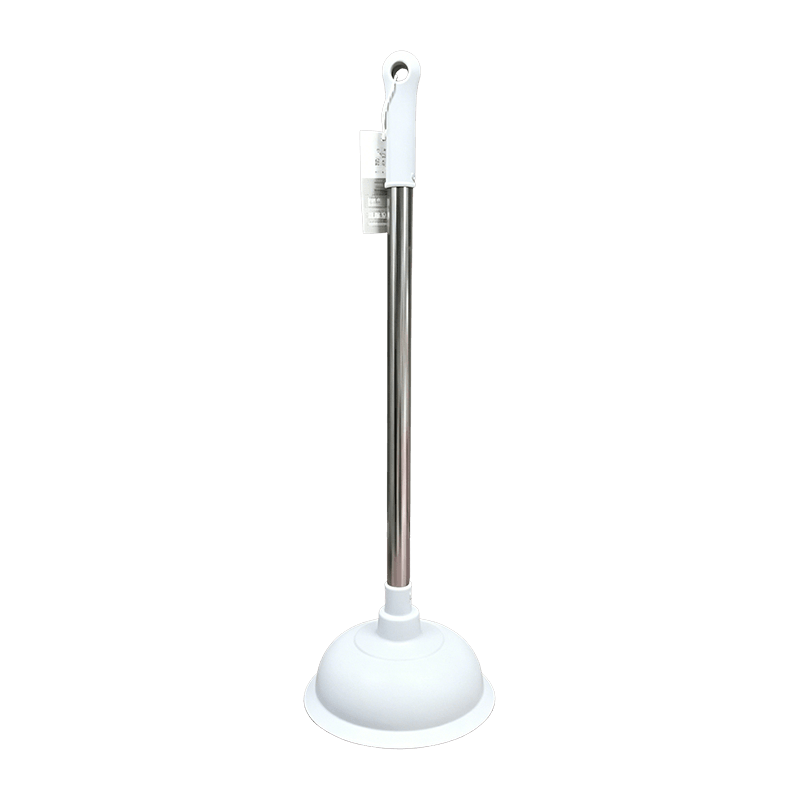
Professional Power TPR Plunger 9515 15cm (52x33x48cm)
Product Overview
The Professional Power TPR Plunger 9515 is a compact but powerful toilet-cleaning tool intended for resolving clogs through manual vacuum pressure. Its main working component is a flexible TPR cup. TPR, or thermoplastic rubber, combines characteristics associated with rubber-like flexibility and thermoplastic processing. This allows the cup to maintain elasticity while also supporting efficient production, stable dimensions, and consistent product quality.
The plunger has a 15-centimeter calibre, making it suitable for many standard toilet and drain openings. The cup is designed to form a seal against the surface around the blockage. By pushing and pulling the handle, the user creates alternating pressure and suction. This action can loosen and move obstructions, helping restore water flow without disassembling the plumbing system.
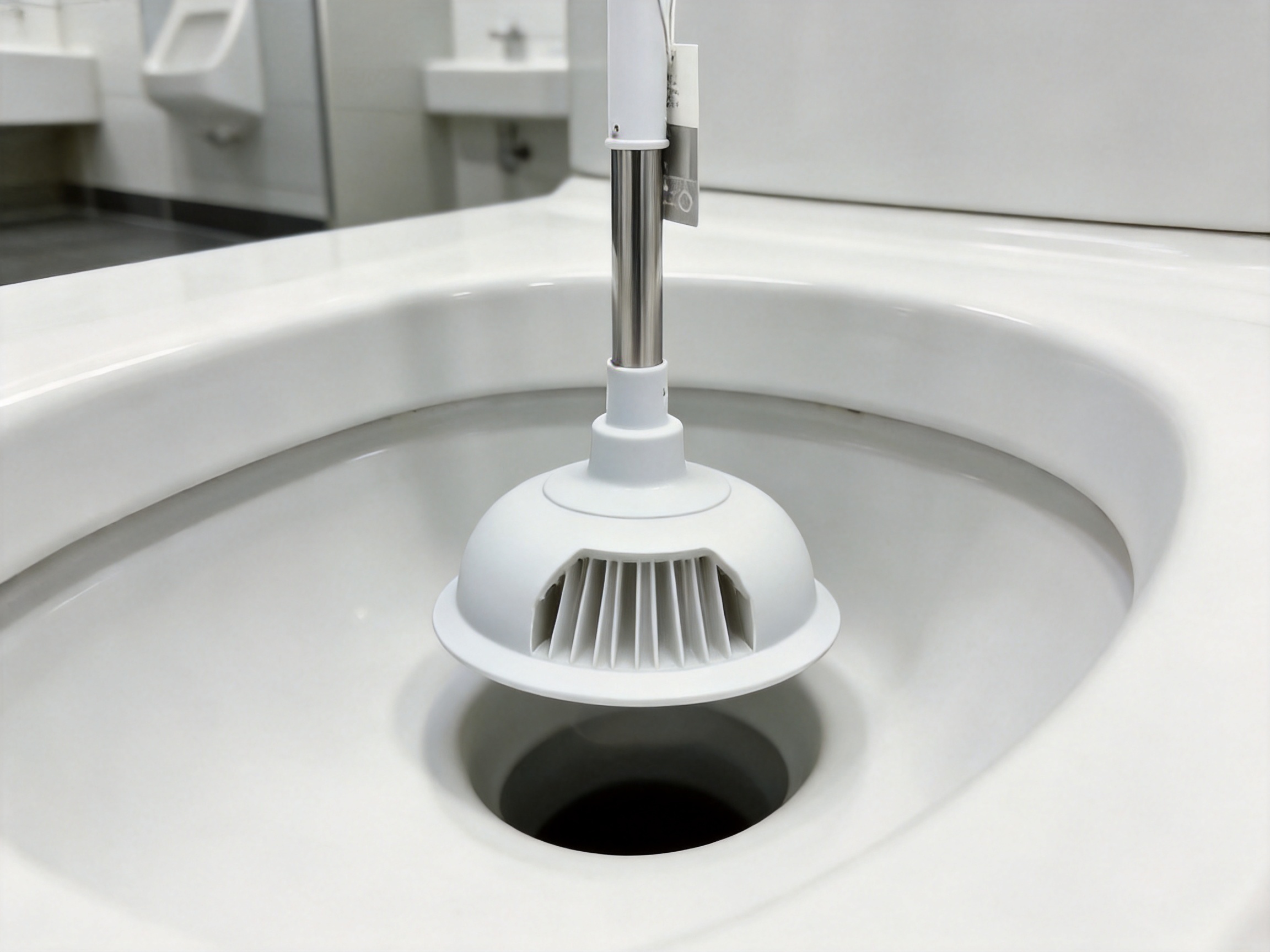
A defining feature of the model is the ribbed interior of the cup. These internal ribs help support the cup wall during use and reduce the risk of the cup collapsing under strong vacuum conditions. This is important because a collapsed cup can reduce effective suction, require additional effort, and make the cleaning process slower. By helping the cup retain its working shape, the rib structure contributes to more stable performance during repeated plunging.
The TPR material is also described as non-marking on white porcelain. This is a valuable advantage in modern sanitary environments, where visible marks or surface discoloration can create an unattractive appearance and increase cleaning requirements. A non-marking contact surface helps cleaning personnel work more confidently around white ceramic toilets and basins, provided that the tool is used correctly and kept free from abrasive debris.
| Specification | Product Information |
|---|---|
| Product name | Professional Power TPR Plunger 9515 |
| Item number | 9515 |
| Calibre | 15 cm |
| Material | TPR |
| Listed volume or carton dimension information | 52 × 33 × 48 cm |
| Quantity per carton | 60 units |
| Net weight | 12 kg |
| Primary application | Toilet and drain clog removal |
| Recommended users | Hospitals, schools, offices, janitorial teams, facility operators, and distributors |
The 60-unit carton configuration is practical for institutional procurement. Professional users frequently need several tools distributed across cleaning stations, restroom areas, service vehicles, or janitorial carts. A bulk carton supports centralized purchasing and can reduce the administrative burden associated with repeated small orders. It is also suitable for wholesalers, importers, supermarkets, hardware distributors, and cleaning-product retailers.
Why TPR Is Suitable for Plunger Manufacturing
Material selection has a direct influence on the performance, appearance, durability, and manufacturing consistency of a cleaning tool. The Professional Power TPR Plunger 9515 uses thermoplastic rubber because it offers a balanced combination of flexibility, resilience, processability, and surface compatibility.
A plunger cup must be flexible enough to conform to the contour around a drain opening. If the material is too rigid, it may fail to form an effective seal. If it is too soft or unstable, it may fold excessively during use and lose pressure. TPR can be formulated and processed to provide the elastic behavior needed for sealing while retaining sufficient structural stability for repeated pressure cycles.
Another advantage of TPR is its suitability for industrial molding processes. Thermoplastic materials can be heated, formed, cooled, and produced with repeatable dimensions. This supports efficient production at commercial volumes and allows manufacturers to maintain consistent shapes across large batches. For buyers, manufacturing consistency can be just as important as the performance of an individual sample because it reduces variation between units received in different shipments.
TPR also supports a smooth and practical surface finish. A well-formed cup is easier to rinse and maintain than a highly textured or irregular surface. In institutional cleaning environments, tools may be used repeatedly throughout a shift and then cleaned, disinfected, or stored on a janitorial cart. A material and surface design that support straightforward maintenance can contribute to better hygiene routines.
The non-marking property stated for this model is particularly useful for white porcelain. Toilets in hospitals, schools, offices, and commercial buildings are often expected to maintain a clean and presentable appearance. When a cleaning tool leaves dark transfer marks, facility staff may need to spend additional time removing them. A non-marking TPR cup helps reduce this concern and supports a more professional cleaning result.
Interior Ribs for More Stable Vacuum Performance
The internal rib structure is one of the most important functional features of the Professional Power TPR Plunger 9515. During plunging, the cup is exposed to alternating pushing and pulling forces. A plain flexible cup may deform when the pressure changes rapidly, particularly if the material is thin or the user applies considerable force.
Interior ribs act as reinforcing features within the cup. They help distribute mechanical stress and support the cup wall as it moves through the pressure cycle. The purpose is not simply to make the product look more substantial. The ribs are designed to help the cup resist collapsing under extreme vacuum conditions, allowing more of the user’s movement to contribute to pressure transfer at the blockage.
Stable cup geometry is important for three reasons. First, it helps maintain contact with the surface around the drain. Second, it helps preserve the pressure differential needed to loosen an obstruction. Third, it makes the tool’s behavior more predictable for the operator. Predictability is valuable in professional cleaning because staff members may need to act quickly and may use the same procedure across many facilities.
Compared with an unreinforced, low-cost plunger, a ribbed cup can provide a more controlled working response. A basic competitor product may bend inward too easily, lose its seal, or require repeated repositioning. These problems can increase the time needed to clear a blockage and may be frustrating for personnel responsible for maintaining several restrooms or public areas.
The ribbed structure does not eliminate the need for correct technique. The user should select an appropriate position, ensure that the cup is aligned with the opening, and apply steady rather than uncontrolled force. However, a product that supports shape retention gives the operator a stronger foundation for effective use.
Designed for Professional Cleaning Environments
The Professional Power TPR Plunger 9515 is intended for more than occasional household use. Its stated applications include hospitals, schools, office buildings, and janitorial carts. These environments share several requirements: rapid response, easy deployment, dependable operation, safe contact with sanitary surfaces, and efficient storage.
Hospitals and Healthcare Facilities
Healthcare facilities operate under strict hygiene expectations and cannot afford prolonged restroom closures. A blocked toilet can affect patients, visitors, healthcare workers, and support staff. Cleaning teams need tools that can be brought to the affected area quickly and used without complicated preparation.
The compact 15-centimeter format makes the plunger convenient for placement in cleaning closets, maintenance rooms, and janitorial carts. Its TPR cup is designed for non-marking contact with white porcelain, while its reinforced interior supports effective vacuum action. These characteristics help maintenance teams address routine blockages promptly and return the restroom to service as soon as practical.
Hospitals should establish their own procedures for cleaning, disinfecting, storing, and replacing plungers. The product itself is a mechanical clearing tool and should be integrated into the facility’s broader infection-control program. It should not be shared between areas without appropriate sanitation procedures, particularly when different risk zones are involved.
Schools and Educational Buildings
Schools experience high restroom traffic and may have many fixtures distributed across classrooms, sports facilities, administrative areas, and public spaces. A maintenance team may need to respond to a blockage while minimizing disruption to students and staff.
Bulk packaging of 60 units per carton is useful for school districts, education authorities, and facility-service contractors responsible for multiple buildings. Products can be allocated to different sites or stored as replacement stock. The plunger’s straightforward operating method also means that trained custodial personnel can use it without specialized technical instruction.
Office Buildings and Commercial Properties
Office managers and property operators have a responsibility to maintain clean, functioning washrooms for employees, tenants, visitors, and customers. A small plumbing problem can quickly become a service complaint if it is not addressed.
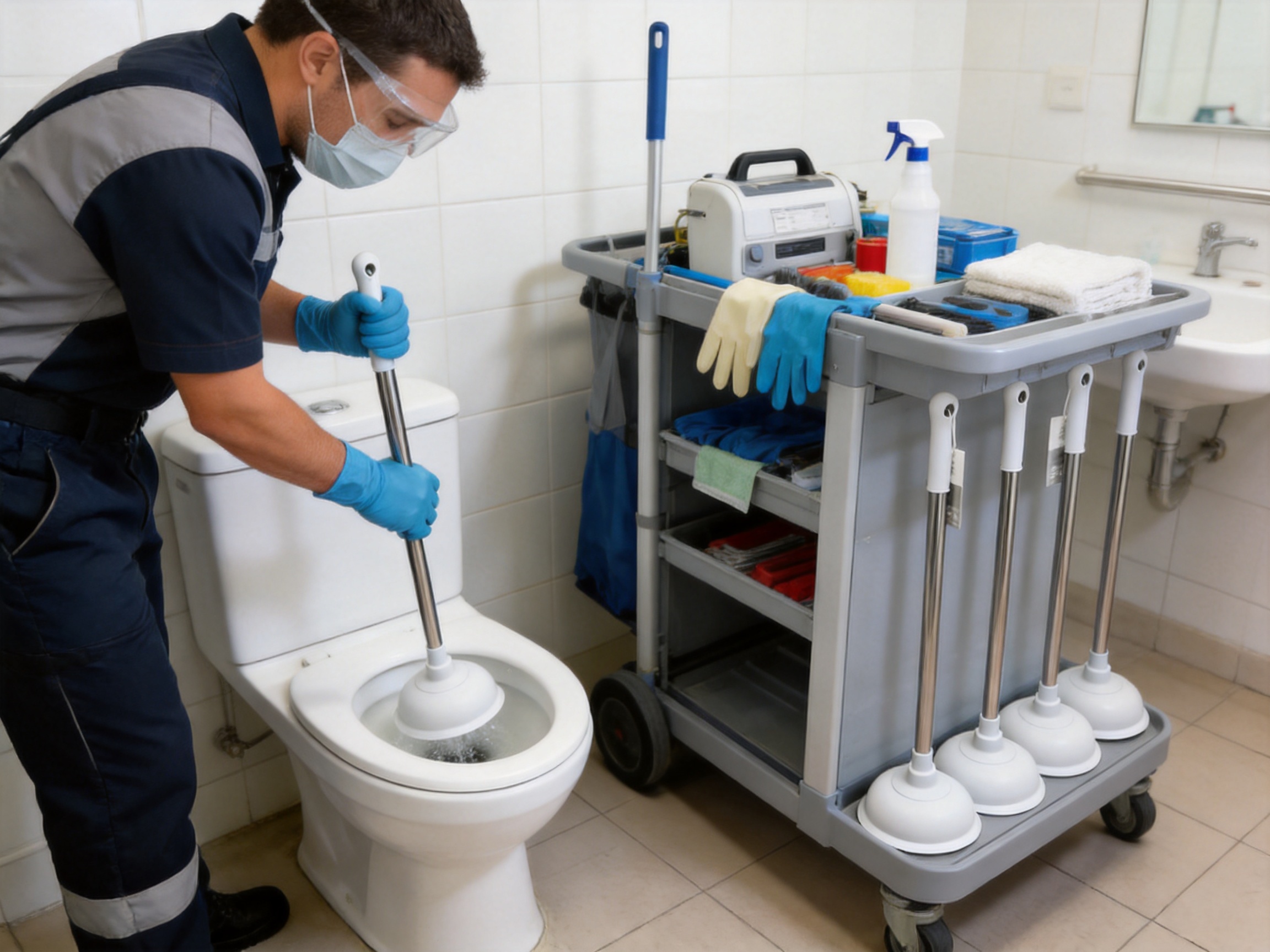
The Professional Power TPR Plunger 9515 can be kept in a janitorial closet or mobile cleaning cart for immediate access. Its professional design helps distinguish it from a fragile household tool and makes it suitable for regular maintenance programs. For property-management groups, standardized purchasing can simplify training, storage, and replacement procedures across multiple buildings.
Janitorial and Contract Cleaning Services
Contract cleaning companies need equipment that can travel between sites and withstand repeated handling. A plunger is a simple tool, but it must still be practical to store, carry, clean, and replace.
The 60-unit carton supports service providers that equip numerous teams or maintain a central inventory. The product can be assigned to restroom-cleaning kits or placed on janitorial carts according to each customer’s requirements. Since the plunger uses a familiar manual operating principle, it can be incorporated into standard operating procedures with minimal training.
Advantages Over Basic Competing Plungers
Product comparisons should consider design, materials, operating stability, surface compatibility, packaging, and supply support rather than focusing only on initial price. The Professional Power TPR Plunger 9515 offers several features that can distinguish it from ordinary plungers found in general retail channels.
Reinforced Internal Design
Many low-cost plungers use a simple cup with limited internal support. Although such products may work for light, occasional tasks, they can become less effective when exposed to stronger vacuum forces. The interior ribs of the 9515 are intended to reduce cup collapse and support a more stable pressure cycle.
Professional TPR Material
Material quality influences sealing performance and service life. TPR provides flexible contact with the sanitary surface while supporting a controlled manufacturing process. The stated non-marking performance on white porcelain is an additional benefit for facilities where visual cleanliness matters.
Rapid Clog-Resolution Potential
A plunger that maintains its shape and seal can help operators clear blockages with fewer interruptions. Faster response is particularly important in institutional buildings, where a closed restroom can affect many people. The 9515 is designed for situations in which rapid clog resolution is a priority.
Bulk-Oriented Packaging
With 60 units per carton, the product is suitable for professional distribution and institutional procurement. This is more practical for wholesalers, maintenance contractors, and facility groups than packaging intended only for individual consumers.
Suitable for Janitorial Carts
The product’s application profile includes janitorial carts, allowing it to remain close to the cleaning area. Ready access can reduce response time and help staff avoid searching for a tool in a distant storage room.
Consistent Industrial Production
Products made through standardized industrial processes generally offer more consistent dimensions and material behavior than irregularly produced tools. For buyers managing large quantities, consistency can help simplify quality checks, distribution, and replacement planning.
These advantages should be understood in the context of proper use. No manual plunger can resolve every type of obstruction. Objects lodged deep in a pipe, structural plumbing defects, severe mineral buildup, or problems in the main sewer line may require professional plumbing equipment. The strength of the 9515 is its role as an immediately available first-response tool for common toilet and drain blockages.
Manufacturing Strengths and Production Capabilities
Jinhua Jieqing Plastic Co., Ltd. was founded in 2008 and operates as an industry and trade enterprise specializing in the research, development, production, and sales of cleaning supplies. Its product range includes brooms, cleaning brushes, household and industrial brushes, plungers, and supporting plastic products.
The combination of manufacturing and trading capabilities is valuable for international buyers. A factory-oriented supplier can understand production details, material selection, tooling, packaging, and quality control. A trade-oriented organization can also support communication, order coordination, export documentation, product presentation, and market-specific purchasing requirements.
The company has its own production base and a complete supply chain. This structure can support better coordination between product development and manufacturing. When a customer requests a modification, the supplier is better positioned to evaluate material options, tooling considerations, packaging changes, and production feasibility in one coordinated process.
Research and Development
Cleaning tools may appear simple, but effective design requires attention to user habits, material behavior, manufacturing limitations, storage, and actual operating conditions. Research and development activities can help improve product geometry, grip, flexibility, reinforcement, dimensions, and packaging.
For the Professional Power TPR Plunger 9515, the interior ribs represent a functional design decision based on the pressure conditions experienced during use. The product is not merely a flexible cup; it is designed to support vacuum performance under demanding operating conditions.
Standardized Production Processes
Standardized production is essential when products are supplied in large quantities. A repeatable process helps control material preparation, molding, cooling, trimming, inspection, packing, and shipment. It also makes it easier to identify deviations and maintain consistent product specifications over time.
For distributors and institutional buyers, process standardization offers practical advantages. Units from different cartons should have a similar shape, similar flexibility, and similar surface finish. Consistency reduces the risk that cleaning teams will receive tools with noticeably different performance from one order to the next.
Quality Control
Stable quality control can include inspections of dimensions, appearance, material condition, molding quality, surface defects, rib formation, and packaging integrity. For a plunger, the cup must be formed correctly so that it can establish an effective contact area. Distortion, incomplete molding, sharp defects, or inconsistent wall structure may affect usability.
A professional manufacturer can establish inspection procedures appropriate to the product and customer requirements. Depending on the purchasing program, buyers may also discuss sample approval, pre-shipment inspection, packaging confirmation, and batch documentation.
Supply-Chain Coordination
A complete supply chain helps connect raw-material sourcing, production scheduling, packaging procurement, warehouse management, and export delivery. This coordination is particularly important for bulk orders, seasonal purchasing, private-label projects, and customers managing several product categories.
Because the company produces multiple cleaning-supply categories, buyers may be able to consolidate orders for plungers, brushes, brooms, and related plastic products. Consolidated sourcing can simplify communication and help create a more consistent product portfolio.
Customization and OEM-Oriented Support
Jinhua Jieqing Plastic Co., Ltd. offers customization based on customer drawings and samples. This capability is important for buyers that need products adapted to a specific market, retail program, facility standard, or brand assortment.
Customization may involve dimensions, material specifications, color, packaging format, carton markings, product labels, handle configurations, or other details subject to technical evaluation. Buyers should provide clear drawings, physical samples, target quantities, packaging expectations, and intended application information when requesting a customized solution.
For the 9515 model, customization discussions may begin with the core performance requirements: 15-centimeter calibre, TPR material, interior-rib structure, non-marking contact, carton quantity, and intended professional use. If a customer requires a different size or cup configuration, the supplier can assess whether existing tooling is suitable or whether new tooling is necessary.
Customization is most successful when performance requirements are defined before cosmetic details. For example, a buyer may prioritize stronger vacuum retention, a particular porcelain-contact behavior, a specific storage format, or improved suitability for a particular toilet design. These requirements can then guide decisions about material hardness, cup geometry, rib layout, and packaging.
Packaging, Logistics, and Procurement Benefits
The product is packed 60 units per carton, with a listed net weight of 12 kilograms. Bulk packaging provides a practical basis for commercial distribution and facility procurement. A carton quantity of this size can support multiple locations while remaining manageable for warehouse handling.
Distributors can allocate cartons to regional warehouses, retail branches, institutional customers, or cleaning-service operations. Facility-management companies can use the quantity for planned replacement stock. Schools, hospitals, and office groups can distribute units among buildings or departments according to restroom counts and maintenance needs.
Before ordering, buyers should confirm carton dimensions, gross weight, loading details, labeling requirements, and shipping marks with the supplier. The provided product information lists 52 × 33 × 48 centimeters alongside the volume field. Because commercial documentation may use different terminology for product volume, carton dimensions, or packing measurements, importers should verify the intended interpretation before finalizing logistics arrangements.
Proper packaging also protects the TPR cups from compression, deformation, contamination, and unnecessary exposure during storage and transportation. Buyers should keep cartons in a clean, dry area away from sharp objects, excessive heat, and chemicals that could affect the material. Long-term storage conditions should follow the supplier’s recommendations.
Recommended Use Procedure
Before using the plunger, inspect the cup and handle for visible damage, excessive deformation, cracks, contamination, or foreign material. Do not use a tool that has become severely damaged or that cannot be cleaned adequately.
Position the cup over the toilet outlet or drain opening so that it forms the best possible seal. If necessary, add enough water to cover the lower edge of the cup, since water helps transfer pressure more effectively than air. Avoid overflowing the fixture.
Begin with controlled downward pressure to expel excess air and establish contact. Then use steady pushing and pulling movements. The internal ribs are designed to help the cup resist collapsing during strong vacuum action, but excessive force or poor alignment can still reduce effectiveness.
After several cycles, pause to observe whether the water level changes. If the blockage begins to move, continue with controlled movements until normal drainage is restored. Do not use violent or uncontrolled thrusts that could splash contaminated water or damage the fixture.
After use, rinse the plunger according to the facility’s sanitation procedure. Where appropriate, apply an approved disinfecting method compatible with TPR. Allow the tool to drain and dry before placing it back on a janitorial cart or in storage. Do not mix tools between designated hygiene zones unless the facility’s sanitation policy permits it.
If repeated plunging does not improve drainage, stop and escalate the issue to qualified maintenance personnel. Continued force may not solve a blockage caused by a solid object, damaged pipe, root intrusion, collapsed line, or main-drain problem.
Maintenance and Service-Life Considerations
A plunger is a relatively low-maintenance tool, but proper care can preserve its performance and hygiene. The cup should be kept clean and free from abrasive particles. Sand, metal fragments, broken ceramic, or other sharp debris may damage the sealing surface and reduce the tool’s effectiveness.
Staff should avoid storing the TPR cup under heavy objects or in a position that permanently compresses its shape. Although TPR is designed to be flexible and resilient, prolonged deformation can affect the way the cup contacts the drain surface.
Cleaning departments should establish replacement criteria. A plunger should be replaced if the cup develops a tear, permanent distortion, major surface damage, loose components, or an odor that cannot be removed through the approved sanitation process. Regular inspection is especially important in healthcare and high-traffic environments.
Service life depends on frequency of use, operating force, storage conditions, cleaning chemicals, temperature, and the type of debris encountered. The Professional Power TPR Plunger 9515 is designed for professional applications, but it should still be treated as a flexible maintenance tool rather than a substitute for specialized plumbing equipment.
Environmental and Operational Considerations
Manual plungers provide a mechanical approach to clog removal and do not require electricity, batteries, or motorized components. This makes them useful during power interruptions and in locations where powered equipment is inconvenient. They can be stored for long periods and deployed immediately when required.
Using a plunger as a first-response tool may also reduce the need for chemical drain openers in suitable situations. Chemical products can create handling, storage, ventilation, and disposal concerns. A mechanical tool does not introduce chemical agents into the plumbing system, although facilities should always follow their own safety policies and determine whether a particular blockage is appropriate for manual treatment.
Responsible product management includes purchasing suitable quantities, maintaining tools properly, and replacing only those that have reached the end of their usable life. The 60-unit carton can support planned inventory control rather than emergency purchasing of individual units.
Applications Across Distribution Channels
The product is suitable for several commercial channels. Cleaning-supply wholesalers can add it to professional restroom-maintenance assortments. Hardware and home-improvement distributors can offer it as a stronger alternative to basic household plungers. Supermarkets can place it in household and facility-cleaning categories. Cross-border e-commerce sellers can present it to customers seeking bulk cleaning tools for property management or small businesses.
Industrial procurement departments may purchase it together with brushes, brooms, dustpans, buckets, and other janitorial products. Facility-management contractors can standardize the plunger across multiple customer sites. Hospitality operators, shopping centers, warehouses, transportation facilities, and public-service buildings may also benefit from maintaining dedicated restroom-maintenance stock.
The company’s broader range of cleaning supplies allows buyers to consider a coordinated product portfolio. This may be useful for importers seeking a single supplier for household and industrial brushes, brooms, plastic accessories, and toilet-cleaning tools.
How to Evaluate This Plunger for Bulk Purchase
Before placing a large order, buyers should identify the number of facilities, restroom fixtures, service teams, and replacement units involved. A simple inventory plan can determine whether 60 units per carton is appropriate for immediate deployment, reserve stock, or distributor resale.
Sample evaluation should focus on cup flexibility, seal formation, rib stability, surface finish, non-marking behavior on suitable porcelain, cleaning compatibility, packaging quality, and overall handling. Users should test the product under realistic but safe conditions rather than judging it only by appearance.
Procurement teams should also confirm the exact commercial specifications. These include item number 9515, 15-centimeter calibre, TPR material, carton quantity, net weight, product or carton dimensions, labeling, and any customized requirements. Clear documentation reduces misunderstandings between the buyer, supplier, freight forwarder, warehouse, and end customer.
For repeat orders, buyers can establish an approved sample or reference specification. This creates a common quality benchmark and supports consistency across future shipments. If the product is customized, the approved drawing, color standard, packaging artwork, and sample should be documented before mass production.
Quality and Safety Practices for Facility Managers
Facility managers should include plungers in their cleaning-equipment procedures rather than treating them as informal emergency tools. Each building or service team can have designated storage locations, cleaning instructions, inspection schedules, and replacement records.
Personnel should receive basic training on safe positioning, controlled pressure, splash prevention, personal protective equipment, hand hygiene, and post-use disinfection. The plunger should not be used to handle sharp objects or materials that could expose workers to unnecessary risk.
In healthcare settings, special attention should be given to separation between clinical areas, public restrooms, staff facilities, and isolation zones. The product’s professional construction supports use in these environments, but facility protocols determine how it should be assigned, sanitized, and stored.
For schools and public facilities, storage should prevent unauthorized or unsafe handling. The tool should be kept with other cleaning equipment and used by trained personnel. Clear procedures help ensure that the advantages of the product are realized without creating avoidable hygiene problems.
Frequently Asked Questions
What is the Professional Power TPR Plunger 9515 used for?
It is used for manual removal of common toilet and drain blockages. The tool creates pressure and suction through a flexible cup, helping loosen obstructions and restore water flow.
What material is used for the plunger cup?
The product uses TPR, or thermoplastic rubber. This material provides flexible sealing behavior and supports repeatable industrial production.
What does the 15-centimeter calibre mean?
The 15-centimeter calibre refers to the stated size of the plunger cup. It is intended for use with many standard toilet and drain openings, although compatibility should be checked for unusual fixtures.
Why does the cup have interior ribs?
The interior ribs help support the cup wall and reduce collapse under strong vacuum conditions. This can help maintain more stable pressure and improve operating consistency.
Is the plunger suitable for white porcelain?
The TPR material is described as non-marking on white porcelain. Users should still keep the cup clean and free from abrasive particles, and they should follow proper operating procedures.
Is this product suitable for hospitals?
Yes. The product is identified as suitable for hospitals and other professional environments where rapid clog resolution is important. Healthcare facilities should apply their own sanitation, infection-control, storage, and area-separation procedures.
Can it be used in schools and office buildings?
Yes. Schools, offices, commercial properties, and janitorial service teams are among the intended application environments. Its compact format and professional design make it practical for cleaning closets and janitorial carts.
How many units are packed in one carton?
The listed packing quantity is 60 units per carton. This configuration is suitable for wholesalers, distributors, contractors, and facility groups purchasing in volume.
What is the listed net weight?
The product information lists a net weight of 12 kilograms. Buyers should confirm whether this figure applies to the stated carton configuration and verify gross weight before shipment.
Can the product be customized?
Jinhua Jieqing Plastic Co., Ltd. provides customization based on customer drawings and samples. Potential modifications should be discussed with the supplier because tooling, material, minimum order quantity, and packaging requirements may vary.
Can this plunger solve every blockage?
No. It is designed for common blockages that can be addressed through manual pressure and suction. Deep obstructions, structural pipe damage, main-line problems, and lodged solid objects may require professional plumbing equipment.
How should the plunger be cleaned?
It should be rinsed and disinfected according to the facility’s approved procedure and the compatibility of the cleaning agent with TPR. After cleaning, allow it to drain and dry before storage.
What distinguishes this model from a basic household plunger?
Key differentiating features include the TPR cup, interior ribs intended to reduce collapse under vacuum, non-marking contact with white porcelain, professional-use positioning, and bulk carton packaging.
How should buyers confirm the product specifications?
Buyers should verify the item number, calibre, material, carton quantity, net weight, dimensions, packaging marks, and any custom requirements before placing an order. Sample approval and written specifications are recommended for bulk or customized purchases.
Conclusion
The Professional Power TPR Plunger 9515 is a practical first-response tool for toilet and drain maintenance in demanding environments. Its 15-centimeter TPR cup is designed to create a flexible seal, while the interior ribs help prevent collapse during strong vacuum action. The non-marking material is suitable for contact with white porcelain, and the compact design supports storage on janitorial carts and in facility cleaning areas.
Its professional advantages become especially clear in hospitals, schools, offices, commercial properties, and contract-cleaning operations where a blocked toilet must be addressed promptly. Compared with simple unreinforced plungers, the rib-supported cup, industrially produced TPR material, bulk packaging, and professional application profile provide a stronger basis for consistent maintenance programs.
The manufacturing capabilities of Jinhua Jieqing Plastic Co., Ltd. further support the product’s commercial value. Founded in 2008, the company combines research and development, production, sales, supply-chain coordination, standardized processes, quality control, export experience, and customization based on customer drawings and samples. This combination makes the company suitable not only for individual product purchasing but also for coordinated sourcing programs involving cleaning brushes, brooms, household cleaning tools, industrial brushes, and supporting plastic products.
For buyers seeking a reliable and scalable solution to routine clog removal, the Professional Power TPR Plunger 9515 offers a balanced combination of functional design, material performance, professional usability, and bulk-supply convenience.
References
1. Product specification sheet for Professional Power TPR Plunger 9515, including item number, material, calibre, carton quantity, and net weight.
2. Technical information concerning thermoplastic rubber materials and their use in flexible molded products.
3. General facility-maintenance principles for manual toilet and drain blockage removal.
4. Standard cleaning-equipment management practices for hospitals, schools, offices, and commercial buildings.
5. Manufacturer-provided company information concerning cleaning-supply research, development, production, quality control, customization, and export services.
Product: Professional Power TPR Plunger 9515 15cm (52x33x48cm)

 CONTACT US
- CONTACT DETAILS
- Address : No. 1388 Cuntong Road, Jinhua City
- Tel: +86-0579-81534043
- Email:wangjinhua1@zjjqsj.com
- PRODUCTS
- Kitchen Cleaning Supplies
- Household Cleaning Supplies
- Indoor & Outdoor Cleaning Supplies
- Baby Products & Cleaning Supplies
- Home Storage Containers
- QUICK LINK
- Company Profile
- Plant equipment
- Certifications
- FAQ
- NEWS CENTER
- Company News
- Industry News
- MOBILE TERMINAL

