

 English
  русский
  Español
  عربى
عربى 
Basic Pocket Clothing Brush: A Practical, Durable Solution for Everyday Garment Care
Date:Sep 13, 2026
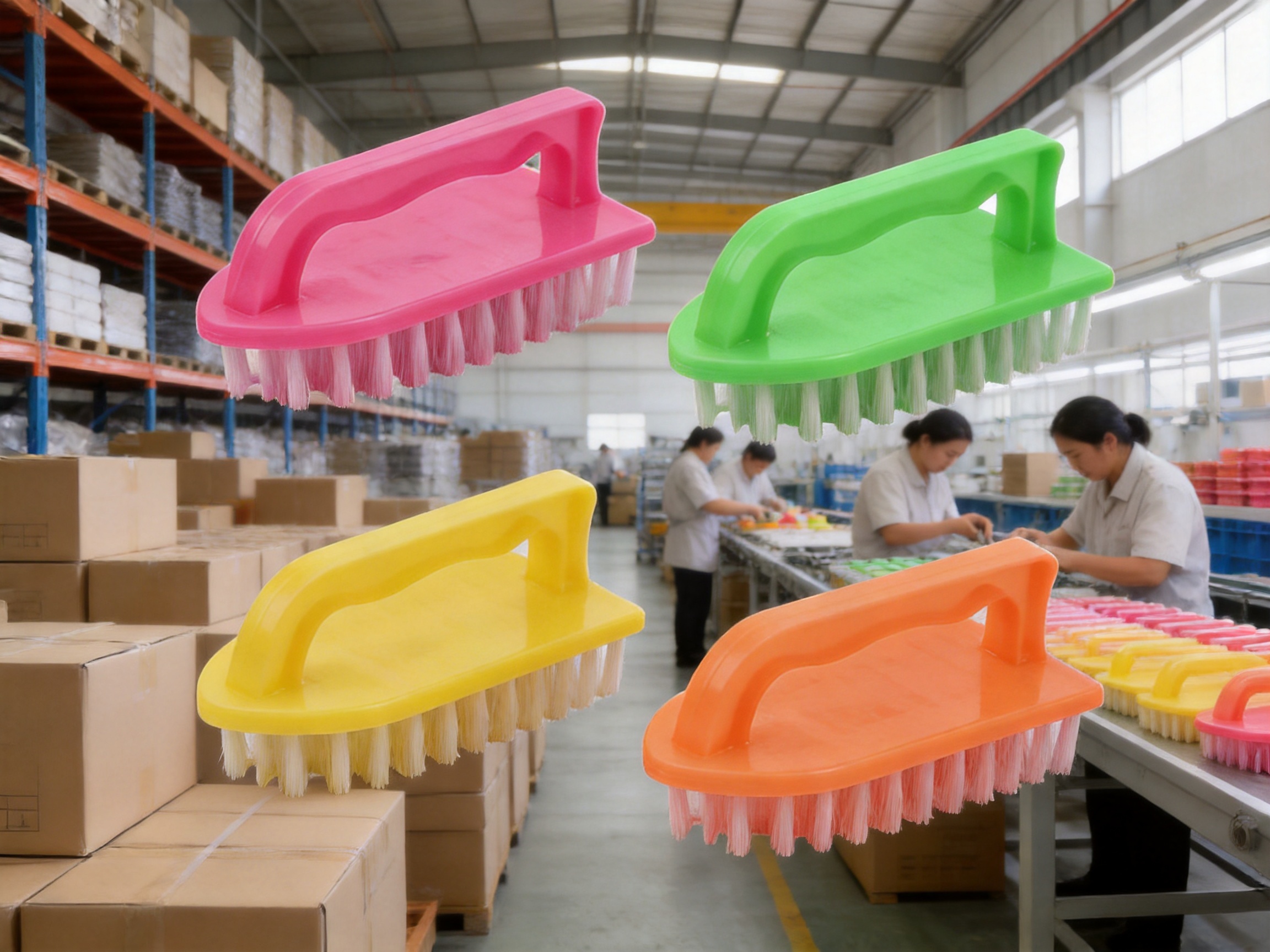
Keeping clothing neat does not always require a complicated appliance or a large collection of specialty tools. In many situations, a compact clothing brush is the most convenient answer. The Basic Pocket Clothing Brush is designed for simple, dependable garment care in homes, workplaces, schools, travel bags, retail environments, and professional uniform programs. Its straightforward construction, portable rectangular form, and balanced bristle stiffness make it suitable for removing lint, loose fibers, dust, and everyday surface debris from a wide range of clothing.
Unlike oversized garment brushes that are inconvenient to carry, or delicate brushes that may lack sufficient cleaning power, this model focuses on practical performance. It is made from inexpensive but durable plastic, allowing buyers to obtain a useful cleaning accessory without paying for unnecessary decorative features. The bristles are stiff enough to work on heavy coats while remaining soft enough for shirts and other commonly worn garments. This balance gives the brush a broad range of applications in a compact format.
The product is also well suited to wholesale distribution. Its simple construction supports efficient storage, easy merchandising, and practical carton utilization. With an item number of 26005 and carton quantity options of 240 or 320 pieces, buyers can select a packaging arrangement that better matches their sales channel, warehouse capacity, and purchasing plan. The product is therefore relevant not only to individual consumers but also to supermarkets, household-goods distributors, uniform suppliers, e-commerce sellers, and institutional procurement teams.
What Makes the Basic Pocket Clothing Brush Useful?
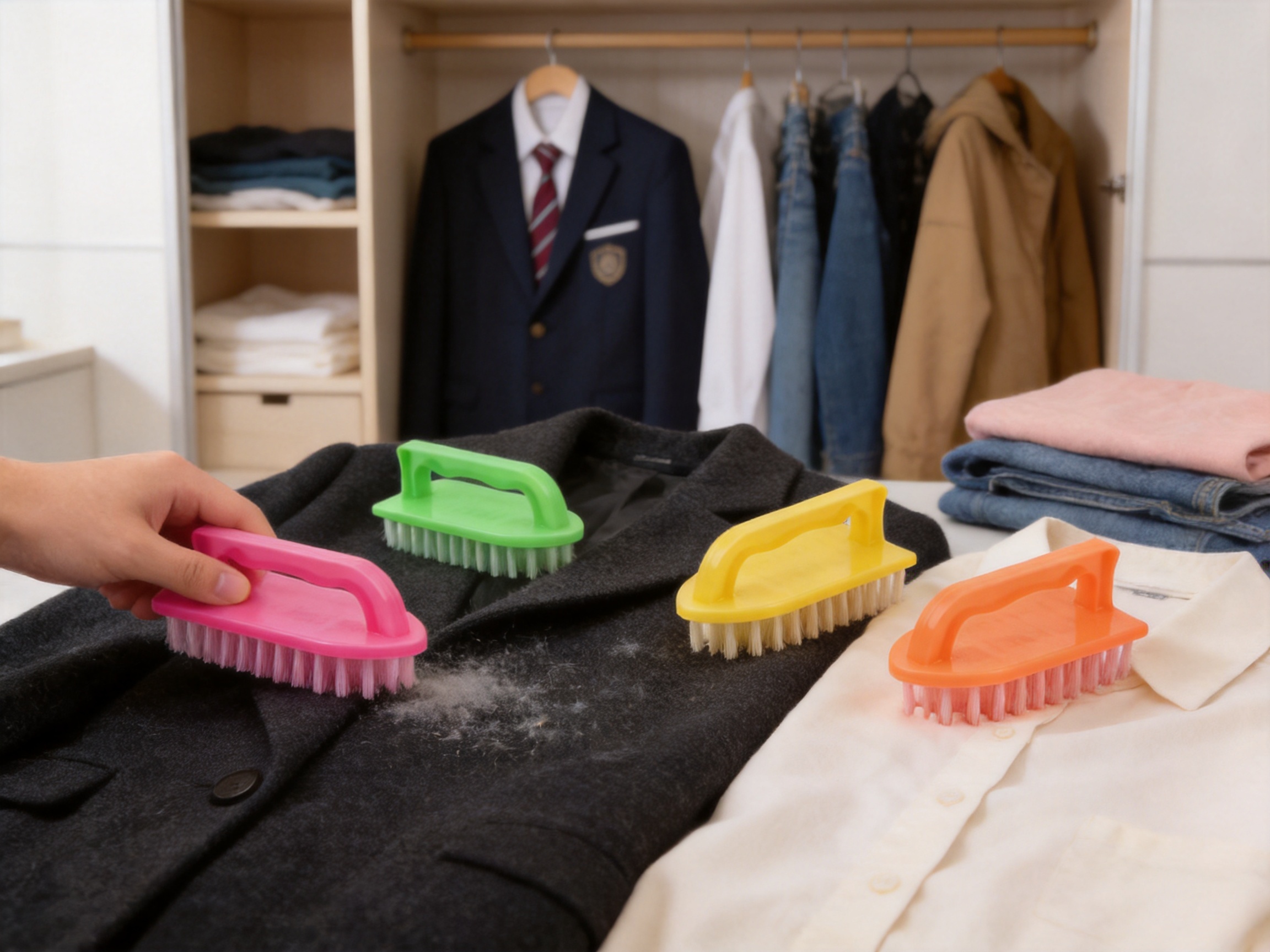
The primary purpose of the Basic Pocket Clothing Brush is to remove unwanted material from the surface of clothing. Lint, hair, dust, textile fibers, and light surface debris can make an otherwise clean garment appear untidy. A few strokes with a clothing brush can improve the appearance of work uniforms, school blazers, jackets, trousers, jeans, and coats without requiring washing or chemical treatment.
The brush is especially useful when a garment needs a quick refresh rather than a complete cleaning cycle. Washing a jacket or coat after every minor exposure to dust is impractical, and adhesive rollers may require replacement sheets or may not be convenient in every situation. A reusable brush provides a simple alternative. It can be stored in a drawer, work locker, suitcase, handbag, school bag, or vehicle compartment and used whenever necessary.
Its rectangular shape is an important part of the design. A simple flat profile takes up little room and can be placed alongside notebooks, clothing accessories, toiletries, or other household items. The product does not need a special stand or a large storage container. This helps retailers present it in compact displays and allows end users to keep it close at hand.
The product category is Clothing Brush, but its usefulness extends beyond formal garments. It can be used on everyday jeans, casual trousers, sweaters, outerwear, uniforms, and fabric accessories, provided that the user selects an appropriate brushing direction and applies reasonable pressure. The brush is intended as a practical surface-care tool rather than a substitute for professional textile cleaning.
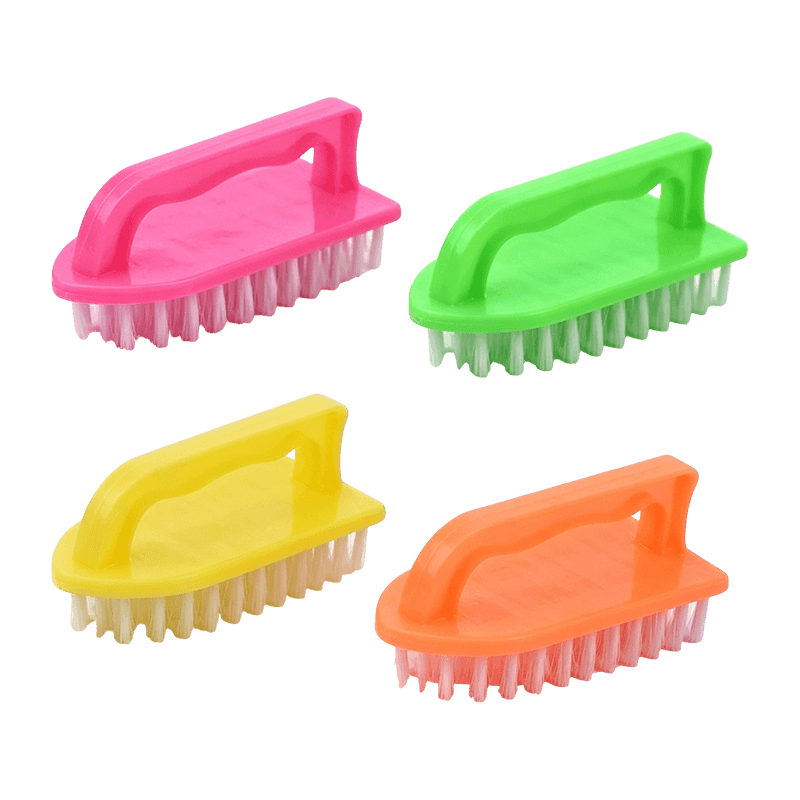
Basic Pocket Clothing Brush
Balanced Bristles for Different Fabrics
A clothing brush must achieve a careful balance. If the bristles are too soft, they may fail to lift lint and dust from heavier fabric. If they are too stiff, they may feel harsh on shirts or delicate clothing. The Basic Pocket Clothing Brush is described as having bristles that are stiff enough for heavy coats but soft enough for shirts. This balanced specification is one of its most valuable advantages.
On a heavy coat, the bristles can penetrate the surface texture sufficiently to help dislodge loose particles and fibers. Outerwear often has a dense weave or a textured finish that requires more than a light wiping motion. A brush with moderate firmness can provide useful contact without requiring the user to press excessively hard.
On shirts, uniforms, and lighter garments, the same brush can be used with lighter strokes. The user can brush in the direction of the fabric surface, paying attention to collars, cuffs, shoulders, pockets, and areas that receive frequent contact. This makes the product appropriate for daily clothing maintenance in offices, schools, hospitality settings, factories, and service businesses.
The bristle balance also improves product versatility for retailers. A highly specialized brush may appeal to a narrow group of consumers, while a general-purpose clothing brush can be offered to a broader market. Buyers do not need to stock separate brushes for coats, uniforms, and casual clothing when one practical model can serve several ordinary garment-care needs.
Suitable Garment Applications
The Basic Pocket Clothing Brush can be used for work uniforms that collect dust during commuting or daily activity. It is also suitable for school blazers, where a neat appearance is often important and quick maintenance is convenient between classes or activities. For everyday jeans and casual trousers, brushing can help remove surface lint and light debris before going out.
Jackets and coats benefit from periodic brushing because their larger surfaces can collect fibers and dust over time. The compact brush can be used at home before storage or carried for use at work and while traveling. It may also be useful for garments kept in retail stockrooms, where dust can accumulate during handling and display.
Users should always consider the fabric care instructions attached to the garment. Delicate textiles, loose knits, embellished surfaces, and sensitive finishes may require a gentler tool or a small test area before broader use. As with any clothing accessory, correct handling helps protect both the garment and the brush.
Simple Plastic Construction with Practical Value
The Basic Pocket Clothing Brush uses a simple plastic construction rather than an elaborate combination of materials. This design decision supports affordability, consistent production, and easy everyday use. The plastic body provides a stable base for the bristles while keeping the item light enough for bags, drawers, and travel storage.
For consumers, an inexpensive product can be valuable when it performs its intended task reliably. Many household accessories are used frequently and may eventually be misplaced, shared, or purchased in multiples. A reasonably priced clothing brush allows families, workplaces, schools, and retailers to maintain several units without a significant budget burden.
For wholesalers, the simple material structure can make purchasing easier to plan. There are fewer decorative elements to coordinate, fewer complex components to explain to customers, and a clear product function that can be communicated through packaging or online listings. The brush can be positioned as an economical essential rather than an occasional luxury item.
The use of durable plastic is also relevant to handling and distribution. Products sold through supermarkets, general merchandise stores, and e-commerce channels may pass through several stages before reaching the end user. A practical plastic body helps the item remain suitable for normal packing, transport, display, and repeated handling. Durability should always be considered together with responsible use, storage, and appropriate end-of-life disposal.
Advantages over More Complicated Competitor Designs
Many clothing-care products compete by adding handles, covers, electronic functions, replaceable parts, decorative surfaces, or specialized mechanisms. Those features may be appropriate for certain markets, but they can also increase product cost, storage requirements, and the number of components that may need maintenance. The Basic Pocket Clothing Brush follows a different approach: it concentrates on the essential brushing function.
Its no-frills design can be an advantage in value-oriented markets. Retailers can offer a functional garment-care accessory at an accessible price point, while buyers can purchase larger quantities for household, institutional, or promotional use. The absence of unnecessary mechanisms also makes the product easy to understand. Customers can see what it is, how it works, and where it belongs in a household-cleaning or garment-care assortment.
Compared with a large handled brush, the rectangular pocket format is easier to store and transport. Compared with disposable adhesive products, a reusable brush does not depend on replacement sheets for ordinary use. Compared with very soft fabric wipes, the bristles provide a more active brushing action for lint and dust. Compared with highly specialized textile tools, it offers broader everyday suitability.
These comparisons do not mean that one product is ideal for every fabric or situation. Rather, the Basic Pocket Clothing Brush occupies a practical middle position. It offers more active cleaning than a simple wipe, more portability than a large brush, and fewer recurring consumables than a disposable roller. This balance can be attractive to consumers who want a dependable tool without complexity.
| Feature | Basic Pocket Clothing Brush | Potential User Benefit |
| Compact rectangular shape | Flat, simple profile | Easy storage in bags, drawers, lockers, and travel cases |
| Plastic body | Inexpensive and durable material | Accessible price and practical handling |
| Balanced bristles | Firm enough for coats and gentle enough for shirts | Useful across several everyday garment types |
| Reusable design | Designed for repeated brushing | Reduces dependence on disposable cleaning sheets |
| Simple construction | No unnecessary mechanisms | Easy to understand, stock, display, and use |
| Wholesale carton options | 240 or 320 pieces per carton | Flexible purchasing for different distribution plans |
Portability for Work, School, and Travel
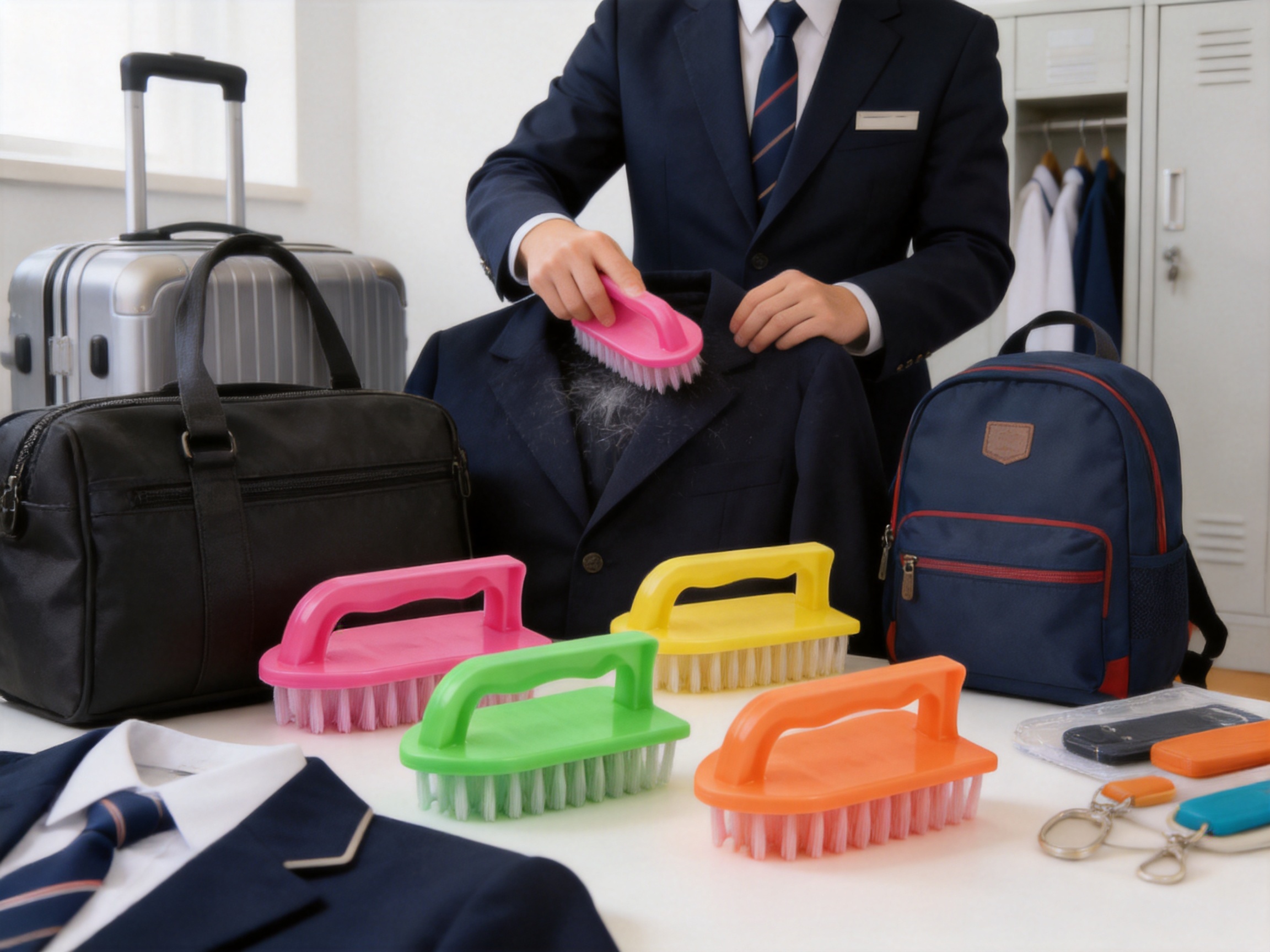
Portability is central to the value of a pocket clothing brush. Garments often need attention away from home, especially when people wear uniforms, formal clothing, or dark fabrics that show lint easily. A compact brush can be stored in a work bag and used before a meeting, in a school locker before an event, or in a hotel room before leaving for the day.
The flat rectangular form is particularly convenient for organized storage. It can fit between clothing layers in a suitcase, inside a side compartment of a backpack, or in a drawer with other personal-care accessories. Because it does not require a charging cable, batteries, or special refills, it is ready for use whenever the user needs it.
Travelers may find a reusable brush helpful when clothing has been packed tightly or exposed to hotel-room dust. Business travelers can use it to refresh a jacket or trousers before a presentation. Students can keep it with school uniforms and sportswear. Hospitality employees, sales representatives, and service professionals can carry it as part of a personal appearance kit.
Portability also supports household convenience. A family may place one brush near the entrance, another in a bedroom, and another with seasonal outerwear. Since the product is economical, several units can be purchased without the cost associated with more elaborate garment-care devices.
Use in Household and Institutional Cleaning Programs
Although the product is small, it can support broader cleaning and appearance-maintenance programs. In homes, clothing brushes are useful alongside laundry baskets, wardrobe organizers, shoe-care tools, and storage containers. In workplaces, they can be supplied in changing rooms, staff lockers, reception areas, or uniform distribution points.
Schools and training institutions may use clothing brushes as part of uniform-care supplies. A simple tool can help students maintain a neat appearance without requiring a large equipment budget. Hotels, restaurants, retail stores, and security companies may also purchase them for employees who wear uniforms or customer-facing clothing.
Industrial and commercial buyers often value consistency. When the same type of brush is distributed across a workplace, staff members know where to find it and how to use it. Standardized purchasing can also simplify inventory management. The Basic Pocket Clothing Brush is suited to this kind of practical procurement because its function is clear and its packaging quantities are suitable for bulk orders.
Retailers may place the product in household cleaning sections, laundry-care displays, travel-accessory areas, or seasonal uniform promotions. The broad category appeal allows it to be marketed to multiple customer groups. Its application is not limited to a single age group, occupation, or household type.
Manufacturing Strengths of the Supplier
Jinhua Jieqing Plastic Co., Ltd. was founded in 2008 and specializes in the research, development, production, and sales of cleaning supplies. Its product scope includes brooms, cleaning brushes, household and industrial brushes, and supporting plastic products. This specialization gives the supplier relevant experience in developing practical cleaning tools for different use environments.
The company operates as an industry and trade enterprise, combining manufacturing activity with sales and market service. This structure can be valuable to international buyers because product development, production coordination, order communication, and export support can be managed through a connected supply system. Buyers seeking a long-term supplier may benefit from working with an organization that understands both factory requirements and distribution-market expectations.
The company has its own production base and a complete supply chain. These strengths can support better coordination from raw-material preparation through production, quality control, packing, and shipment. A connected supply chain may also help reduce unnecessary handoffs and make it easier to respond to product specifications, packaging requirements, and order schedules.
Standardized production processes are another important strength. For a simple product such as a clothing brush, consistency remains essential. The body should maintain a dependable shape, the bristle area should be properly formed, and the finished units should be suitable for packing and use. Standardization helps support repeat orders and reduces avoidable variation between production batches.
Product Development and Customization
The company provides customization based on customer drawings and samples. This capability is important for buyers who need changes to color, packaging, labeling, product combinations, or other commercially relevant details. A buyer may wish to create a private-label household-care line, match a retailer’s visual identity, or develop a brush assortment for a specific market.
Customization based on drawings and samples also creates a clearer communication process. Instead of relying only on verbal descriptions, the buyer and supplier can review a physical reference or technical illustration. This can help clarify dimensions, proportions, surface details, bristle arrangements, packaging layout, and other requirements before production begins.
For the Basic Pocket Clothing Brush, customization may be useful when a distributor wants several color options, a particular retail card, a multipack configuration, or a coordinated set with other household cleaning products. Any customization should be evaluated with regard to minimum order quantities, tooling, production time, packaging materials, and quality requirements.
The ability to customize does not reduce the value of the standard model. In many cases, buyers prefer a proven basic design because it can be introduced quickly and sold through established channels. The standard product offers a practical starting point, while the supplier’s development capability creates room for future adaptation.
Quality Control for a Small but Important Product
Quality control is not limited to complex machinery or high-value products. Small household tools also need to meet reasonable expectations for appearance, function, durability, and packaging. A clothing brush that loses its shape, has inconsistent bristles, or arrives damaged can create unnecessary complaints even if the product itself is inexpensive.
The supplier’s standardized production processes and stable quality control provide a foundation for managing these expectations. Relevant checks may include visual inspection of the plastic body, review of bristle placement, confirmation of product quantity, examination of packaging condition, and verification that finished goods correspond to the approved sample or specification.
For bulk buyers, quality control is especially important because a single production issue can affect many units. Consistent inspection helps protect the buyer’s retail reputation and reduces the likelihood of sorting large quantities after delivery. It also supports repeat purchasing, since buyers can have greater confidence that a subsequent order will match the original product standard.
Buyers should communicate their quality requirements clearly before production. They may specify acceptable color variation, packaging materials, labeling information, carton markings, inspection standards, and sample-approval procedures. Clear documentation allows the supplier to align production and inspection activities with the buyer’s commercial needs.
Packaging and Carton Information
The listed product information provides two carton configurations for item number 26005. One configuration contains 240 pieces, with a carton measuring 51 by 37 by 33 and a gross weight of 6.6. The second contains 320 pieces, with a carton measuring 51 by 37 by 44 and a gross weight of 10. The listed volumes are 0.062 and 0.083 respectively.
These options give buyers flexibility. A 240-piece carton may be suitable for distributors that prefer a lower quantity per carton or that need to manage warehouse space carefully. A 320-piece carton may be attractive to larger buyers seeking more units per outer carton and efficient replenishment for high-volume channels.
Carton quantity affects more than purchasing price. It influences warehouse organization, pallet planning, freight calculations, handling requirements, and order allocation. Buyers should confirm the unit of measurement for carton dimensions and volume with the supplier before finalizing logistics documents, especially when preparing international shipment plans.
The gross weight information can help freight forwarders and warehouse teams estimate handling needs. It can also support preliminary shipping calculations, although final freight planning should be based on confirmed packing lists, carton markings, destination requirements, and the selected transport method.
| Item No. | Carton Quantity | Carton Length | Carton Width | Carton Height | Gross Weight | Volume |
| 26005 | 240 pieces | 51 | 37 | 33 | 6.6 | 0.062 |
| 26005 | 320 pieces | 51 | 37 | 44 | 10 | 0.083 |
Because packaging specifications can vary according to product presentation, buyers should confirm whether the listed carton data applies to bulk packing, retail-ready packing, or another agreed configuration. Any change to inner packaging, color assortment, labels, or promotional materials may affect carton quantity and shipping measurements.
Value for Supermarkets and General Merchandise Retailers
Supermarkets and general merchandise retailers often seek products that are easy to explain, easy to display, and relevant to regular household needs. The Basic Pocket Clothing Brush meets these requirements with a clear function and a broad user base. Customers do not need extensive technical knowledge to understand its purpose, and the product can be placed near laundry, clothing care, storage, or cleaning supplies.
The economical design supports price-sensitive purchasing. Many shoppers are willing to add a small household accessory when the item appears useful and affordable. The brush may also be included in seasonal promotions connected with school uniforms, winter coats, travel, back-to-work clothing, or spring household organization.
Retailers can sell the product individually or as part of a clothing-care assortment. It may be paired with laundry bags, lint-removal products, garment organizers, shoe brushes, or storage containers. Such cross-merchandising can help shoppers find complementary products while increasing the visibility of the brush.
The compact shape may reduce shelf-space demands compared with larger cleaning tools. Retailers can use hanging packaging, small bins, countertop displays, or multipack presentations according to their store format. Packaging customization from the supplier can further support a retailer’s visual identity and product-positioning strategy.
Value for E-Commerce and Cross-Border Sellers
E-commerce sellers often need products that are lightweight, compact, durable, and simple to demonstrate through images and short descriptions. The Basic Pocket Clothing Brush fits this profile. Its function can be communicated through a few clear benefits: portable storage, reusable construction, balanced bristles, and suitability for coats, shirts, uniforms, blazers, and jeans.
The product can be offered as a single unit, multipack, family set, uniform-care kit, or travel-care bundle. Sellers may also use it as an add-on item in clothing, laundry, travel, or household-organization categories. Its relatively simple design reduces the need for lengthy technical explanations, while its practical application provides several opportunities for lifestyle-oriented marketing.
For cross-border sellers, supply reliability and documentation are important. The supplier’s export experience, complete product range, and flexible customization services can support buyers who sell across different markets. Product descriptions, packaging language, carton marks, and labeling should be prepared according to the destination market’s requirements.
Online sellers should represent the product accurately. It should not be promoted as a stain remover, washing device, or universal solution for every textile. Clear descriptions build customer trust and reduce returns. Appropriate wording can emphasize everyday lint and surface-debris removal while advising users to follow garment-care instructions.
How to Use the Brush Effectively
Before brushing, place the garment on a flat surface or hang it securely. Remove larger pieces of debris by hand if necessary. Begin with light strokes in the direction of the fabric surface. Work from the upper part of the garment downward, or follow the natural construction of the clothing.
Pay particular attention to areas where lint and dust accumulate, including shoulders, sleeves, collars, cuffs, pockets, and the front of trousers. On heavier coats, moderate repeated strokes may be useful. On shirts and lighter fabrics, use less pressure and shorter passes. The objective is to lift surface material without pulling or stressing the textile.
When using the brush on a new or delicate garment, test a small, less visible area first. Avoid aggressive brushing over loose threads, decorative attachments, open knits, sequins, or fragile finishes. If the garment label provides special-care instructions, those instructions should take priority.
After use, remove accumulated lint from the brush and store it in a clean, dry location. Regularly removing fibers helps maintain effective contact between the bristles and the garment. The plastic body can generally be wiped as needed, but users should avoid exposing the product to conditions that may damage its material or structure.
Maintenance and Product Longevity
A reusable clothing brush offers value over time when it is stored and handled properly. The user should avoid placing heavy objects on the bristle area for extended periods, as excessive pressure may affect the shape of the bristles. Keeping the brush away from unnecessary heat and harsh chemicals can also help preserve the plastic body.
Cleaning frequency depends on how often the brush is used and what materials it removes. In a household, occasional removal of collected lint may be sufficient. In a workplace or uniform program, the brush may need more frequent attention because it is used by multiple people or on garments exposed to dust and fibers.
For institutional buyers, a short care instruction can be included in staff guidance or product packaging. Users should understand that the brush is intended for surface maintenance and should be applied in a way that respects the garment. Simple instructions can improve satisfaction and extend the useful life of both the brush and the clothing being maintained.
Responsible Purchasing and Product Selection
When selecting a clothing brush for wholesale purchase, buyers should consider the intended market, expected order volume, packaging format, target price, and fabric types commonly encountered by end users. A basic model is often most successful when its practical role is clearly defined rather than compared with every type of garment-care equipment.
Buyers should request current samples when developing a new order, especially if they require customized colors, packaging, labels, or bristle specifications. Sample approval provides a reference for production and can help identify changes before a larger quantity is manufactured.
It is also useful to review carton requirements early. The two listed carton options provide a starting point, but final packaging may differ if the product is sold in a retail box, header card, polybag, multipack, or branded assortment. Confirmed packing data supports accurate freight and warehouse planning.
Responsible sourcing also includes transparent communication about material, use, packaging, and disposal. A supplier with a stable production base and complete supply chain can help buyers coordinate these details more effectively. Long-term cooperation is most successful when product expectations, quality standards, delivery schedules, and customization requirements are documented clearly.
Why the Supplier Is Suitable for Long-Term Cooperation
A product supplier should be evaluated not only by one item but also by its ability to support future needs. Jinhua Jieqing Plastic Co., Ltd. offers a broader range of cleaning supplies, including brooms, household brushes, industrial brushes, and related plastic products. This range can help buyers consolidate sourcing across several cleaning categories.
The company’s experience since 2008 provides a substantial operating history in the cleaning-supplies field. Its own production base supports direct attention to manufacturing, while its industry-and-trade structure can help connect production with export and customer-service requirements.
Its complete supply chain and standardized production processes are relevant to buyers who need stable replenishment. Its customization service is relevant to buyers who want to develop private-label programs or adapt products to specific retail channels. Its export experience is relevant to customers working across borders and coordinating international logistics.
The Basic Pocket Clothing Brush illustrates how a focused product can fit into this broader capability. It is simple enough for high-volume distribution, versatile enough for multiple markets, and suitable for customization when commercial conditions require it. Buyers can begin with the standard model and later expand into related cleaning products or customized assortments.
Frequently Asked Questions
What is the Basic Pocket Clothing Brush designed to remove?
It is designed to help remove lint, dust, loose fibers, hair, and light surface debris from clothing. It is especially suitable for everyday garments such as coats, shirts, uniforms, school blazers, trousers, and jeans.
Are the bristles suitable for both heavy coats and shirts?
Yes. The product is described as having bristles stiff enough to remove lint from heavy coats while remaining soft enough for shirts. Users should still apply lighter pressure to delicate or sensitive fabrics.
Why is the rectangular shape useful?
The simple rectangular shape stores flat and takes up little space. It can be kept in a bag, drawer, locker, suitcase, or vehicle compartment, making it convenient for work, school, travel, and home use.
Is the brush reusable?
Yes. It is intended for repeated use. Users should remove collected lint after brushing and store the product in a clean, dry place to help maintain its performance.
Is this product suitable for every fabric?
No garment-care tool should be assumed suitable for every textile. Users should follow garment-care labels and test the brush on a small hidden area when working with delicate, embellished, loosely knitted, or sensitive fabrics.
What material is used for the product?
The brush is made from inexpensive but durable plastic, with bristles designed for practical clothing maintenance. Buyers requiring exact material information for a particular market should confirm the specification with the supplier.
What is the item number?
The listed item number is 26005.
What carton quantities are available?
The listed carton quantities are 240 pieces and 320 pieces. The corresponding carton dimensions, gross weights, and volumes should be confirmed with the supplier during order planning.
Can the product be customized?
The supplier provides customization based on customer drawings and samples. Buyers can discuss possible changes to color, packaging, labeling, product combinations, and other requirements during the development process.
Who can purchase this product in bulk?
Potential bulk buyers include supermarkets, household-goods distributors, cross-border e-commerce sellers, uniform suppliers, schools, hospitality businesses, industrial procurement teams, and retailers of laundry or cleaning accessories.
Can the product be sold as part of a household cleaning assortment?
Yes. It can be placed in a clothing-care, laundry, household-cleaning, travel, or storage-related assortment. It may also be combined with other brushes, brooms, garment organizers, or storage products.
What information should buyers confirm before ordering?
Buyers should confirm the approved sample, material details, bristle requirements, colors, packaging format, carton quantity, labeling, quality standards, minimum order quantity, delivery schedule, and shipping information.
Conclusion
The Basic Pocket Clothing Brush demonstrates the value of focused product design. It does not rely on complicated mechanisms or decorative features. Instead, it provides a compact plastic body, practical portability, and bristles balanced for common clothing types. These qualities make it suitable for heavy coats, shirts, uniforms, school blazers, jeans, and everyday garments.
Its advantages over more complex or disposable alternatives include accessible pricing, reusable operation, simple storage, easy product communication, and broad everyday application. The rectangular pocket format supports personal portability as well as efficient retail and wholesale handling. The two listed carton configurations provide additional flexibility for distributors and institutional purchasers.
The supplier adds further value through experience in cleaning-supply manufacturing, an own production base, standardized processes, stable quality control, a complete supply chain, export experience, and customization based on drawings and samples. These capabilities make the product relevant to buyers seeking both a dependable standard item and a foundation for private-label or market-specific development.
For consumers, the brush is a convenient tool for maintaining a neat appearance. For retailers, it is an accessible household-care product with broad category potential. For wholesale and industrial buyers, it offers practical bulk packaging and integration into larger cleaning-supply programs. Its simple design is precisely what gives it lasting commercial usefulness: it performs a familiar task, travels easily, stores efficiently, and can be produced and customized through an experienced plastic-products supplier.
References
1. Product information supplied for Basic Pocket Clothing Brush, item number 26005, including product description, bristle application, carton quantities, dimensions, gross weights, and volumes.
2. Company information supplied for Jinhua Jieqing Plastic Co., Ltd., including company history, production scope, supply-chain capabilities, customization services, and export experience.
3. General principles of household textile care, including the use of brushing, surface maintenance, garment-label compliance, and fabric-sensitivity testing.
4. General packaging and wholesale distribution principles for household cleaning accessories, including carton planning, inventory handling, and retail assortment development.
Product: Basic Pocket Clothing Brush

 CONTACT US
- CONTACT DETAILS
- Address : No. 1388 Cuntong Road, Jinhua City
- Tel: +86-0579-81534043
- Email:wangjinhua1@zjjqsj.com
- PRODUCTS
- Kitchen Cleaning Supplies
- Household Cleaning Supplies
- Indoor & Outdoor Cleaning Supplies
- Baby Products & Cleaning Supplies
- Home Storage Containers
- QUICK LINK
- Company Profile
- Plant equipment
- Certifications
- FAQ
- NEWS CENTER
- Company News
- Industry News
- MOBILE TERMINAL

