

 English
  русский
  Español
  عربى
عربى 
Short-Handled Car Brush with Yellow Bristles: A Practical Solution for Controlled Vehicle Cleaning
Date:Sep 19, 2026
Vehicle cleaning is often described as a simple task, but the quality of the result depends heavily on the tools used. Large washing brushes may cover broad areas quickly, while narrow detailing tools can reach small gaps and delicate edges. Between these two types of equipment is the short-handled car brush with yellow bristles, a practical cleaning tool designed for direct handling, controlled movement, and dependable everyday use.
This brush is especially useful when the user needs to work close to a vehicle surface rather than reach across a large body panel. Its compact handle places the hand near the bristle head, allowing more precise movement around wheel covers, lower panels, trims, corners, and uneven sections. The design is straightforward, but that simplicity is one of its principal strengths. It avoids unnecessary mechanisms and concentrates on the essential functions of a vehicle cleaning brush: effective contact, comfortable handling, easy rinsing, and reliable repeat use.
The yellow bristles provide a visible, practical cleaning surface. Their color makes the brush easy to identify in a tool collection and helps users see dirt, mud residue, and remaining soap during the cleaning process. At the same time, the bristles are intended to balance softness and firmness. They can move dust, road film, and light grime without requiring aggressive scraping, while their flexible structure allows them to enter textured or irregular areas.
For retailers, distributors, vehicle-care suppliers, workshops, and bulk purchasers, the product also represents a flexible category item. It can be positioned as a car-washing brush, wheel-cleaning brush, household utility brush, garage brush, or general outdoor cleaning tool. Its application range gives buyers more opportunities to serve different customer groups without managing an excessively complicated product line.
Understanding the Product Design
The short-handled car brush is built around a simple relationship between handle length, bristle arrangement, and user control. A long handle is valuable when a user needs to reach the center of a large vehicle, the upper surface of a recreational vehicle, or a distant area that cannot be accessed comfortably. However, long handles can make small movements less precise. They may also create more leverage than necessary in narrow spaces.
A short handle produces a different cleaning experience. The hand remains close to the bristle head, so the user can guide the tool with compact movements. This is useful for cleaning one section at a time, especially when the surface contains trim pieces, grooves, raised lettering, wheel details, or other areas that require attention. Instead of making broad sweeping strokes, the operator can use short back-and-forth movements, circular motions, or carefully directed strokes.
The brush is therefore suited to maintenance tasks in which control is more important than maximum reach. It can support routine washing, spot cleaning, pre-rinse work, and the removal of accumulated residue from areas that are often missed by larger cleaning tools. Its format also makes it easy to keep within reach during a larger vehicle-washing process.
The grip area is designed for wet working conditions. Water, shampoo, foam, and loosened dirt are common during vehicle maintenance, and a handle that becomes difficult to hold can reduce both comfort and control. A practical wet-use grip helps the user continue working without constantly adjusting the hand position. This is particularly useful for repeated cleaning tasks in professional settings, where an operator may use the brush for several vehicles during a working period.
The brush does not depend on batteries, pumps, interchangeable heads, or complex operating instructions. This reduces the number of components that can fail and makes the product easy to understand for both experienced users and first-time buyers. The result is a tool that can be placed directly into a cleaning kit and used with water and a suitable cleaning solution.
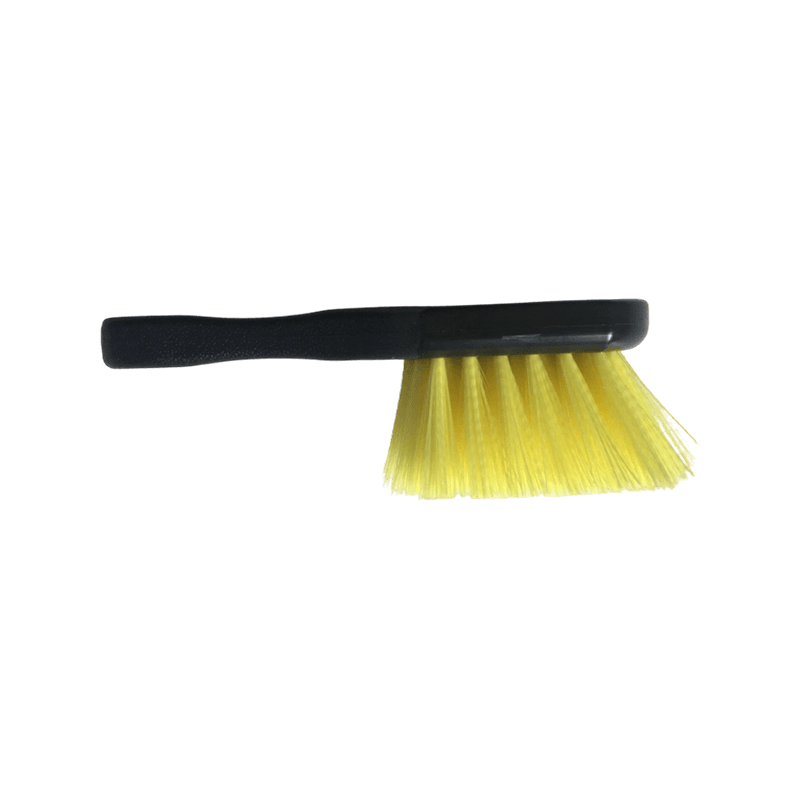
Short-Handled Car Brush with Yellow Bristles
Why a Short Handle Can Improve Cleaning Control
Many cleaning difficulties arise not because the operator lacks effort, but because the tool does not match the shape of the working area. A wide vehicle panel can be washed efficiently with a large sponge or long-handled brush. A wheel cover, lower door edge, mirror base, or trim groove is different. These sections contain changes in shape and limited clearance, so they benefit from a tool that can be guided accurately.
The short handle reduces the distance between the user’s hand and the cleaning head. This arrangement gives the operator a more immediate sense of pressure and direction. If an area requires lighter contact, the user can adjust the force quickly. If dirt is concentrated in a corner, the brush can be angled and moved into the area without the handle causing unnecessary swinging.
Short-handled tools can also be easier to store and transport. They fit into small buckets, vehicle-care cases, workshop drawers, and supply cabinets. For mobile car washers or service teams, compact storage can be an important practical advantage. A brush that takes up little space can remain available without interfering with larger equipment.
Another benefit is visual access. With a short tool, the user’s hand and the bristle head are usually closer to the work area, making it easier to observe how the bristles are contacting the surface. This helps the operator notice whether dirt is being lifted, whether additional water is needed, or whether the cleaning method should be adjusted.
The product is not intended to replace every type of vehicle brush. Long-reach brushes remain useful for roofs, windshields, and other distant areas. Instead, the short-handled model complements larger tools by offering a specialized solution for close, controlled work. In a well-organized cleaning kit, it can serve as the tool used after broad washing or as the primary brush for smaller vehicles, motorcycles, bicycles, and equipment.
Yellow Bristles and Their Practical Role
The bristle material and arrangement are central to any cleaning brush. For vehicle maintenance, the brush must be useful against dust and road residue while remaining suitable for regular contact with common exterior surfaces. The yellow bristles on this model are described as soft enough for routine washing but firm enough to move away stuck dust, mud traces, and road film.
This balance is important because an excessively soft brush may lack the cleaning strength needed for lower panels and wheel areas. It may flatten quickly without lifting embedded dirt. In contrast, an excessively rigid brush may feel harsh and can make users hesitant to apply enough movement. A moderately flexible bristle set offers a more balanced experience for ordinary cleaning tasks.
When pressure is applied, the bristles spread slightly. This allows them to follow uneven textures rather than touching only the highest points of a surface. Such contact is useful around wheel covers, molded plastic parts, lower body panels, protective trim, and outdoor equipment. The bristles can enter shallow grooves and textured areas where a flat cloth may not make complete contact.
The yellow color also has functional value. A bright brush is easy to locate in a garage, storage cabinet, vehicle trunk, cleaning trolley, or retail display. It can be distinguished from black, gray, blue, or white tools in a busy work area. For professional teams, color visibility can support quick tool selection and help prevent a small brush from being overlooked after use.
Color alone does not determine cleaning performance, and users should always select a brush according to the surface and type of dirt involved. The value of the yellow bristles lies in the combination of visibility, flexibility, and practical cleaning strength. When used with water and an appropriate vehicle-cleaning solution, they can support regular maintenance without making the cleaning process unnecessarily complicated.
Vehicle Areas Suitable for the Brush
Wheel Covers and Wheel Details
Wheel covers and similar components often collect dust, mud, brake residue, and road film. Their shapes may include recesses, ribs, openings, and raised sections. The short-handled design helps the user work around these features with controlled strokes. The brush can be moved along the contours of the cover, while the flexible bristles reach into shallow spaces.
Users should rinse away loose grit before scrubbing whenever possible. Removing coarse particles first can reduce the chance of dragging abrasive material across a surface. After pre-rinsing, the brush can be used with water and a suitable cleaning solution to loosen remaining dirt. The brush should then be rinsed regularly so that the bristle bundle does not retain excess soil.
Lower Body Panels
The lower portions of vehicle doors, bumpers, and side panels are frequently exposed to mud splashes and road film. These sections are often more heavily soiled than upper panels and may require repeated passes. Because the brush is held close to the working area, users can apply steady pressure while monitoring the surface.
The product can be useful for spot cleaning before a complete wash or for addressing stubborn areas after the main body has been rinsed. Its compact shape makes it easier to work along panel edges and around molded features than a very large brush.
Trims, Seams, and Narrow Edges
Exterior trims and seams may collect fine dust that is difficult to remove with a large sponge. A short-handled brush can be directed along these narrow features, helping loosen material without requiring wide arm movements. The user can change the angle of the bristles according to the shape of the trim.
Care is still important around painted surfaces, polished finishes, decals, and sensitive coatings. A responsible cleaning process begins with a test on a less visible area, uses clean water, and avoids excessive pressure. The brush is a practical general-purpose tool, but correct technique remains an important part of surface care.
Motorcycles, Bicycles, and Outdoor Equipment
The brush is not limited to passenger vehicles. Its compact shape is suitable for bicycles, motorcycles, scooters, garden equipment, storage boxes, and other outdoor items. These products often contain exposed frames, textured plastic, metal brackets, and small spaces where a short-handled brush is easier to guide.
For bicycles, it may be used on mudguards, frame sections, pedals, racks, and areas around the wheels. For outdoor equipment, it can help remove dust, soil, and light deposits from handles, housings, and protective surfaces. Users should avoid forcing the bristles into delicate mechanical components or electrical openings and should follow the maintenance instructions for the equipment being cleaned.
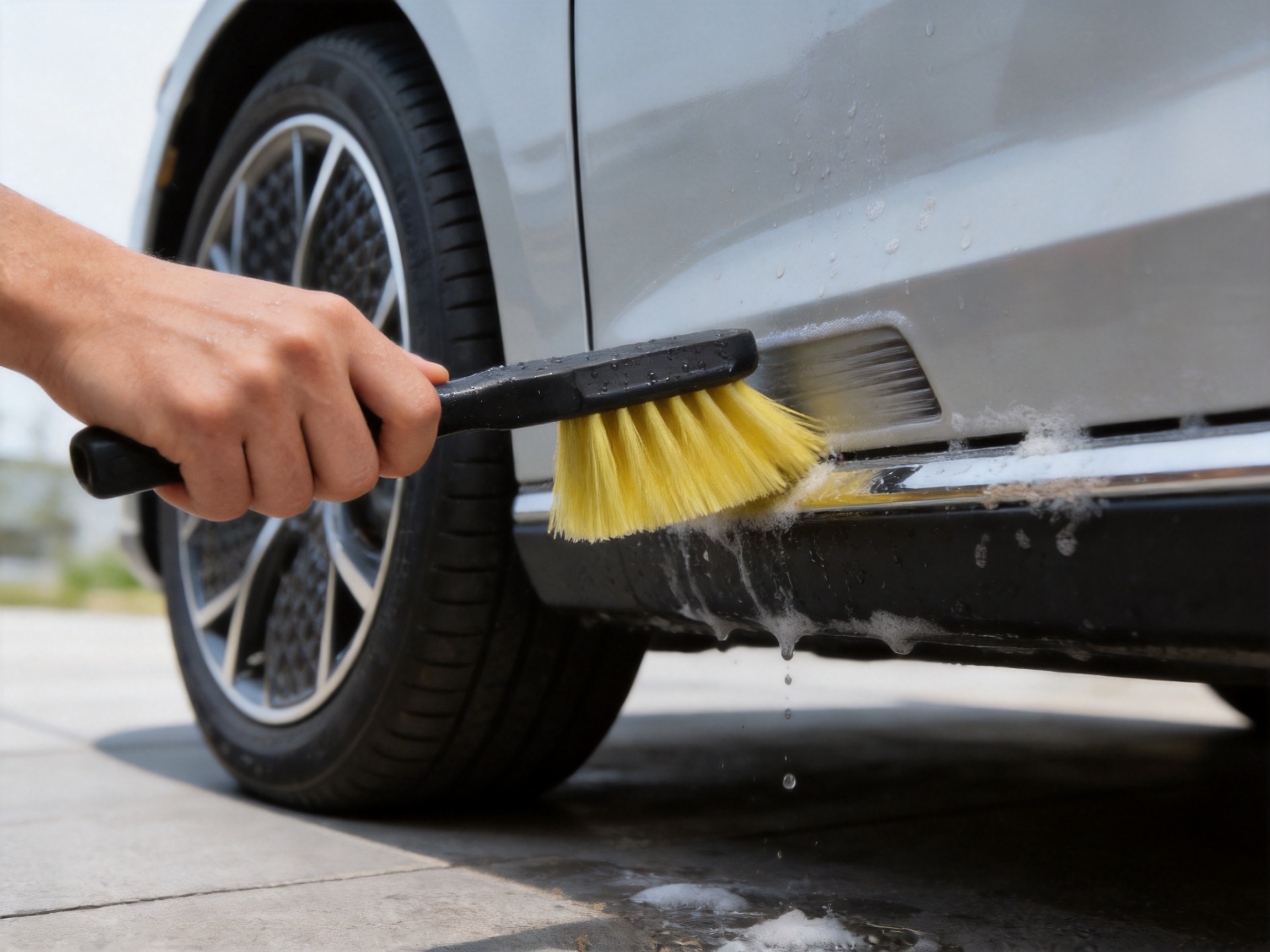
Advantages Compared with Competing Brush Formats
A product comparison should consider how a tool performs in its intended situation rather than declaring one brush superior for every task. The short-handled car brush offers several advantages over competing formats when the priority is direct control and close-range cleaning.
| Cleaning Tool Type | Primary Strength | Common Limitation | Position of the Short-Handled Brush |
|---|---|---|---|
| Long-handled vehicle brush | Extended reach across large or high surfaces | Less precise in narrow areas and may require more storage space | Provides better close-range control for wheels, trims, and lower panels |
| Large wash sponge | Fast coverage of broad, smooth panels | May not enter grooves, recesses, or textured sections effectively | Offers bristles that can follow uneven surfaces and narrow features |
| Small detailing brush | Fine work in very narrow gaps | May cover little area and require extended cleaning time | Balances detail work with a larger, more practical bristle area |
| Rigid utility brush | Strong scrubbing action on rough surfaces | May feel too harsh for routine vehicle exterior cleaning | Uses a softer, more flexible bristle approach for regular washing |
| Cloth or microfiber towel | Wiping, drying, and polishing support | Does not always reach textured areas or loosen embedded dirt | Provides mechanical bristle contact for lifting dust and road film |
The product’s most important competitive distinction is not an extreme feature but a useful balance. It is more controlled than a long-reach tool, broader and more efficient than a very fine detailing brush, and more surface-adaptive than a flat cloth. This middle position can make it appealing to buyers who want one compact brush for a range of ordinary cleaning tasks.
Another advantage is operational simplicity. Some competing products include telescoping handles, adjustable heads, water-flow systems, or replaceable attachments. These features may be valuable in specialized situations, but they also add cost, weight, and potential maintenance requirements. The short-handled brush focuses on the essential cleaning action, which can be attractive to household users, workshops, distributors, and bulk purchasers seeking a dependable basic tool.
The product can also be easier to introduce to customers. Its use is intuitive, and its benefits can be demonstrated quickly in a retail environment or product catalog. Buyers do not need extensive training to understand how to hold it, wet the bristles, apply cleaning solution, and work across a soiled area. This low learning barrier can support repeat purchasing and broad market placement.
Practical Benefits for Household Users
For household users, car cleaning often takes place in a driveway, garage, shared washing area, or outdoor space. A tool that is easy to pick up and use can make occasional maintenance more manageable. The short-handled brush fits naturally into a basic cleaning set containing a bucket, hose, wash solution, drying cloth, and larger sponge or brush.
Its compact form is especially convenient for users who do not have a dedicated vehicle-care cabinet. The brush can be placed in a household storage container, carried in a vehicle trunk, or kept with garden and outdoor maintenance tools. Because it does not require a power source, it is ready for use wherever water is available.
The brush may also support partial cleaning. A vehicle does not always need a complete wash. A user may wish to clean only a muddy wheel cover, a lower door section, or a dirty bicycle after a short trip. In these situations, a small controlled brush can be more convenient than setting up a full cleaning system.
After use, rinsing the bristles is straightforward. Removing loosened dirt before storage helps maintain the brush and reduces the chance of transferring grime during the next cleaning session. The product does not require special handling or complex drying equipment. Allowing it to drain and dry in a suitable ventilated location is generally sufficient for normal use.
Value for Workshops and Professional Cleaning Teams
Professional cleaning environments have different priorities from occasional household use. A workshop, vehicle-detailing service, dealership preparation area, rental fleet facility, or maintenance team may need multiple brushes that are easy to distribute, identify, clean, and replace. The short-handled car brush is suitable for these environments because it supports repeated close-range work without requiring complicated operation.
Its size can be useful at workstations where space is limited. Operators can keep the brush near a wash basin, mobile trolley, or service bay. The bright bristles make it easier to locate among towels, hoses, buckets, and other tools. If a business uses different brushes for different tasks, the yellow design can also contribute to a simple visual organization system.
For fleet maintenance, the brush may be assigned to lower panels, wheel covers, utility vehicles, or equipment areas. For vehicle preparation, it can help address small remaining areas after a broad wash. For workshops that clean parts or tools, the brush may be useful on suitable non-sensitive surfaces where a compact, flexible-bristled brush is preferred.
Professional users should establish basic care procedures. Brushes should be rinsed after use, inspected for trapped debris, and stored in a manner that permits drying. Separate tools may be assigned to heavily soiled mechanical areas and painted exterior surfaces to reduce cross-contamination. These procedures help preserve cleaning quality regardless of the brush supplier.
Manufacturing Strengths Behind the Product
The performance of a simple cleaning brush depends on more than its visible appearance. Consistent results require stable sourcing, controlled molding or forming processes, accurate assembly, appropriate bristle placement, and inspection at different production stages. Jinhua Jieqing Plastic Co., Ltd. is described as an industry and trade enterprise specializing in the research, development, production, and sales of cleaning supplies.
The company was founded in 2008 and operates with its own production base. This manufacturing foundation supports closer coordination between product development, production planning, quality control, and sales service. For customers purchasing in volume, such coordination can be valuable because product supply is not based solely on external trading arrangements.
The company’s product range includes brooms, cleaning brushes, household brushes, industrial brushes, and supporting plastic products. This broader category experience can contribute to practical product development. Knowledge gained from multiple brush types may help the manufacturer understand different handle structures, bristle requirements, usage environments, packaging formats, and customer expectations.
Standardized production processes are another stated strength. Standardization helps reduce variation between production batches. In the case of a short-handled car brush, relevant checkpoints may include handle appearance, grip formation, bristle distribution, attachment strength, dimensional consistency, and cleanliness before packing. Although each buyer may apply its own inspection standards, a stable internal process provides an important foundation.
Quality control is most effective when it is treated as a continuing process rather than a final visual check. Raw materials, semi-finished components, assembly operations, finished products, and packaging can all influence the customer experience. A manufacturer with an established quality system can identify problems earlier and make adjustments before larger quantities are completed.
The company also provides customization based on customer drawings and samples. This capability is important for distributors and private-label buyers that may need a different color, handle style, bristle specification, packaging method, label arrangement, or product combination. Customization can allow a buyer to develop a product better suited to a particular retail market instead of selecting only from standard catalog options.
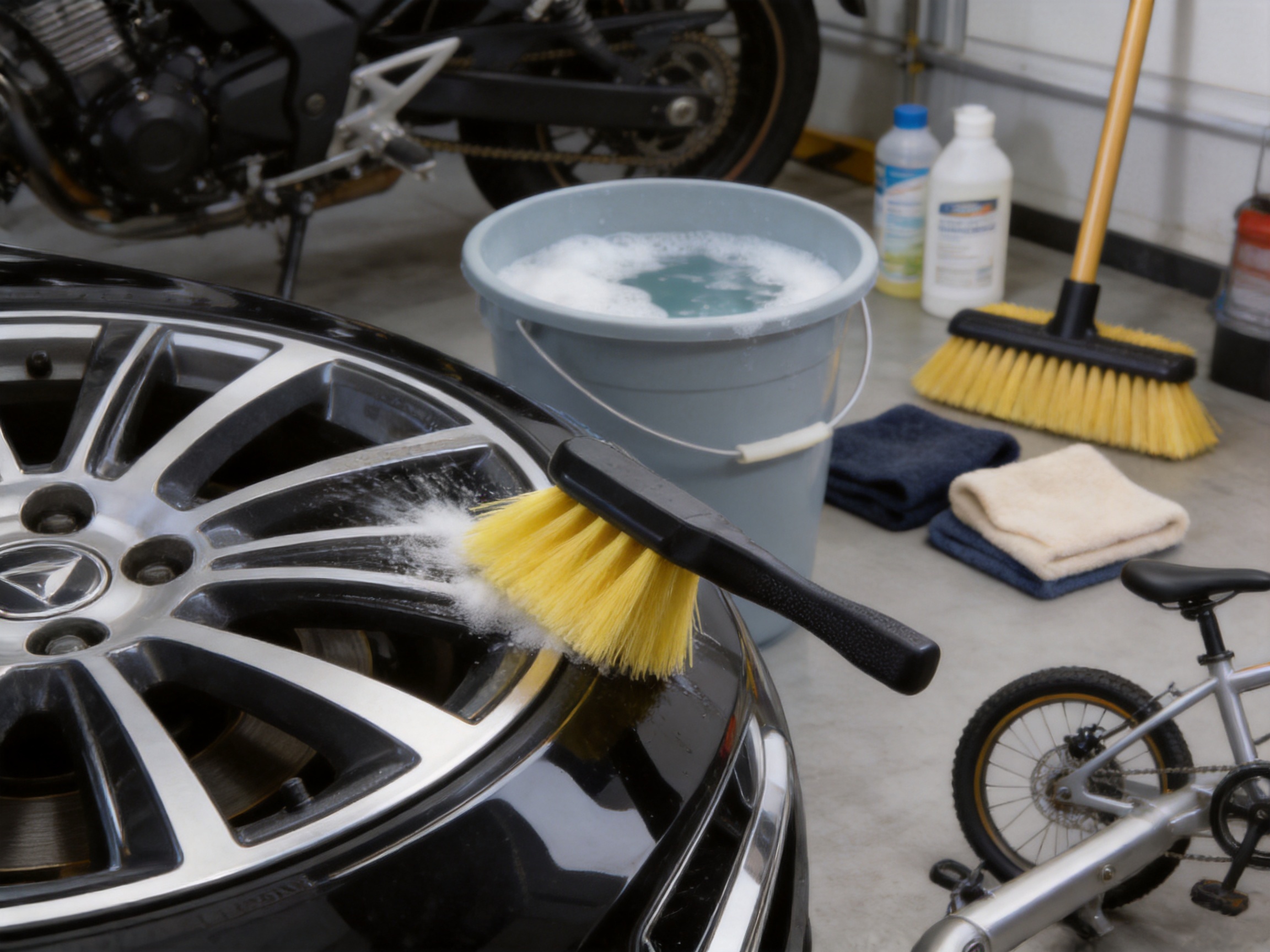
Development and Customization Capabilities
Product customization begins with understanding the intended application. A buyer may want the brush for home car washing, professional vehicle cleaning, supermarket distribution, online retail, industrial maintenance, or promotional packaging. Each channel may require different priorities. A retail product may emphasize color visibility and compact packaging, while a workshop product may emphasize repeated use, carton quantity, and easy identification.
Customer drawings and samples provide a practical starting point for communication. They allow the manufacturer and buyer to discuss overall shape, dimensions, bristle length, color, handle details, packaging space, and other requirements. When an existing sample is available, it can help clarify expectations that may be difficult to express through written specifications alone.
A capable development process should evaluate whether the requested design is suitable for production, packing, transport, and regular use. Changes to handle thickness may affect grip comfort and material consumption. Changes to bristle density may influence cleaning feel and insertion requirements. Color changes may affect raw material planning and visual consistency. Discussing these factors early can reduce misunderstandings during mass production.
For bulk buyers, customization can also improve product differentiation. A private-label distributor may request a specific color family or packaging identity. A professional supplier may want several brush colors for task separation. An industrial purchaser may need a configuration designed for a particular cleaning routine. The ability to adjust the product within practical manufacturing limits gives customers more flexibility.
Customization should not be confused with unlimited modification. Every change requires evaluation of tooling, material availability, production time, minimum order quantity, inspection requirements, and cost. A responsible supplier should communicate these factors clearly so the buyer can choose an efficient specification.
Production Process Considerations
Material Preparation
Plastic cleaning tools depend on suitable material preparation for both appearance and structural consistency. The handle must be formed with enough stability for ordinary hand pressure, while the bristles must maintain their intended flexibility. Material selection can also influence color, surface finish, weight, and resistance to routine exposure to water and cleaning solutions.
For a yellow-bristled brush, color consistency is an important part of batch presentation. Buyers serving retail customers generally expect products in the same shipment to have a consistent visual appearance. Proper material planning and controlled production conditions help support that expectation.
Component Forming
The handle and brush head must be formed accurately enough to support comfortable use and reliable assembly. A well-controlled forming process helps maintain the intended dimensions and reduces visible defects. The grip area should be practical for wet conditions, while the brush head should hold the bristle bundle securely.
Tooling condition and process monitoring can affect repeatability. Regular attention to equipment, molds, and production parameters helps reduce variation. For customers ordering repeatedly, consistency between shipments is often as important as the performance of the first order.
Bristle Assembly
Bristle assembly is a key stage because the bristles provide the direct cleaning action. The bundle should be positioned securely and distributed in a way that produces useful surface contact. Uneven or loose bristles can reduce performance and create an inconsistent user experience.
Inspection may include checking bristle appearance, density, alignment, attachment, and resistance to ordinary handling. The exact inspection method depends on the product design and internal quality requirements. A manufacturer with experience in household and industrial brushes is better positioned to recognize the practical importance of these details.
Finishing and Inspection
Finishing operations may include removing unwanted flash, checking handle edges, confirming overall appearance, and preparing the item for packing. Final inspection can identify obvious defects before the goods leave the production base. Packaging inspection is also relevant because a clean, organized presentation supports warehouse handling and retail display.
The company’s stated standardized production processes, stable quality control, and complete supply chain are important strengths in this context. Together, they indicate an approach designed to support repeatable production rather than isolated small-batch output only.
Supply Chain and Export Support
A complete supply chain can help coordinate raw materials, production scheduling, packaging, storage, and shipment preparation. For international buyers, this coordination may reduce communication gaps between separate suppliers. It can also make it easier to combine multiple cleaning products into one procurement program.
Jinhua Jieqing Plastic Co., Ltd. has extensive export experience according to the supplied company information. Export experience can support practical coordination related to documentation, product specifications, packaging requirements, shipment planning, and communication with overseas customers. These factors are especially important for distributors and cross-border e-commerce businesses.
For supermarket supply, the manufacturer may need to support consistent carton quantities, readable product information, and packaging suitable for shelf or hanging display. For online sellers, the product may need packaging that protects the brush during transport while still presenting its main benefits clearly. For industrial procurement, bulk packing and efficient handling may be more important than individual retail presentation.
A one-stop supplier can simplify these requirements by combining product selection, customization discussion, production, inspection, and order coordination. Buyers should still confirm all specifications before ordering, including materials, dimensions, packaging, color, sample approval, quantity, and delivery arrangements.
Cleaning Method for Best Results
Using the brush correctly can improve cleaning efficiency and help protect the vehicle surface. Begin by removing loose dust, sand, and mud with water. This preliminary step reduces the amount of abrasive material present during brushing.
Prepare a suitable vehicle-cleaning solution according to the product instructions. Immerse the bristles or apply the solution as appropriate, then work on a manageable section rather than allowing the solution to dry over a large area. Use moderate pressure and controlled movements, especially on painted or polished surfaces.
For wheel covers, lower panels, and textured trims, direct the bristles into the shape of the surface without forcing them into narrow openings. The short handle allows the user to change direction quickly. Rinse the brush regularly during the process, particularly after cleaning heavily soiled areas.
After washing, rinse the vehicle section thoroughly to remove loosened dirt and cleaning solution. Rinse the brush itself, shake away excess water, and place it where air can circulate. Avoid storing it while saturated with soil or chemical residue.
Users should inspect delicate finishes before general use. If a surface has a special coating, matte finish, exposed paint defect, or manufacturer-specific maintenance instruction, the vehicle owner should follow the relevant guidance. No general-purpose brush should be treated as automatically suitable for every surface.
Maintenance and Storage
Routine maintenance is simple but useful. After each use, flush water through the bristles to remove dirt and soap. If particles remain trapped, gently separate the bristles with the fingers or rinse again. Do not use excessive force that could bend or pull the bristles unnecessarily.
Store the brush in a clean location away from direct heat and conditions that could deform plastic components. Allowing the bristles to dry naturally can help prevent unpleasant odors and maintain a clean working surface. The handle should also be kept free from thick deposits of soap or mud so that the grip remains comfortable.
In professional environments, brushes should be assigned according to task where practical. A brush used on heavily soiled mechanical parts should not automatically be used on a clean painted panel without thorough washing and inspection. Color coding, including the bright yellow bristle appearance, can help teams organize tools according to their internal procedures.
Regular visual checks can identify loose bristles, damaged handles, cracks, or accumulated contamination. Replacing a worn brush at the appropriate time supports consistent cleaning quality and protects the surfaces being maintained.
Purchasing Considerations for Bulk Buyers
Bulk purchasers should evaluate more than the unit price. A suitable procurement decision considers product consistency, application range, packaging, customization options, production capacity, quality control, communication, and delivery reliability.
First, the buyer should define the intended use. A household retailer may require a compact, visually appealing product for general car care. A workshop may prioritize grip, bristle performance, and carton efficiency. An industrial customer may need a larger supply of standardized tools for repeated maintenance tasks.
Second, the buyer should confirm the physical specification. Important details may include handle length, overall dimensions, bristle color, bristle softness, bristle density, handle color, product weight, packaging format, and carton quantity. A pre-production sample or approved reference sample can help prevent later disagreement.
Third, the buyer should discuss customization requirements early. Private-label printing, color changes, barcode placement, product inserts, retail packaging, and mixed-item shipments may affect production planning. Clear written confirmation is beneficial for both parties.
Fourth, the buyer should assess the manufacturer’s ability to support repeat orders. Stable supply is important for sellers who need the same product over multiple seasons. The company’s own production base, complete supply chain, and stated export experience are relevant strengths for this evaluation.
Finally, the buyer should consider after-sales communication. A supplier that responds clearly to technical questions, sample feedback, packaging requests, and order updates can reduce the practical risk of international procurement.
Positioning for Different Sales Channels
The brush can be presented differently depending on the market channel. In supermarkets and household stores, the main message may focus on convenient vehicle cleaning, compact storage, bright color visibility, and multi-purpose use. The product can be displayed with other car-care supplies or household cleaning tools.
For cross-border e-commerce, product descriptions should explain the short-handle advantage, the intended cleaning areas, bristle characteristics, wet-use grip, rinsing process, and additional applications. Clear photographs and accurate dimensions can help customers understand the product before purchase.
For professional distributors, the emphasis may shift toward supply consistency, private-label support, bulk packaging, customization, and the manufacturer’s production capabilities. Distributors may also appreciate the opportunity to combine this brush with brooms, household brushes, industrial brushes, and related plastic products.
For workshops and fleet operators, the brush can be positioned as a compact task-specific tool. It may be included in cleaning stations, vehicle preparation kits, mobile service cases, or equipment-maintenance programs. Its broad but controlled application range can help reduce the number of specialized tools required for ordinary work.

Q&A: Common Questions About the Short-Handled Car Brush
What is the main purpose of this brush?
The main purpose is close-range cleaning of vehicle surfaces and components. It is particularly useful for wheel covers, lower body panels, trims, edges, textured areas, and other sections where direct control is more valuable than extended reach.
Why choose a short handle instead of a long handle?
A short handle keeps the user’s hand close to the bristles. This supports precise movement and makes it easier to control pressure and direction in small areas. A long-handled brush remains useful for roofs and distant surfaces, but the short-handled model is better suited to detailed, close work.
Are the yellow bristles soft or firm?
The bristles are described as soft enough for regular washing while remaining firm enough to move away dust, mud traces, and road film. They also spread slightly under pressure, helping them follow uneven textures.
Can the brush be used on painted vehicle surfaces?
It can support ordinary vehicle cleaning, but users should rinse away loose grit first, use suitable cleaning solution, apply moderate pressure, and test an unfamiliar or delicate surface before wider use. Special coatings and sensitive finishes should be maintained according to the vehicle manufacturer’s instructions.
Can it clean wheels and wheel covers?
Yes. The short handle and flexible bristles are useful for working around wheel-cover contours, ribs, recesses, and other uneven areas. Heavy grit should be rinsed away before brushing, and the brush should be cleaned regularly during use.
Is the product only for cars?
No. It can also be used for bicycles, motorcycles, scooters, outdoor equipment, garage edges, storage containers, and other suitable surfaces. The user should avoid applying it to delicate components or areas where water and cleaning solution could cause damage.
Is the handle suitable for wet conditions?
The grip area is shaped for wet use and is intended to remain practical when water or soap is present. Users should still hold the brush securely and rinse away slippery residue after cleaning.
How should the brush be cleaned after use?
Rinse the bristles thoroughly with clean water, remove trapped dirt, shake off excess water, and allow the brush to dry in a ventilated location. Avoid storing it while heavily contaminated with mud or cleaning chemicals.
What makes the product competitive?
Its competitive advantages include controlled short-handle operation, flexible yellow bristles, suitability for uneven surfaces, simple maintenance, compact storage, and a broad application range. It occupies a useful middle position between large long-reach brushes and very small detailing tools.
Can the product be customized?
Customization is available based on customer drawings and samples, subject to production evaluation. Buyers can discuss possible adjustments to colors, handle details, bristle specifications, packaging, labeling, and other practical requirements.
What manufacturing strengths support the product?
The manufacturer has its own production base, a complete supply chain, standardized production processes, quality-control practices, export experience, and a broad product range covering household and industrial cleaning brushes. These strengths support both standard orders and selected customized programs.
Who may purchase this brush in bulk?
Potential bulk buyers include supermarkets, household-goods distributors, vehicle-care suppliers, workshops, fleet-maintenance organizations, industrial procurement teams, private-label brands, and cross-border e-commerce sellers.
What should buyers confirm before placing an order?
Buyers should confirm the product dimensions, bristle specification, colors, packaging, labeling, order quantity, sample approval, customization details, quality requirements, shipment arrangements, and expected delivery schedule. Written specifications help ensure that both sides share the same expectations.
Overall Product Assessment
The short-handled car brush with yellow bristles is a practical tool for users who need more control during vehicle cleaning. Its value comes from a balanced design rather than a complicated feature list. The compact handle supports direct movement, while the bristles provide a useful combination of flexibility and cleaning strength. Together, these features make the brush suitable for wheels, lower panels, trims, corners, outdoor equipment, and other areas that benefit from close-range attention.
Compared with a long-reach brush, it is easier to control in small spaces. Compared with a sponge, it can enter uneven textures. Compared with a very small detailing brush, it can cover a more practical area. Compared with a rigid utility brush, it offers a gentler approach for regular vehicle-care routines. These distinctions give the product a clear position within the broader cleaning-tool market.
The manufacturing background behind the item adds further value for commercial buyers. Jinhua Jieqing Plastic Co., Ltd. brings experience in cleaning supplies, its own production base, standardized production methods, quality-control procedures, a broad supply chain, export experience, and customization support. These capabilities are relevant to customers seeking not only a single product but also dependable long-term sourcing.
For household users, the brush is compact, easy to understand, and simple to maintain. For professional teams, it can serve as a repeat-use tool for detailed vehicle cleaning and equipment maintenance. For distributors and private-label buyers, its broad application range and customization potential create opportunities across several sales channels.
When used with appropriate cleaning methods, regular rinsing, and responsible surface testing, the short-handled car brush can become a useful part of everyday vehicle-care equipment. Its straightforward design, practical bristle structure, and manufacturing support make it a dependable option for both standard retail supply and customized bulk procurement.
References
1. Product information supplied for the Short-Handled Car Brush with Yellow Bristles, including product title, category, features, applications, and handling characteristics.
2. Company information supplied for Jinhua Jieqing Plastic Co., Ltd., including company history, product range, manufacturing base, quality-control approach, customization services, and export experience.
3. General principles of vehicle exterior cleaning, including pre-rinsing, controlled brushing, cleaning-solution use, surface testing, and post-use tool maintenance.
4. General product-development and procurement practices for household, automotive, and industrial cleaning brushes.
Product: Short-Handled Car Brush with Yellow Bristles

 CONTACT US
- CONTACT DETAILS
- Address : No. 1388 Cuntong Road, Jinhua City
- Tel: +86-0579-81534043
- Email:wangjinhua1@zjjqsj.com
- PRODUCTS
- Kitchen Cleaning Supplies
- Household Cleaning Supplies
- Indoor & Outdoor Cleaning Supplies
- Baby Products & Cleaning Supplies
- Home Storage Containers
- QUICK LINK
- Company Profile
- Plant equipment
- Certifications
- FAQ
- NEWS CENTER
- Company News
- Industry News
- MOBILE TERMINAL

