

 English
  русский
  Español
  عربى
عربى 
Kitchen Bottle Brushes: Does Handle Design Change Cleaning Reach
Date:Sep 25, 2026
Kitchen bottles come in shapes yet each opening creates the same cleaning challenge. The brush has to move through a neck to reach the bottom and sidewalls. Many people focus on the shape of the brush head. The handle is also critical. The handle decides how far the cleaning head can move and how control the user has. A designed kitchen bottle brush therefore needs a handle that works well with the head, shaft and grip.
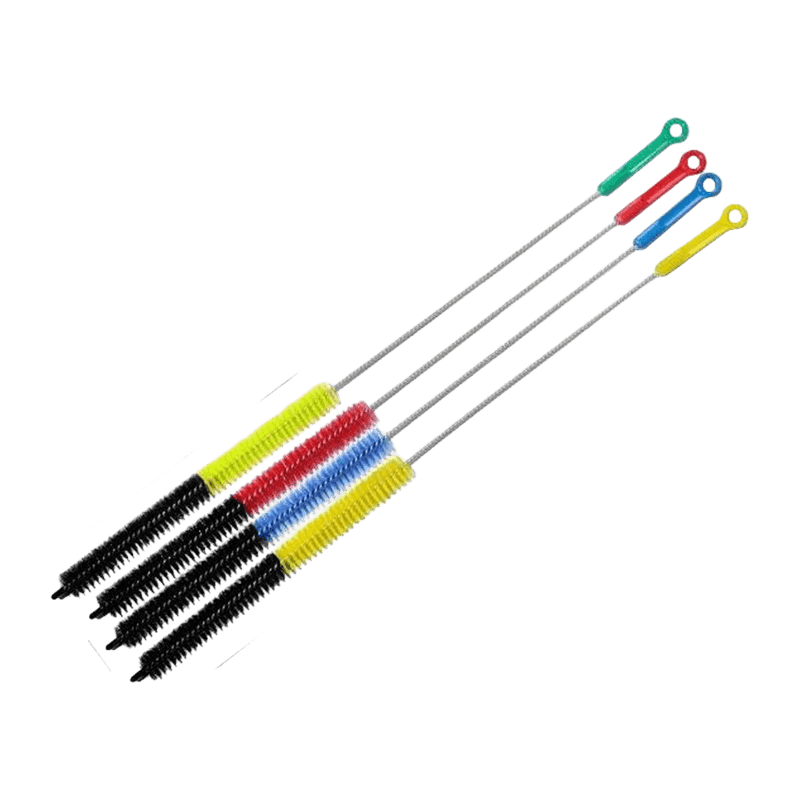
1. Handle Length Defines the Working Distance
Tall bottles, insulated containers, pitchers, and narrow-neck jars require more reach than short cups. A handle that is too short may leave the bottom section difficult to access, even with a suitable brush head.
- Short handles: Provide close control for cups, mugs, and smaller containers.
- Medium handles: Balance reach and maneuverability across common kitchen bottles.
- Long handles: Extend the cleaning range inside tall bottles, carafes, and narrow containers.
Current bottle brush designs commonly use extended handles. Some products reach around 33–38 cm, while other kitchen models use approximately 29 cm overall lengths. Such dimensions show how handle length can be adjusted around container height and neck design.
2. A Flexible Neck Changes the Cleaning Angle
Length alone does not guarantee useful reach. A rigid shaft may reach the bottom of a bottle but struggle to follow curved walls or rounded shoulders. Flexible neck construction allows the brush head to change its angle as it moves inside the container.
This structure becomes useful around bottles with a narrow opening and wider internal body. The handle remains outside the container while the flexible section directs the bristles toward the bottom edge or sidewall.
- Moderate flexibility: Helps follow curved interior surfaces.
- Controlled bending: Maintains pressure instead of allowing the brush head to move without resistance.
- Flexible shaft construction: Helps reach corners without requiring an oversized brush opening.
Some flexible bottle brush designs are built to bend around hard-to-reach internal angles while remaining firm enough for scrubbing.
3. Grip Structure Affects Brush Control
Water and detergent can make a kitchen brush handle slippery. Grip texture therefore influences how accurately the user can move the brush head. A smooth cylindrical handle may work adequately under dry conditions but provide less control with wet hands.
Textured surfaces, contoured grips, or rubberized sections can provide additional contact between the hand and handle. Product dimensions can also be adjusted according to the intended user group and application.
A practical kitchen bottle brush should balance grip size with handle length. Excessive thickness may make a long handle harder to control, while an extremely thin shaft may feel unstable during scrubbing.
4. Handle Rigidity Matters at the Bottle Bottom
Deep reach and scrubbing force create a design trade-off. A highly flexible handle can follow curved surfaces, but excessive movement may reduce pressure at the cleaning point. A rigid handle provides stronger direct force but may be less adaptable around corners.
Some brush structures therefore combine a relatively stable handle with a flexible neck. This configuration gives the user control from the grip while allowing the brush head to adjust its position inside the bottle.
5. Brush Head and Handle Need Matching Dimensions
Handle design cannot be considered separately from brush head dimensions. A long handle paired with an oversized head may still fail to enter a narrow opening. Likewise, a slim head attached to an excessively short handle may not reach the base of a tall container.
- Narrow neck + slim head: Allows entry through restricted openings.
- Tall bottle + extended handle: Provides additional internal reach.
- Rounded bottle + flexible neck: Helps direct bristles toward curved sections.
- Wide container + broader head: Increases contact across larger interior surfaces.
Some current products specifically combine long handles with narrow profiles, while others use different brush sizes for different container openings.
6. Handle Design Can Support Different Kitchen Applications
Not every kitchen container needs the same reach. Water bottles may require a long slim brush, while coffee mugs can benefit from a shorter handle with a broader head. Carafes and pitchers may require both extended reach and a flexible shaft.
This creates opportunities for manufacturers to develop several kitchen bottle brush configurations instead of relying on one universal dimension.
- 29–30 cm formats for general bottle and mug cleaning
- 33–38 cm formats for taller or narrow-neck containers
- Slim shafts for restricted bottle openings
- Flexible necks for curved internal surfaces
- Textured grips for wet-hand control
Does Handle Design Really Change Cleaning Reach?
Handle design affects more than distance. Length determines how deep the brush can travel, flexibility changes the cleaning angle, grip texture influences control, and shaft rigidity determines how much pressure reaches the brush head.
That combination makes handle engineering an important part of kitchen bottle brush design. Matching handle dimensions with bottle height, neck width, interior shape, and brush head structure can create a tool that reaches deeper while remaining controllable during everyday kitchen cleaning.
 CONTACT US
- CONTACT DETAILS
- Address : No. 1388 Cuntong Road, Jinhua City
- Tel: +86-0579-81534043
- Email:wangjinhua1@zjjqsj.com
- PRODUCTS
- Kitchen Cleaning Supplies
- Household Cleaning Supplies
- Indoor & Outdoor Cleaning Supplies
- Baby Products & Cleaning Supplies
- Home Storage Containers
- QUICK LINK
- Company Profile
- Plant equipment
- Certifications
- FAQ
- NEWS CENTER
- Company News
- Industry News
- MOBILE TERMINAL

